Search has changed. For decades, getting found online meant ranking in a list of ten links on Google. A user typed a query, saw your link, and clicked through to your site. That model is breaking down fast.
Today, when someone asks ChatGPT for a software recommendation, asks Google a question and gets an AI Overview, or asks Siri what the best digital marketing agency is, they do not see a list of links. They get a single, synthesized answer. One source gets cited. The rest are invisible.
This guide covers everything you need to know about Answer Engine Optimization (AEO): what it is, why it matters urgently in 2026, how it differs from SEO and GEO, every major answer engine you need to optimize for, the core strategies that drive AI citations, how to measure performance, how it applies to your specific business type, and answers to the most common questions about AEO.
If you are a marketer, SEO professional, or business owner trying to stay visible as search moves into an AI-first world, this is your starting point.
What Is Answer Engine Optimization (AEO)?
AEO definition in simple terms
Answer Engine Optimization (AEO) is the practice of structuring and formatting digital content so that AI-powered systems can extract it and present it as a direct answer to a user query. These systems include ChatGPT, Google AI Overviews, Perplexity AI, Microsoft Copilot, and voice assistants like Siri, Alexa, and Google Assistant.
Unlike SEO, which earns ranked positions in a list of links, AEO focuses on becoming the answer. Your content is not just discovered. It is selected by an AI system as the definitive response and delivered directly to the user, often without any click to your website required.
EXTRACTABLE DEFINITION= AEO (Answer Engine Optimization) is the discipline of engineering content to become the cited source in AI-generated responses. Where SEO asks how to rank for a keyword, AEO asks how to become the answer an AI system delivers for a query.
How AEO is different from traditional SEO
SEO earns clicks by ranking in a list of links. AEO earns citations by being selected as the single synthesized answer. Both share the same technical foundation (crawlability, authority signals, E-E-A-T) but their success metrics, content format, and timelines diverge.
For the full breakdown across ranking signals, KPIs, and strategy including which to prioritize for your situation → see: AEO vs SEO: Key Differences, KPIs & Strategy
Why AEO Matters in 2026
The shift from link-based to answer-based search
Several measurable trends have converged to make AEO urgent. These are not predictions. They are confirmed data points from 2024 and 2026.
| Statistic | Figure | Source |
|---|---|---|
| Zero-click search rate on Google | 64.82% of searches (up from 60%) | SparkToro, 2024 |
| ChatGPT weekly active users | 900 million as of October 2026 | OpenAI, Sam Altman, October |
| Organic traffic shift to AI chatbots | 25% predicted shift by 2026 | Gartner |
| Google AI Overviews on problem-solving queries | 74% of queries trigger an AI Overview | Authoritas, 2025 (10K keyword study) |
| CTR drop for #1 Google ranking | Fell from approximately 30% to 28% | Industry analysis, |
| AI-formatted content citation rate | Up to 3x more likely to be cited (45% to over 67%) | Princeton GEO Study (Aggarwal et al., 2023) |
| Optimized vs non-optimized brand in AI answers | 18% vs 3% of relevant answers | BrightEdge, January 2026 |
| ChatGPT share of AI referral traffic | 87.4% of all AI referral traffic | Conductor, 2026 |
The behavioral shift is generational. According to Pew Research Center (December 2025), 68% of Gen Z adults (ages 18 to 27) use AI answer engines weekly, and 41% prefer them over traditional search for factual queries. If your audience skews under 40, AEO is your primary search channel, not a secondary one.
What happens if you ignore AEO
Brands with strong traditional SEO performance are still being bypassed in AI-generated answers. Strong rankings do not automatically translate to AI citation. An AI system evaluating sources prioritizes clarity, directness, and trust signals over ranking position alone.
The risk is compounding. Early adopters of AEO are building citation authority that becomes increasingly difficult for competitors to displace. A brand that appears consistently in ChatGPT comparisons and Google AI Overviews for its category shapes buyer perception before those users ever visit a website. A brand invisible in those answers is starting every buyer conversation from a disadvantage.
In the era of AI-driven search, share of voice measures how often and how prominently a brand appears across AI-generated answers, zero-click results, and conversational platforms compared to competitors.
PERFORMANCE MARKETING IMPLICATION= If your paid media strategy depends on organic traffic feeding remarketing pools or funnel entry points, AEO decline directly reduces your retargeting audience size and raises your cost per acquisition. Brand visibility in AI answers is now a paid media efficiency factor.
AEO vs SEO vs GEO: Key Differences
SEO is the technical and authority foundation. 99% of URLs surfaced in Google AI Mode come from the top 20 organic results, so weak SEO means weak AEO regardless of content structure. GEO (Generative Engine Optimization) is a sub-discipline of AEO focused specifically on LLM citation (ChatGPT, Gemini, Claude, Perplexity). In most agency and marketing contexts, AEO and GEO are used interchangeably.
For the detailed three-way comparison including ranking signals, KPIs, and timelines, see AEO vs SEO: Key Differences.
What AEO specifically targets
AEO optimization targets AI Overviews, voice search results, featured snippets, People Also Ask boxes, knowledge panels, and direct answers in conversational AI platforms. The common thread across all of these is zero-click delivery. The user receives the answer without needing to visit a source website.
| Factor | SEO | AEO | GEO |
|---|---|---|---|
| Full name | Search Engine Optimization | Answer Engine Optimization | Generative Engine Optimization |
| Primary target | Google and Bing SERPs | AI Overviews, voice, featured snippets | ChatGPT, Gemini, Perplexity, Claude |
| Content format | Keyword-rich, long-form | Direct answers, Q&A, structured | Factual, citable, specific passages |
| Success metric | Rankings, traffic, CTR | Citation rate, AI mention frequency | LLM brand mention rate |
| Timeline | 3 to 12 months | Weeks to months | Months to years |
| Zero-click | Loses traffic | Gains citations | Gains citations |
| Replaces SEO? | N/A | No. Builds on SEO. | No. Extends AEO. |
What Are the Main Answer Engines to Optimize For?
Each major answer engine has a distinct retrieval method, citation behavior, and content preference. Understanding these differences allows you to prioritize optimization effort and verify your visibility on each platform manually.
Google AI Overviews and AI Mode
PRIORITY 1
Google AI Overviews and AI Mode= Google AI Overviews use a retrieval-augmented generation (RAG) approach, grounding responses in live-crawled web content. They appear in approximately 30% of all searches, 74% of problem-solving queries and 69% of question-based searches(Authoritas, 2025). Google AI Mode, launched May 2025, extends this with multi-step reasoning across complex queries. Google still holds approximately 89% – 91% of the global search market in 2026, making this the highest-volume channel for AEO. Optimization priorities: FAQ schema, Article schema, E-E-A-T signals, direct answer formatting, and fast page load speed.
ChatGPT and OpenAI search
PRIORITY 1
ChatGPT and OpenAI Search= ChatGPT accounts for 87.4% of all AI referral traffic across industries (Conductor, 2025) and serves 900 million weekly active users as of October 2026. ChatGPT with browsing retrieves live web content and cites sources with inline links. ChatGPT without browsing draws from its training data, which is updated periodically. For live retrieval optimization: ensure crawlability, use direct answer formatting, and build domain authority. For training data influence: pursue long-term topical authority and third-party citations on authoritative sites.
Perplexity AI
PRIORITY 2
Perplexity AI= Perplexity uses a live retrieval RAG model and provides numbered source citations for every answer. Its user base is growing rapidly and it has secured significant funding as of 2025. Perplexity is particularly relevant for research-oriented and professional audiences. Content freshness is a stronger signal on Perplexity than on other platforms. Direct answers, visible publication dates, and clear citation of primary sources perform best. Monitor your brand visibility on Perplexity by manually searching your category queries weekly.
Microsoft Copilot and Bing
PRIORITY 2
Microsoft Copilot and Bing= Microsoft Copilot is integrated into Bing, Edge, Windows, and Microsoft 365. Microsoft reported a 10x increase in Bing mobile app downloads after integrating AI chat features. Bing’s index feeds Copilot responses, so Bing SEO fundamentals (Bing Webmaster Tools verification, schema markup, structured content) directly influence Copilot visibility. Copilot is particularly prevalent among enterprise and B2B audiences who use Windows and Microsoft 365 environments.
Voice assistants (Alexa, Siri, Google Assistant)
PRIORITY 3
Voice Assistants= An estimated 153.5 million to 157.1 million Americans use voice assistants, with voice commerce projected to reach$186 billion to over $700 billion by the early 2030s. Voice assistants extract answers primarily from featured snippets and structured data. Queries are 5 to 9 words long and conversational in nature. Critical optimization requirements: concise answers in 40 to 60 words, FAQ schema with full-sentence answers (not fragments), local schema for location-based queries, and SpeakableSpecification markup for voice-specific content. Voice assistants read answers aloud so every FAQ answer must work as spoken language.
Reddit and Quora (third-party AEO)
DIFFERENTIATOR
Reddit and Quora: Third-Party AEO
This is a key gap most competitors miss. Reddit appears in 21% of Google AI Overview citations (Semrush analysis). Reddit threads and Quora answers are high-authority, high-trust sources for AI systems because they contain real user experiences, a signal that purely promotional brand content lacks. Brands should monitor conversations about their category on both platforms, participate authentically in relevant discussions (without promotional intent in early posts), and ensure accurate information about their products appears in the top answers for category queries. Third-party citation building on Reddit and Quora is one of the highest-ROI AEO activities available.
.
How to Optimize for AEO: Core Strategies That Work in 2026
Optimizing for AEO starts with two structural changes that cost zero budget and can be implemented in days. Every other strategy in this section builds on top of these two foundations.
Content formatting for AEO
The single highest-impact change you can make is placing a complete, self-contained direct answer in the first 40 to 60 words of every key page. AI systems extract the first clear response on a page. Content that buries the answer inside a long introduction is passed over entirely.
Additional formatting requirements that directly improve AI extraction rate:
- Use question-based H2 and H3 headings that mirror the exact phrasing of natural search queries
- Use numbered lists for procedural content. AI systems extract ordered steps more reliably than prose instructions
- Use comparison tables for comparison queries. Google AI Overviews frequently extract full tables for ‘X vs Y’ queries
- Write every FAQ answer as a standalone response. It must make complete sense without surrounding context
- Open with the answer, then provide context. Never open with context and save the answer for later
THE 40 TO 60 WORD RULE= Featured snippets and AI Overviews extract content most reliably from paragraphs of 40 to 60 words that immediately follow a question-format heading. This is the single highest-leverage AEO formatting rule. Apply it to every page you want cited.
Schema markup and structured data
Schema.org markup provides machine-readable context that answer engines use for reliable content extraction. Without schema, AI systems must infer the structure of your content. With schema, you tell them directly.
Priority schema types by impact level:
- FAQPage schema: converts Q&A sections into directly parseable data. Highest AEO impact per hour of implementation
- HowTo schema: makes procedural content eligible for rich results and voice extraction
- Article schema: establishes author, publisher, datePublished, and dateModified. Required for E-E-A-T assessment
- Organization schema: builds brand entity recognition and knowledge panel eligibility
- BreadcrumbList schema: helps AI systems understand site hierarchy and content relationships
- Product schema (for ecommerce): enables pricing, availability, and review data in AI responses
Validate every schema implementation at search.google.com/test/rich-results before publishing. A broken schema is worse than no schema because it can confuse the extraction process.
AEO Best Practices for 2026
These are the practices that separate brands consistently cited in AI answers from brands that are structurally invisible to AI systems regardless of their SEO performance.
E-E-A-T and authority signals
E-E-A-T stands for Experience, Expertise, Authoritativeness, and Trustworthiness. It is Google’s content quality framework and the primary trust signal AI systems use to determine whether a source is worth citing. A brand with weak E-E-A-T signals is filtered out during the authority scoring stage of AI retrieval, even if its content is well-structured.
Practical E-E-A-T implementation checklist:
- Author pages: every content piece should link to an author bio with verifiable credentials, title, and external publication history
- Primary source citations: cite original research, official data, and authoritative sources within every key piece of content
- Visible dates: publication and last-updated dates must be visible on every page. AI systems actively weight recency
- About page: company history, founding date, team credentials, certifications, and verifiable contact information
- Third-party mentions: earn citations on authoritative industry sites, news outlets, and professional platforms
There is a 0.65 linear correlation between domain authority and AI citation frequency (2026 research). Digital PR is now one of the highest-ROI combined SEO and AEO investments available. A single authoritative citation on a major industry publication does more for AEO than dozens of low-authority backlinks.
Conversational and question-based content
AI systems are trained on natural language. Content written in promotional, jargon-heavy, or overly formal language performs consistently worse in AI extraction than content written in clear, direct, conversational prose.
Map your key content pages to the exact question format your audience uses. Tools that surface real question-format queries:
- AlsoAsked: maps People Also Ask clusters visually for any seed query
- AnswerThePublic: organizes question-format queries by type (what, why, how, when, where)
- Google Search Console: filter queries starting with ‘what’, ‘how’, ‘why’, ‘best’ to find existing question-format impressions
- Semrush and Ahrefs: filter keyword research by question format
Build a FAQ section on every key page with a minimum of five questions. Each answer must be a complete sentence or paragraph that works as a standalone response. Voice assistants read answers aloud. Single-word or fragment answers do not work for voice delivery and reduce extraction probability for text-based AI answers as well.
AEO Optimization Strategies: Technical and Off-Site
Technical and off-site AEO strategies form the infrastructure layer of your AI visibility. Content structure and E-E-A-T signals sit on top of this layer. Without it, even perfectly structured content may be invisible to AI retrievers.
Technical AEO foundations
AEO is built on technical SEO. Content that cannot be crawled, indexed, and loaded quickly will not be cited regardless of how well it is structured. These are the non-negotiable technical requirements:
- Core Web Vitals: pass all three metrics (LCP, INP, CLS) as confirmed in Google Search Console
- Page speed: load time under 3 seconds on mobile as verified by Google PageSpeed Insights
- Mobile-first design: AI systems retrieve content the same way Google crawls it, which is mobile-first
- Clean site architecture: logical URL structure, proper internal linking, and breadcrumb navigation
- Canonical tags: prevent duplication signals that confuse AI retrieval systems
- XML sitemap submitted to Google Search Console and Bing Webmaster Tools
- Robots.txt: ensure key content pages are not accidentally blocked from crawlers
llms.txt and AI crawler signaling
Create a plain text file at yoursite.com/llms.txt using Allow: and Description: directives for your key pages. This is a developing standard for signaling AI crawlers about your content inventory. Example:
| # llms.txt for yoursite.comAllow: /blog/what-is-aeo-answer-engine-optimizationDescription: Complete 2026 guide to AEO covering definition, strategies, tools, and how to rank in AI search.Disallow: /adminDisallow: /private |
This file is not yet universally supported across all AI platforms as of April 2026. However, it is a confirmed developing standard with low implementation cost and meaningful signal value. Add it to your site root now.
Third-party and off-site AEO
Off-site AEO involves building brand citations on the sources AI systems trust and retrieve from most frequently. The highest-priority targets are:
- Wikipedia: 47.9% of ChatGPT referrals include Wikipedia as a source. A Wikipedia page or citation is a significant AEO signal
- Reddit: appears in 21% of Google AI Overview citations. Authentic participation in relevant subreddits builds real user experience signals
- Quora: consistently retrieved by Perplexity and Google AI Overviews for question-format queries. Detailed, accurate answers on relevant topics build authority
- Industry publications and news sites: coverage on authoritative sites trains LLM models to associate your brand with your category
- YouTube: cited as the number one source for visual and how-to queries in AI search. Transcripts from your videos are indexable content
How to Rank in AI Search: Step-by-Step Framework
Quick Start: The 5 Highest-Impact AEO Changes
Every brand should implement these five changes before pursuing any other AEO tactics:
1. Rewrite the opening paragraph of your top 10 pages to lead with a 40 to 60 word direct answer
2. Reformulate H2 and H3 headings as natural language questions
3. Add FAQPage schema to pages with Q&A sections, validated via Rich Results Test
4. Add Article schema with author, publisher, and dates to all editorial content
5. Create or update author pages with verifiable credentials and external publication links
These five steps produce measurable results in weeks. For the full 12-step framework including topical clustering, llms.txt setup, off-site citations, and the 90-day weekly system, read AEO Strategy + GEO Strategy: Rank in AI and Dominate Featured Snippets.
PRIORITY RULE= Steps 1 through 6 are structural changes that produce the fastest results. Do not skip to later steps before completing these. A llms.txt file and off-site citations have no impact if your core pages cannot be crawled, do not lead with direct answers, and lack author credentials.
How to Measure AEO Performance
AEO requires different measurement approaches than traditional SEO. Traffic metrics alone do not capture AI visibility. A brand can have significant AI citation influence on buyer decisions with minimal direct referral traffic, because most AI-assisted discovery happens before users visit any website.
| Metric | How to Track It | Tool |
|---|---|---|
| Featured snippet ownership | Track which queries trigger snippets from your domain | Semrush, Ahrefs |
| Google AI Overview appearances | Monitor AI Overview presence for tracked keywords | Semrush AI Overview Tracker, Authoritas |
| AI referral traffic | Segment AI platform referrals in Google Analytics 4 | Google Analytics 4 |
| ChatGPT brand visibility | Manual query testing: search brand and category terms in ChatGPT weekly | Manual (no automated tool confirmed available at time of publication) |
| Perplexity brand visibility | Manual query testing: search brand and category terms in Perplexity weekly | Manual monitoring |
| Branded search volume | Track branded keyword search volume trend | Google Search Console, Semrush |
| AI citation tracking (multi-platform) | Automated tracking across ChatGPT, Perplexity, Gemini, Claude, Copilot | Conductor (confirmed available April 2026) |
| AEO performance benchmark | Measure brand AI visibility score vs competitors | HubSpot AI Search Grader (confirmed available April 2026) |
HONEST CAVEAT= Automated multi-platform AI citation tracking tools are available but the category is still maturing as of April 2026. Conductor offers the most comprehensive coverage confirmed. Manual testing remains a reliable complement. Always verify tool capabilities directly with vendors before purchasing, as feature sets change quarterly.
AEO for Different Business Types
AEO priorities and implementation approaches vary by business model. The core principles apply universally. The emphasis and starting points differ.
AEO for small businesses
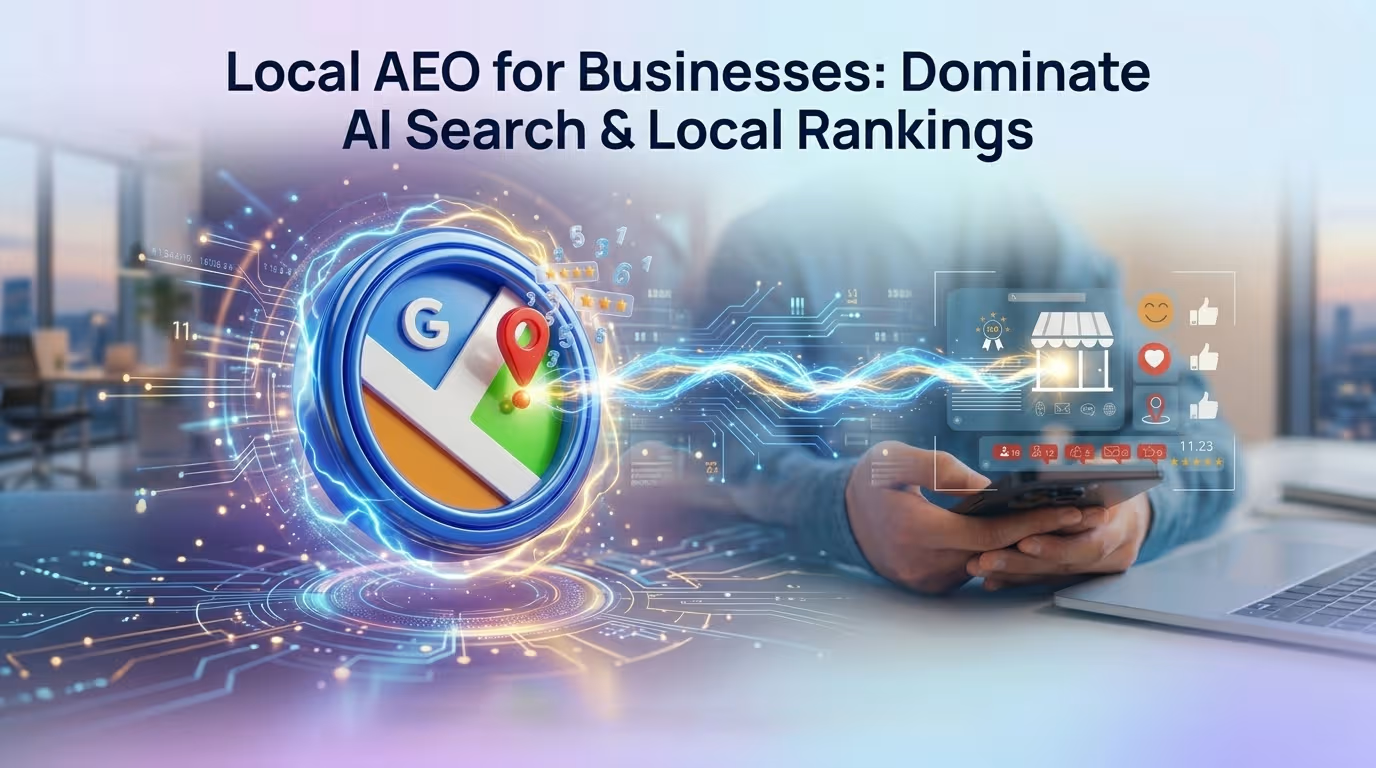
For small businesses, local AEO is the most direct path to visible results. Optimize your Google Business Profile completely and keep it updated. Ensure consistent NAP (name, address, phone) data across all business directories, because AI systems cross-reference multiple sources when generating local answers.
Prioritize FAQ schema on your homepage and key service pages, answering the most common questions your customers ask by phone or email. Create a simple, clearly structured About page with business history, credentials, and service area. For local service businesses, appearing in AI-generated answers for location-specific queries (plumber in Anaheim, marketing agency near me) can replace significant paid search spend.
AEO for ecommerce
Ecommerce AEO focuses on product and category-level content rather than editorial content alone. Implement Product schema with accurate pricing, availability, ratings, and review data. Add structured FAQs to product pages addressing common pre-purchase questions: sizing, materials, compatibility, return policy, shipping time.
For category pages, add a brief educational section at the top that defines the category and explains how to choose products within it. This structure targets the informational queries that precede purchase decisions and positions your brand as the authoritative source before users compare options. Review schema and aggregate rating markup can also appear in AI responses for purchase-intent queries.
AEO for B2B companies
B2B AEO prioritizes topical authority and thought leadership over broad traffic volume. The buyer journey in B2B is long and research-intensive. Appearing in AI-generated answers during the research phase builds brand familiarity and credibility before a prospect ever reaches a sales page.
Invest in comprehensive, deeply detailed content on the specific problems your category solves. Use precise industry terminology that matches how professionals actually ask questions. Build author credibility through LinkedIn presence, published articles on industry platforms, speaking credentials, and certifications. For B2B brands, the Microsoft Copilot optimization priority is elevated because enterprise users in Windows and Microsoft 365 environments encounter Copilot frequently during research workflows.
AEO for agencies and service providers
Agencies face a dual AEO opportunity: optimizing for their own visibility and delivering AEO as a service to clients. For agency brand visibility, the priority is owning the definitional and comparison queries in your specialty areas (what is AEO, AEO vs SEO, best AEO strategies) alongside strong local and category visibility.
For client delivery, AEO scales well as a white-label service because the core deliverables (content restructuring, schema implementation, topical authority building, technical audits) are discrete and measurable. Build a standard AEO audit framework and content brief template that can be applied consistently across client engagements. The checklist in this guide provides a starting framework.
Frequently Asked Questions About AEO
These answers are structured for direct extraction by AI systems and voice assistants. Each answer is complete and self-contained.
What does AEO stand for?
AEO stands for Answer Engine Optimization. It is the practice of structuring digital content so that AI-powered answer engines, including ChatGPT, Google AI Overviews, Perplexity, and voice assistants, can extract and cite it as a direct answer to user queries.
Is AEO the same as GEO?
AEO and GEO are related but not identical. AEO (Answer Engine Optimization) is the broader discipline covering all answer-delivery systems: voice search, featured snippets, knowledge panels, and AI platforms. GEO (Generative Engine Optimization) is a sub-discipline of AEO focused specifically on optimizing content for citation by large language models like ChatGPT, Gemini, and Claude. The terms are frequently used interchangeably in marketing practice.
Does AEO replace SEO?
No. AEO does not replace SEO. Research shows 99% of URLs appearing in Google AI Mode come from the top 20 organic search results. Domain authority directly predicts AI citation frequency with a 0.65 correlation. Strong SEO foundations are a prerequisite for effective AEO. The two disciplines are additive: SEO drives click-through traffic while AEO builds brand visibility in AI-generated responses.
How long does AEO take to work?
AEO typically produces measurable results in a few weeks to a few months. Sites with strong existing SEO foundations see faster AEO gains because domain authority is already established. Structural changes (direct answer formatting, schema markup implementation) can produce results in weeks. Building topical authority and E-E-A-T signals takes months. Content formatted for LLM extraction is 3 times more likely to be cited, so structural changes deliver relatively fast returns.
What is the easiest AEO win to start with?
Structural changes direct answer blocks, schema markup can produce AI citation results within weeks. Building the topical authority and E-E-A-T signals that sustain long-term citation takes months. For a full comparison with SEO timelines, see our AEO vs SEO guide.
What is AEO in digital marketing?
AEO (Answer Engine Optimization) in digital marketing is the process of optimizing content so that search engines and AI-powered platforms can directly extract and present it as answers to user queries. It focuses on delivering clear, structured, and authoritative information that can be easily understood and used by tools like AI chatbots, voice assistants, and search engine answer boxes.