What Is Share of Voice?
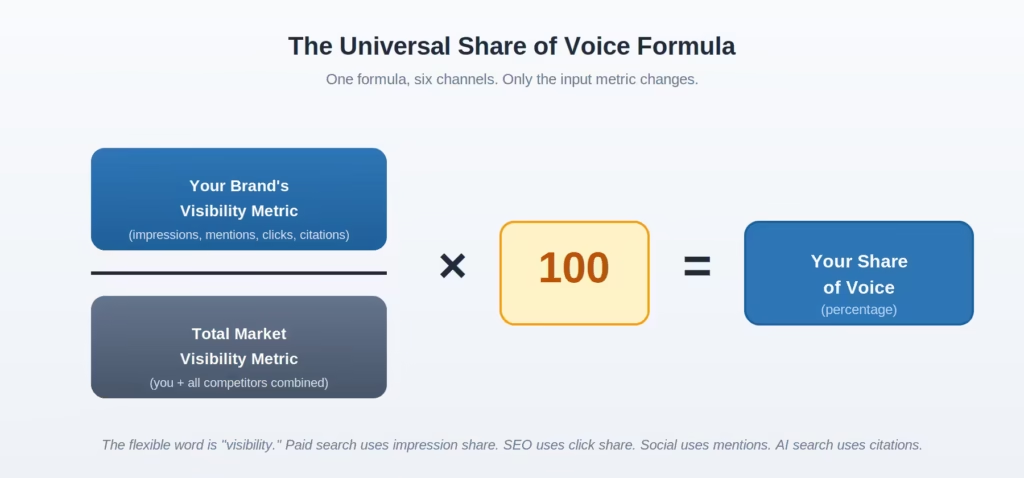
The classic formula is simple:
| SOV (%) = (Your brand’s visibility metric ÷ Total market visibility metric) × 100 |
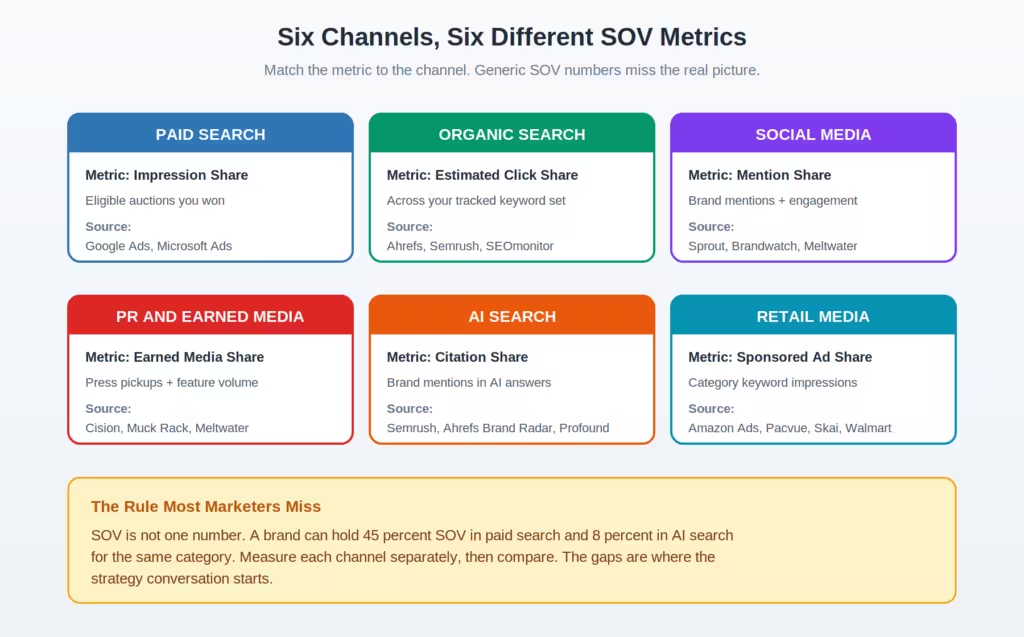
The flexible word is visibility. The metric you plug into that formula depends on the channel you care about. In paid search, it is impression share. In SEO, it is estimated clicks across your tracked keywords. In social, it is brand mentions. In PR, it is earned media pickups. In AI search, it is brand citations inside AI-generated answers. Same formula, different fuel.
A quick example. If your skincare brand captures 2,000 clicks from a target keyword set that generates 10,000 total clicks to all competitors, your SEO share of voice for that keyword set is 20 percent. You own one fifth of the attention for queries your buyers actually type.
Why Share of Voice Matters More in 2026 Than Ever
Traditional rank tracking, click volume reports, and spend dashboards all tell you how your own channel performed. None of them tell you how you performed relative to the competitive set you are actually fighting. That is the problem share of voice solves. It forces the comparison most marketers quietly avoid.
Three shifts have made SOV more important right now, not less.
1. AI search broke the traffic model
When someone asks ChatGPT, Gemini, Claude, or Perplexity for the best retinol serum or the top CRM for a 20-person sales team, the model answers directly. The user often never clicks a website. If your brand is not named in that answer, you lost the sale without ever getting a session in Google Analytics. Traditional SEO metrics miss this entirely. AI share of voice captures it.
According to Seer Interactive’s analysis, organic click-through rates have dropped roughly 61 percent for queries where Google AI Overviews appear. Semrush’s 2026 brand visibility research found that 62 percent of brands are what it calls “technically invisible” to generative AI systems, and that only 8 to 12 percent overlap exists between results that appear in AI-generated answers and those that rank well in traditional search. That gap is the opportunity.
2. Channels fragmented, and so did attention
A single buyer now splits research across Google, YouTube, Reddit, TikTok, LinkedIn, ChatGPT, Perplexity, and peer communities like Slack groups. Dominating one channel is no longer enough. A brand that ranks first in Google but is invisible on Reddit and absent from AI-generated comparisons will lose ground to a challenger who spreads thinner but shows up in more places.
3. Performance-only budgets have hit a wall
Customer acquisition cost is up, CPMs are up, and the pure performance playbook of bidding harder on bottom-funnel keywords is producing diminishing returns. Marketers are rediscovering what Les Binet and Peter Field have documented for over a decade in the IPA Databank: brand investment that grows share of voice ahead of share of market is a long-term growth lever, not a luxury. The research behind this claim is covered in the next section.
Share of Voice vs Share of Market: The Difference That Actually Predicts Growth
The two terms sound similar and get used interchangeably in loose marketing conversations. They are not the same, and confusing them has real budget consequences.
| Dimension | Share of Voice (SOV) | Share of Market (SOM) |
|---|---|---|
| What it measures | Visibility and presence in your category | Actual sales or revenue captured |
| Question it answers | How loud is your brand vs competitors? | How much of the pie are you eating? |
| Timing | Leading indicator (what is coming) | Lagging indicator (what already happened) |
| Data source | Impressions, mentions, rankings, AI citations | Revenue, units sold, customer count |
| How fast it moves | Weekly or monthly | Quarterly or annual |
Share of voice is the leading indicator. Share of market is the scoreboard. Your visibility today is what pulls market share toward you tomorrow, which is why smart teams track both together and look at the gap between them.
Excess Share of Voice (ESOV): the growth formula you should know by heart
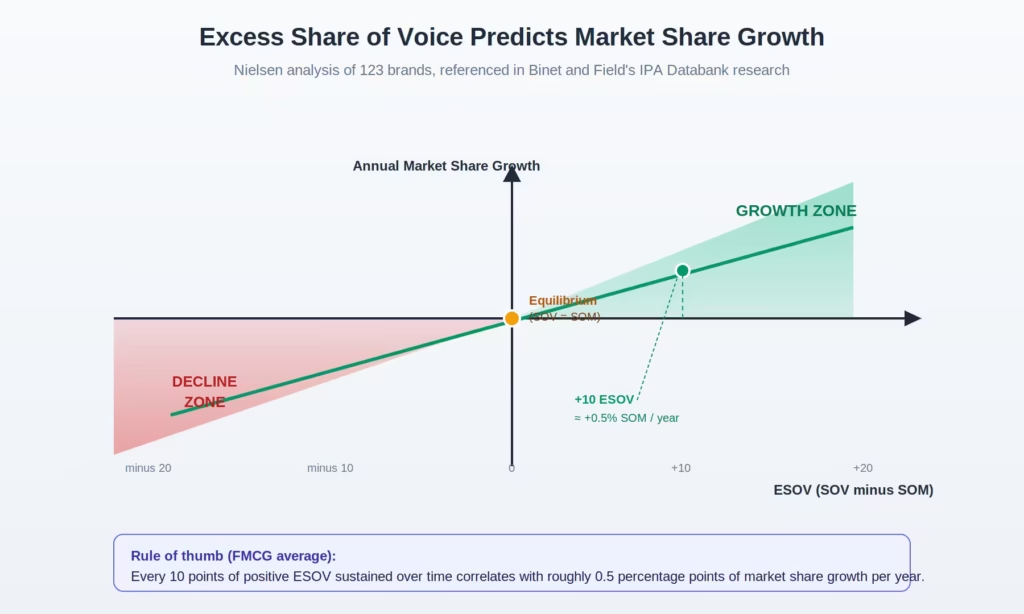
This is where SOV stops being a reporting metric and becomes a planning tool. Excess share of voice is the gap between your SOV and your SOM. If your brand holds 15 percent SOV but only 10 percent SOM, your ESOV is plus 5.
Decades of research by Les Binet and Peter Field, analyzing thousands of campaigns in the IPA Databank, established a consistent pattern. Nielsen analyzed 123 brands from that dataset and found that brands tend to grow market share by roughly 0.5 percentage points per year for every 10 points of positive ESOV sustained over time. Brands with negative ESOV, meaning they talk less than their market share, tend to shrink. The figure varies by category: some drinks categories in Europe show growth of 1.5 points per 10 points of ESOV, while most categories require sustained ESOV of 20 points to drive 1 point of annual growth, per Binet and Field’s own work in The Long and the Short of It.
The original rule traces back further. John Philip Jones published the first formal version of the SOV rule in his 1990 Harvard Business Review article “Ad Spending: Maintaining Market Share”, showing that the relationship between advertising share and market share was not coincidental. The Ehrenberg-Bass Institute later reinforced the mechanism: visibility builds mental availability, and mental availability is what drives brand choice at the moment of purchase.
The practical interpretation for a performance marketer: if your paid spend, content output, and PR activity put you at 12 percent SOV while your actual sales only represent 8 percent of the category, your next 12 months probably trend upward, assuming creative and offer hold. If the numbers are reversed, you are currently consuming brand equity you built earlier. Eventually the market notices.
The Six Types of Share of Voice (And How to Calculate Each)
Generic SOV numbers are useful for executive summaries. Channel-specific SOV is what actually drives decisions. Each channel uses a different metric in the numerator, and each has a different data source.
Paid search share of voice: impression share in Google Ads
In paid search, share of voice is effectively synonymous with impression share, a metric Google Ads and Microsoft Advertising both report natively. Impression share is the percentage of auctions your ad was eligible for where your ad actually showed. If your impression share is 40 percent, competitors captured the remaining 60 percent of available ad views for those targeted searches.
What makes impression sharing especially useful for performance marketers is that Google Ads also breaks down why you lost the rest. Two diagnostic columns sit next to impression share: Search lost IS (budget) and Search lost IS (rank). The first tells you how much visibility your budget capped. The second tells you how much you lost to auction rank, which points to quality score, bid, or ad relevance issues.
As of April 2026, the navigation is: in your Google Ads account, open Campaigns, Ad groups, or Keywords, click the Columns icon, select Modify columns, expand Competitive metrics, and pick the impression share columns you want.
| 2026 update worth knowing. In April 2025, Google changed its Unfair Advantage Policy to allow advertisers to display multiple text ads on a single search results page (one top, one bottom). Each placement now counts as a separate impression. That means your impression share can decline even when your strategy has not changed, simply because eligible impressions have increased due to double-serving. Interpret impressions share trends over 30 to 90 days, not 7 days, and compare against auction insights before concluding a competitor has become more aggressive. |
Benchmarks matter here too. For branded keywords, impression share below 90 percent usually means a competitor is buying your brand name, and you should investigate immediately. For non-branded category keywords, anything above 40 percent is competitive, and 60 percent plus is strong. These ranges are directional and vary meaningfully by auction competitiveness.
Organic search share of voice: the SEO version
Organic SOV is the percentage of estimated clicks or traffic you capture from a defined keyword set, compared to all domains ranking for those keywords. Rankings alone do not tell the story. A position-three ranking on a keyword with 100,000 monthly searches is worth more than a position-one ranking on a keyword with 200 monthly searches, and organic SOV weights that math automatically.
The calculation, simplified:
- Pick the keyword set you actually care about. Mix branded, non-branded, commercial, and informational terms that match your ICP’s search behavior.
- Record each keyword’s search volume and your current rank.
- Apply a click-through rate curve for each rank (position one roughly 30 percent, position two roughly 15 percent, position three roughly 10 percent, with numbers dropping quickly after).
- Multiply each keyword’s CTR by its search volume to get your estimated monthly clicks per keyword, then sum across the keyword set.
- Divide your estimated total clicks by the total possible clicks for that keyword set. Multiply by 100.
In practice, no marketer does this in a spreadsheet once they scale past a handful of clients. Ahrefs Rank Tracker and Semrush Position Tracking both calculate organic SOV automatically once you set up a project with your keyword list and competitor domains.
Social media share of voice
Social SOV is mentioned. You count how often your brand appears in conversations on the relevant platforms (X, LinkedIn, Instagram, Reddit, TikTok, and whatever else your audience uses), then divide by total mentions across your competitive set.
A worked example. Your brand gets 1,200 mentions in a month. Your three main competitors get 2,000, 800, and 1,000. Total market mentions are 5,000. Your social SOV is 1,200 divided by 5,000, which is 24 percent.
Tools like Sprout Social, Brandwatch, Talkwalker, and Meltwater track this automatically and layer sentiment on top. Sentiment matters because a 30 percent SOV made up of complaints is not a win. It is a visible crisis.
PR and earned media share of voice
PR SOV is the share of earned media mentions (articles, podcasts, newsletters, industry publications) you capture compared to direct competitors. Cision, Muck Rack, and Meltwater all track this. For most B2B brands, PR SOV is less about mention volume and more about mention quality: one feature in a Tier 1 trade publication can outweigh fifty passing mentions on smaller sites.
AI share of voice: the metric that did not exist two years ago
This is the newest and fastest-moving category. AI share of voice measures how often your brand appears in responses generated by ChatGPT, Google AI Mode, Gemini, Perplexity, Copilot, and similar tools for the prompts your buyers actually use.
A candid note on what is currently possible versus what is still evolving: the metric is maturing, and no two tools calculate it exactly the same way. Semrush’s AI Visibility Toolkit defines AI visibility as a combination of mention frequency, citation count, share of voice compared to competitors, and distribution across AI platforms, scored on a 0 to 100 scale. Ahrefs Brand Radar tracks AI share of voice through its ChatGPT and AI References reports, using a prompt database drawn from real search query data. Profound takes a third approach, allocating prompts by tier.
Neither approach has become an industry-wide standard. AI platforms are also non-deterministic, meaning the same prompt can produce slightly different answers each time, so teams should track AI SoV as a range rather than a fixed number. Day-to-day fluctuation of plus or minus 10 percentage points is normal. Monthly averaging gives a more stable read. Expect this measurement layer to keep evolving through 2026 as LLMs, platform APIs, and tool methodologies continue to change.
Retail media share of voice
For brands selling on Amazon, Walmart Connect, Instacart, or similar platforms, retail media SOV measures the percentage of sponsored ad impressions your brand captures on category search terms. Amazon Ads and Walmart Connect provide some of this data natively, and tools like Pacvue and Skai add cross-retailer views. Pacvue has documented how SOV in retail media connects to a related concept called share of shelf, which combines paid ad share and organic product ranking share.
The Share of Voice Formula (With Worked Examples)
The universal formula is one line:
| SOV = (Your Metric ÷ Total Market Metric) × 100 |
What changes is what you plug in. Three concrete examples performance marketers encounter weekly.
Example 1: paid search SOV for a Google Ads campaign
You run Google Ads on the keyword “enterprise CRM software.” Over 30 days, Google Ads shows your impression share at 35 percent. Competitors collectively own 65 percent of eligible impressions. Your Search lost IS (budget) is 22 percent and your Search lost IS (rank) is 43 percent. Your paid SOV is 35 percent, and your biggest lever is not more budget: it is ad rank, which usually traces back to quality score, bid, or landing page relevance.
Example 2: organic SOV for a content cluster
You track 50 non-branded keywords relevant to your product. Total monthly search volume across that set is 720,000. After applying a standard CTR curve to your current rankings, your estimated monthly clicks from those 50 terms are 120,000. Your organic SOV is 120,000 divided by 720,000, which equals approximately 16.7 percent. If the top competitor in the same set is at 28 percent, you have an 11-point gap. That gap is your content strategy’s target for the next two quarters.
Example 3: social SOV during a product launch
You launch a new SKU and track mentions over the following 14 days. Your brand gets 4,200 mentions. Competitor A gets 6,000, Competitor B gets 2,800, Competitor C gets 1,000. Total mentions: 14,000. Your social SOV is 4,200 divided by 14,000, which is 30 percent. Layer on sentiment: 78 percent of your mentions are positive or neutral, versus Competitor A at 61 percent. You are second on volume but first on quality, which is usually more actionable information than the raw percentage.
How can i measure my share of voice in ai-generated answers?
Measuring your share of voice (SOV) in AI-generated answers means tracking how often your brand appears in responses from platforms like ChatGPT, Google Gemini, Perplexity AI, and Microsoft Copilot. To do this, identify high-intent keywords in your niche and analyze whether your website, brand, or content is cited, mentioned, or used as a source in AI-generated responses and Google Search features like featured snippets.
Use structured data (schema markup), entity-based SEO, and FAQ optimization to make your content easier for AI systems to understand and extract. Consistently monitoring brand mentions, citation frequency, and competitor visibility across AI platforms helps you benchmark and improve your AI-driven share of voice over time.
What Counts as a Good Share of Voice? Benchmarks by Range
SOV benchmarks vary by category, by brand size, and by channel. A 20 percent SOV in a fragmented category with fifteen competitors is extraordinary. A 20 percent SOV in a duopoly where the market leader holds 55 percent is a warning sign. That said, the following ranges hold up across most industries.
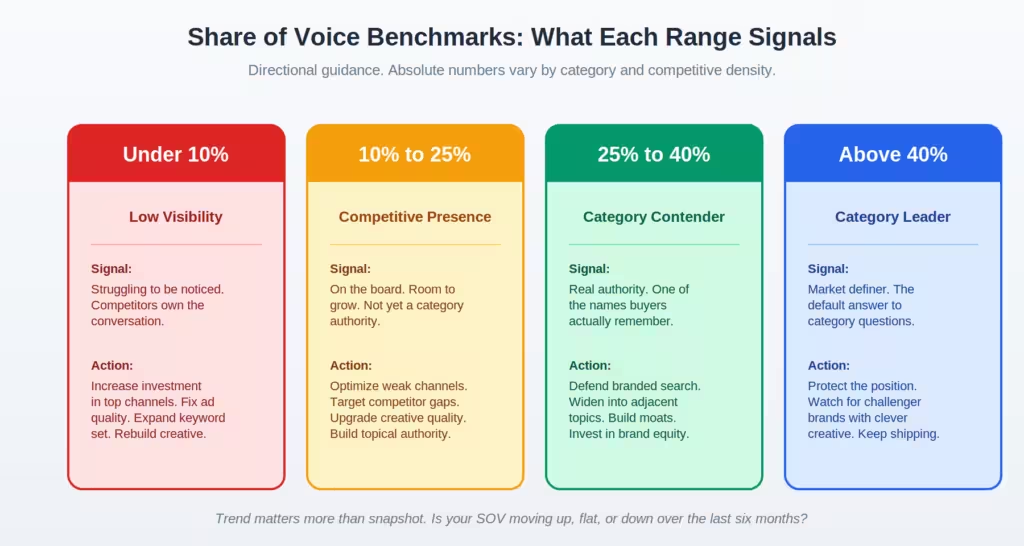
Whatever range you fall into, the most useful question is always directional: is your SOV moving up, flat, or down? Trend beats snapshot every time.
SOV Measurement Tools: What to Use in April 2026
The tools landscape for SOV measurement split in late 2025 into two clear camps: platforms that added AI visibility on top of traditional SEO suites (Semrush, Ahrefs, SE Ranking), and dedicated AI visibility specialists (Profound, Scrunch AI, Otterly.AI). The table below covers the main options for tracking traditional and AI share of voice, with pricing accurate as of April 2026. Prices are list and often change quickly in this category.
| Tool | Starting Price (April 2026) | Best For | Key SOV Features |
|---|---|---|---|
| Semrush (AI Visibility Toolkit + Position Tracking) | Guru plan from $249.95/mo. AI Visibility included at mid tiers. | Agencies and in-house teams already in the Semrush ecosystem. Good for combining traditional SEO SOV with AI SOV in one workspace. | Visibility Overview dashboard, sentiment tracking, prompt discovery, competitor research for up to 4 rivals, ChatGPT Position Tracking. |
| Ahrefs (Brand Radar + Rank Tracker) | Lite plan from $129/mo. Brand Radar available as add-on. | Teams that want AI visibility layered onto the deepest backlink and keyword data. Strong for research-heavy SEO work. | AI share of voice, top cited pages, top cited domains, prompts from Ahrefs’ database of real search queries, API access for citation data. |
| Profound | Starter $99/mo (ChatGPT only, 50 prompts). Growth $399/mo (3 AI platforms, 100 prompts). | Enterprise teams focused purely on AI visibility depth, sentiment, and citation intelligence. | Prompt-limit model, cross-engine tracking (ChatGPT, Perplexity, Google AI Overviews at Growth), Agency Mode, enterprise security. |
| Brandwatch | Custom pricing (enterprise). | Brands with serious PR, reputation, or social listening needs across 100M+ online sources. | Social SOV, mention volume, sentiment, crisis detection, hashtag tracking, competitive benchmarking. |
| Sprout Social | Standard plan from $249/seat/mo. | Social-first teams that want SOV plus publishing and engagement in the same platform. | Social SOV reports, competitor analysis, sentiment, engagement share, hashtag and keyword tracking. |
| Cision | Custom pricing (enterprise PR). | PR teams measuring earned media SOV against named competitors across print, broadcast, and online. | Media monitoring, earned media share, journalist database, coverage analytics, sentiment. |
| Pacvue | Custom pricing (retail media enterprise). | Brands running paid and organic on Amazon, Walmart Connect, Instacart, and other marketplaces. | Retail media SOV, share of shelf, sponsored ad impression share, cross-retailer reporting. |
| How to pick. If you already use Semrush or Ahrefs for SEO, add their AI visibility module before buying a new vendor. If AI visibility is your primary pain point and you need depth across multiple engines, Profound and similar specialists go deeper. If your category lives on social or PR, match the tool to the channel that matters most. Most mid-market teams end up running two tools: one SEO platform with AI visibility, plus one social listening tool. |
How to Increase Your Share of Voice: A Practical Playbook
Growing SOV is not a one-channel game. The brands that climb fastest do several things at once, across paid, organic, social, PR, and AI. Here is the sequence that produces the most reliable lift.
For paid search
- Fix rank-related lost impression share before you increase budget. Higher quality score buys more impressions at the same cost.
- Protect branded keywords first. Impression share below 90 percent on your own brand terms means a competitor is actively stealing traffic that was already yours.
- Run auction insights weekly. The auction insights report in Google Ads shows which advertisers overlap most with your campaigns and how often they outrank you.
- Align landing pages to intent. Stronger ad-to-page relevance raises quality score, which raises impression share at the same CPC.
For SEO
- Build content clusters, not orphan posts. Competitors ranking in the top three usually own a topical cluster, not just a page.
- Target commercial-intent and informational-intent keywords in parallel. Brands that appear only at the moment of purchase lose to brands that also appear during research.
- Optimize for SERP features beyond blue links. Featured snippets, People Also Ask panels, video carousels, and image packs all contribute to SOV if your content is formatted to be extracted into them.
- Refresh old content before writing new content. Updated pages often gain more ranking points than new pages starting from zero.
For social and PR
- Pick a narrow editorial angle your competitors will not touch and repeat it relentlessly.
- Pitch journalists original data, not press releases. Data-led stories earn feature placements and backlinks simultaneously, which compounds SOV and authority.
- Activate employees and subject-matter experts as a distribution channel. LinkedIn posts from senior operators outperform most brand page posts.
For AI search (expanded)
This section deserves more detail because it is where most marketers are still guessing. The tactics below are based on what Semrush, Ahrefs, Profound, and independent GEO research have published through early 2026, with the caveat that AI platforms keep changing and best practices are still stabilizing.
- Build topical authority, not volume. AI models weight quality and consistency of mentions across reputable sources more than the number of posts on your own blog. Ten in-depth pages that fully cover a subcategory outperform 50 thin pages that scrape the surface.
- Earn mentions on third-party sites that AI systems already cite heavily. Reddit threads, Quora answers, G2 and Capterra reviews, YouTube transcripts, Wikipedia, and industry publications are high-leverage targets. Semrush’s 2026 research found that ChatGPT Search primarily cites pages ranked 21st or lower in Google, which means traditional SEO rankings are not enough on their own.
- Use structured formats LLMs can extract. Clear H2 and H3 headings, direct definitional openers (lead with the answer), comparison tables, FAQ blocks with 2 to 4 sentence answers, and numbered lists are all more likely to be extracted and cited than dense narrative paragraphs.
- Implement Article and FAQPage schema. Schema gives AI crawlers unambiguous signals about what a page is and what it answers. This will not on its own move AI SOV, but it reduces noise and hallucination risk in the answers that do get generated.
- Consider an llms.txt file. Some brands in 2026 are adopting llms.txt (an emerging convention similar to robots.txt) to provide a canonical, LLM-friendly version of their site. Adoption is still early and the standard has not been ratified by any official body, so treat this as an experimental edge rather than a guaranteed win.
- Monitor AI SoV monthly, not weekly. AI results fluctuate day to day by as much as 10 percentage points for the same prompt. Monthly averaging is more stable and more actionable.
- Use sentiment alongside share of voice. Semrush and Ahrefs both report sentiment in AI answers. A 30 percent AI SOV with predominantly negative framing (“X is known for outages”) is worse than a 12 percent AI SOV with overwhelmingly positive framing.
For everything
- Track weekly, report monthly, strategize quarterly. SOV is noisy at the daily level.
- Always track SOV alongside SOM. The gap between them (your ESOV) is the number that tells you whether you are growing or coasting.
- Segment SOV by funnel stage. Winning top-of-funnel visibility but losing bottom-of-funnel visibility is a very different problem from the reverse.
Common Share of Voice Mistakes That Waste Budget
The metric is simple on paper and deceptively easy to get wrong in practice. These are the mistakes that show up most often on live client accounts.
- Measuring too narrow a keyword or competitor set. If your keyword list is too short or your competitor set is too small, your SOV looks artificially high. You think you dominate when you actually occupy one corner of the category.
- Confusing SOV with rankings. Ranking first on ten keywords with no search volume is worse than ranking fifth on one keyword with huge volume. SOV weights this automatically, which is why it beats raw rank tracking.
- Ignoring sentiment. A high SOV driven by a PR crisis is a trap, not a win. Always pair volume with sentiment analysis.
- Reporting SOV once and forgetting it. A single snapshot is a data point. A 12-month line chart is a strategy.
- Treating AI share of voice as noise. The marketers who dismissed mobile SEO in 2013 are the same ones dismissing AI visibility in 2026. Both were wrong.
- Using SOV to justify a fixed budget instead of a strategic shift. A low SOV means the underlying approach is not working. Pouring more money into the same broken creative rarely moves the number.
Frequently Asked Questions
What is the share of voice in simple terms?
Share of voice is the percentage of total visibility, mentions, or presence your brand captures in a category, compared to all competitors in that same category. It answers one question: out of all the attention available in your market, how much belongs to you?
How do you calculate the share of voice?
The formula is: (Your brand’s visibility metric divided by the total market visibility metric) multiplied by 100. The metric changes by channel. In paid search it is an impression shared. In SEO it is estimated clicks across tracked keywords. In social it is brand mentions. In PR it earned media pickups. In AI search it is brand citations inside AI-generated answers.
What is a good share of voice percentage?
It depends on your category and competitive set, but general ranges hold up. Under 10 percent usually means low visibility and a need to invest more. 10 to 25 percent is competitive with room to grow. 25 to 40 percent signals category authority. Above 40 percent typically indicates a market leader. What matters more than the absolute number is the direction: is your SOV trending up, flat, or down over time?
What is the difference between share of voice and impression share?
Impression share is the share of voice for paid search specifically. Google Ads and Microsoft Advertising report it natively as the percentage of eligible impressions your ads actually received. Share of voice is the broader concept that also applies to organic search, social, PR, AI search, and retail media. Impression share is one channel’s version of SOV.
What is the excess share of voice (ESOV)?
Excess share of voice is the gap between your share of voice and your share of market. If your SOV is 15 percent and your SOM is 10 percent, your ESOV is plus 5. Research by Binet and Field using the IPA Databank, and Nielsen’s analysis of 123 brands, shows that brands with sustained positive ESOV tend to grow market share (roughly 0.5 percentage points of annual growth per 10 points of positive ESOV in most categories), while brands with negative ESOV tend to shrink.
Is share of voice still relevant in the AI era?
More relevant, not less. AI search has introduced a new layer called AI share of voice, which tracks how often your brand is cited or mentioned in responses from ChatGPT, Gemini, Perplexity, and Google AI Mode. Users increasingly get their answers directly from AI tools without clicking through, which means visibility inside those answers is now a direct determinant of whether a buyer considers your brand at all.
How often should I measure share of voice?
Track weekly for trend detection, report monthly to stakeholders, and use quarterly reviews to make strategic decisions. Paid SOV and social SOV can be pulled daily without much noise. SEO SOV is best reviewed monthly because rankings fluctuate. AI SOV should be averaged monthly because AI platforms are non-deterministic and produce different outputs for the same prompt on different days.
Can a small brand realistically compete on share of voice?
Yes, and the research supports it. Binet and Field documented that smaller brands can generate positive ESOV and grow market share even with limited budgets, as long as creative quality is high, the message reaches new category buyers (not just existing customers), and investment is sustained. Creative quality acts as a multiplier. Their analysis of the IPA Databank showed creatively-awarded campaigns delivered roughly 5.4 points of share growth per 10 points of ESOV, versus 0.8 points for non-awarded campaigns. Challenger brands with clever creative can punch well above their weight class.
Where to Go From Here
Share of voice is no longer a single number on a quarterly report. In 2026, it is a set of linked measurements across paid search, SEO, social, PR, AI search, and retail media that together describe whether your brand is growing attention or losing it. The formula is the same everywhere. What changes is what you measure and where.
Start with one channel. If your business depends most on paid search, open Google Ads today, enable the competitive metrics columns, and baseline your impression share for the next 30 days. If your growth depends on organic, set up a Rank Tracker or Position Tracking project with a defined keyword set and a competitor list. If your brand lives in AI search answers, pick ten high-intent prompts and monitor them monthly. Pick one. Measure it. Improve it. Then expand.
The brands that win the next three years will not be the loudest. They will be the ones that measure visibility with the same discipline they measure conversion, and they will invest where the numbers say to invest, not where habit says to spend.