The State of AI Chatbots in 2026: Who Dominates the Market?
The global generative AI chatbot market crossed $11 billion in 2026, with over 987 million users worldwide. ChatGPT remains the dominant player, but its grip is loosening at an accelerating pace. In just twelve months, ChatGPT’s market share fell from 87% to approximately 64-68%, as Google Gemini surged to 18.2% market share a 370% year-over-year growth fueled by deep integration with Google Search, Workspace, and Android.
The market is fragmenting. Grok, DeepSeek, Perplexity, and Claude are each carving out defensible niches. The era of a single AI tool for every task is over.
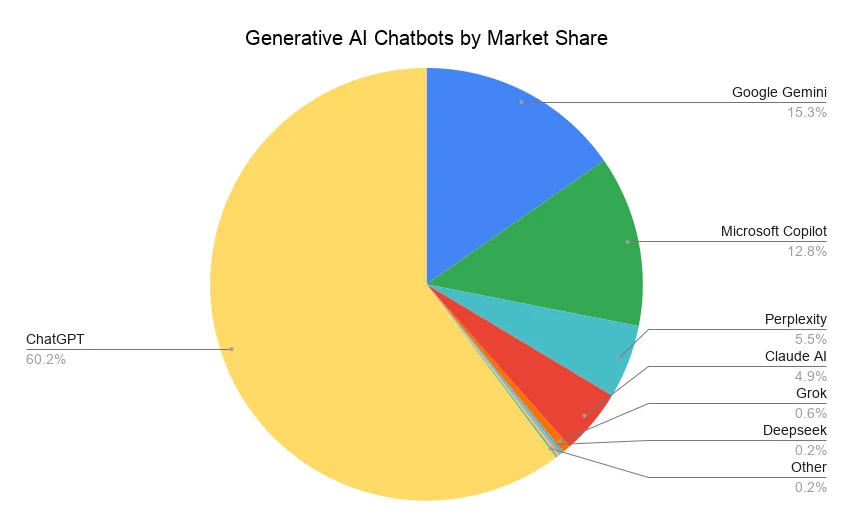
Key market statistics as of April 2026:
- ChatGPT: 900 million weekly active users, 64.5% market share, $25B annualized revenue
- Google Gemini: 18.2% market share, 2 billion monthly visits up 647% year-over-year
- Grok: 3.4% overall share, but 15.2% of US mobile daily active users the surprise performer
- Perplexity: 45 million monthly active users, 800% overall growth since launch
- Claude: 2% market share but $2.2B projected revenue in 2025 dominant in enterprise
Individual AI Breakdown: Strengths, Weaknesses & Best Use Cases
ChatGPT (OpenAI) The Versatile All-Rounder
ChatGPT, powered by GPT-5.4, is the undisputed consumer market leader with 900 million weekly active users. OpenAI is now valued at $852 billion (March 2026), and 92% of Fortune 500 companies use ChatGPT in some capacity. It is the safe, proven default for most users.
Strengths: ChatGPT excels in creative writing, coding, brainstorming, and general productivity. It has the widest third-party integration ecosystem connecting natively with Microsoft 365, Slack, Zapier, and hundreds of other tools. The GPT-5.4 model scores 92.8% on GPQA reasoning benchmarks and achieves a 57.7% SWE-bench coding score.
Weaknesses: ChatGPT’s context window is smaller than Claude’s. Its real-time web access, while available, is not as seamlessly research-focused as Perplexity’s. Enterprise pricing scales quickly.
- Best for: Content writers, marketers, developers, small businesses, and students
- Monthly cost: $20/month (Plus) | Free tier available
- Latest model: GPT-5.4
Google Gemini The Ecosystem Integrator
Gemini is the fastest-growing AI assistant in the world. Google’s strategy is not to win on raw model quality but on distribution and it is working. Gemini 3.1 Pro is deeply embedded in Google Search, Gmail, Docs, Sheets, and Android, giving it 2 billion monthly visits and 450 million monthly users.
Strengths: Unmatched integration with Google Workspace. Gemini leads all models on multimodal tasks handling video, audio, and images with a 1 million token context window. Real-time web access is native, not a plugin. GPQA reasoning score of 94.3% is the highest of any current model.
Weaknesses: Gemini’s value depends heavily on whether you already use Google Workspace. As a standalone tool, it can feel less polished than ChatGPT for creative tasks. Writing quality sometimes lacks the nuance of Claude.
- Best for: Google Workspace users, journalists, financial analysts, multimodal workflows
- Monthly cost: $19.99/month (Advanced) | Free tier available
- Latest model: Gemini 3.1 Pro
Claude (Anthropic) The Analytical Powerhouse
Claude is the professional’s AI. Despite a modest 2% consumer market share, Anthropic’s enterprise revenue surpassed OpenAI’s in mid-2025, a remarkable statistic that tells the true story of where Claude wins. Designed from the ground up to be safe, accurate, and nuanced, Claude has become the tool of choice for legal teams, researchers, compliance professionals, and developers.
Strengths: Claude leads on long-document analysis with a 200K token context window. It produces the most natural, nuanced prose of any model; Claude Sonnet 4.6 achieves 128K output tokens per response. GPQA score of 91.3% on reasoning. The Artifacts feature, loved by developers and writers, saves hours of work monthly.
Weaknesses: Fewer native third-party integrations than ChatGPT. Real-time web browsing is in beta. Less appealing to casual users looking for a quick, witty AI companion.
- Best for: Lawyers, researchers, developers, compliance teams, long-form document analysis
- Monthly cost: $20/month (Pro) | Free tier available
- Latest model: Claude Sonnet 4.6 / Claude Opus 4.6
Perplexity AI The Research Engine
Perplexity is the most specialized tool in this comparison. It does not try to be everything to everyone it is built to be the most accurate, well-cited AI search and research tool on the market. With 45 million monthly active users and 800% overall growth, Perplexity has found a loyal audience among academics, journalists, and analysts.
Strengths: Every answer is sourced and cited in real time. Perplexity uniquely allows users to access multiple underlying models (including GPT-5.4, Claude, and Gemini) within one interface, making it a meta-research tool. The platform hit 780 million queries in May 2025 and is on track to exceed 1 billion weekly queries in 2026.
Weaknesses: Perplexity is not a creative writing or coding tool. Its outputs lack the depth of Claude for complex analytical reasoning. It is narrower in scope than the other tools on this list.
- Best for: Researchers, journalists, fact-checkers, academics, and analysts
- Monthly cost: $20/month (Pro) | Free tier available
- Latest model: Sonar Pro (proprietary + third-party models)
Grok (xAI) The Real-Time Social AI
Grok, developed by Elon Musk’s xAI and embedded in the X (formerly Twitter) platform, has been the surprise mobile performer of 2026. Its daily active user share in the US jumped from 1.6% to 15.2% largely because it ships pre-installed for X Premium subscribers. Grok is best understood as a social media AI, not a general-purpose tool.
Strengths: Unmatched real-time access to trending X conversations and live social data. Grok’s personality is deliberately irreverent and informal appeals to users who find other AI tools too corporate. Fast response times of 1-3 seconds on average.
Weaknesses: Grok at $30/month is the most expensive plan in this comparison, and benchmarks do not justify the premium. Limited to users who are active on the X ecosystem. Analytical depth lags behind Claude and ChatGPT. Privacy considerations around X data integration concern some users.
- Best for: Social media managers, X power users, real-time trend monitoring
- Monthly cost: $30/month (Premium+) | Limited free access via X
- Latest model: Grok 4
Side-by-Side Feature Comparison
The table below summarizes each tool across the dimensions most relevant to professional and personal use in 2026.
| Feature | ChatGPT | Gemini | Claude | Perplexity | Grok |
| Reasoning Quality | Excellent | Excellent | Excellent | Good | Good |
| Creative Writing | Excellent | Good | Excellent | Average | Average |
| Coding Ability | Excellent | Good | Excellent | Average | Good |
| Real-Time Search | Good | Excellent | Beta | Excellent | Excellent |
| Context Window | 128K tokens | 1M tokens | 200K tokens | ~32K tokens | ~128K tokens |
| Third-Party Integrations | Extensive | Google Suite | Limited | Limited | X / Twitter |
| Long Document Analysis | Good | Excellent | Excellent | Good | Average |
| Privacy / Safety Focus | Good | Good | Excellent | Good | Below average |
| Free Tier | Yes (GPT-4o) | Yes | Yes (Sonnet) | Yes (5/day) | Yes (limited) |
| Paid Plan Price | $20/month | $19.99/month | $20/month | $20/month | $30/month |
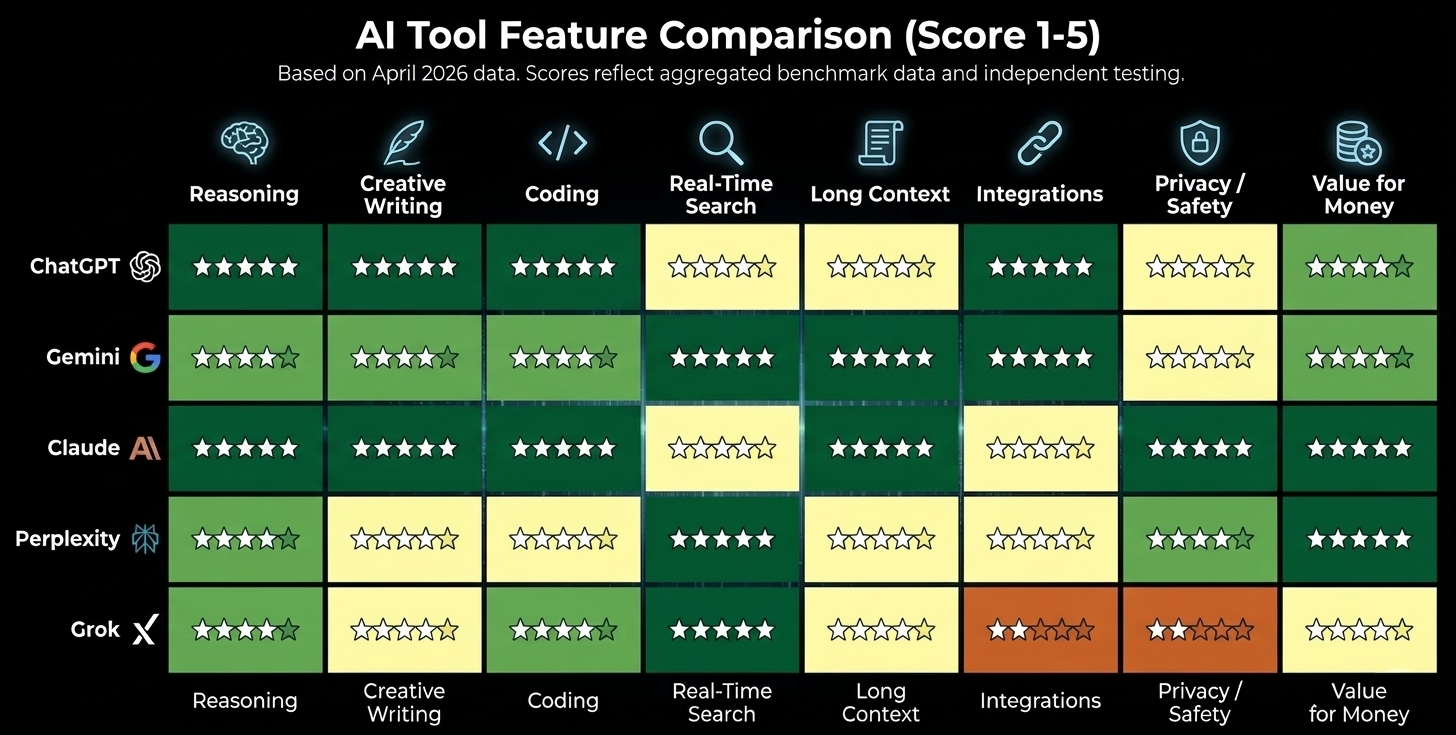
Figure 2: Feature Comparison Heatmap Scored 1-5 across 8 dimensions | April 2026
Pricing Comparison: Which AI Gives You the Most for Your Money?
All five tools follow a freemium model, offering a free tier with usage limits and a paid plan that unlocks full model access, higher rate limits, and advanced features. Prices have stabilized across the industry at approximately $20/month with one notable exception.
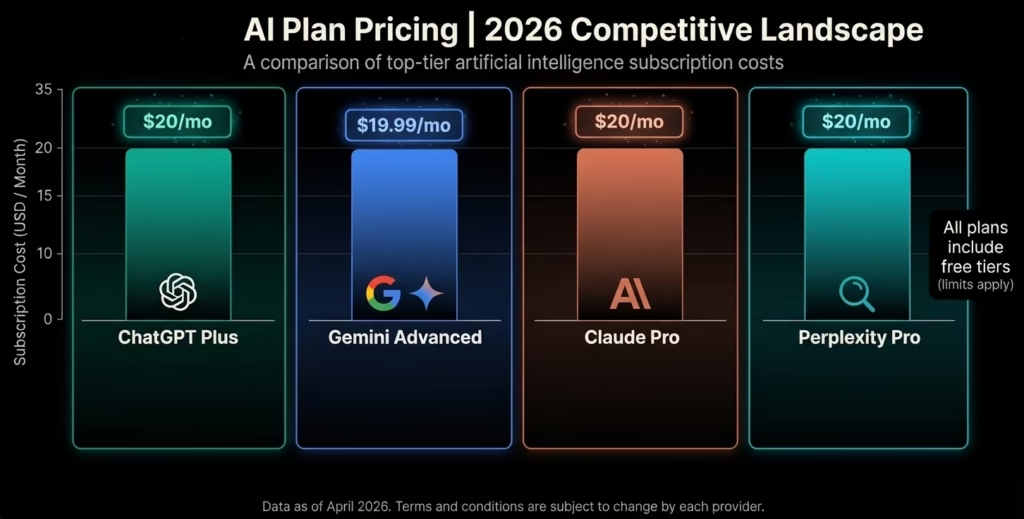
Figure 3: Monthly Pricing for Paid Plans All tools offer free tiers | April 2026
Value assessment by use case:
- Best value for professionals who write or code: Claude Pro ($20) the Artifacts and Claude Code features alone justify the cost
- Best value for researchers and academics: Perplexity Pro ($20) unlimited searches with citations and access to multiple underlying models
- Best value for Google Workspace users: Gemini Advanced ($19.99) deep integration eliminates the need for multiple tools
- Best value for general users: ChatGPT Plus ($20) broadest capability set and the most established ecosystem
- Least value for price paid: Grok Premium ($30) benchmark scores and features do not justify a 50% premium over competitors
Capability Profiles: What Each AI Does Best
Rather than a single winner, each AI tool occupies a distinct capability niche. The radar charts below visualize how each tool performs across six dimensions critical for professional use.
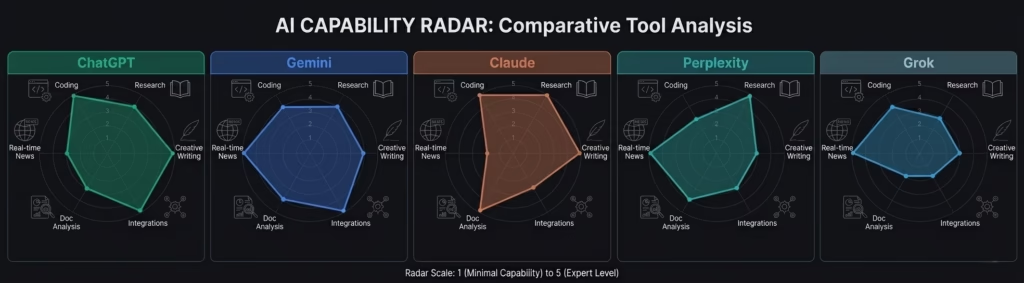
Figure 4: Capability Radar Each tool across 6 dimensions (1=weak, 5=excellent) | April 2026
The takeaway is clear: no single AI dominates every dimension. Claude and ChatGPT share the lead on writing and reasoning; Gemini and Grok lead on real-time data; Claude leads on document analysis and privacy; ChatGPT and Gemini lead on integrations. Power users often subscribe to two tools rather than one.
Which AI Should You Choose? A Decision Guide
Choosing the right AI tool is ultimately about matching the tool’s strengths to your primary workflow. Here is the practical decision framework:
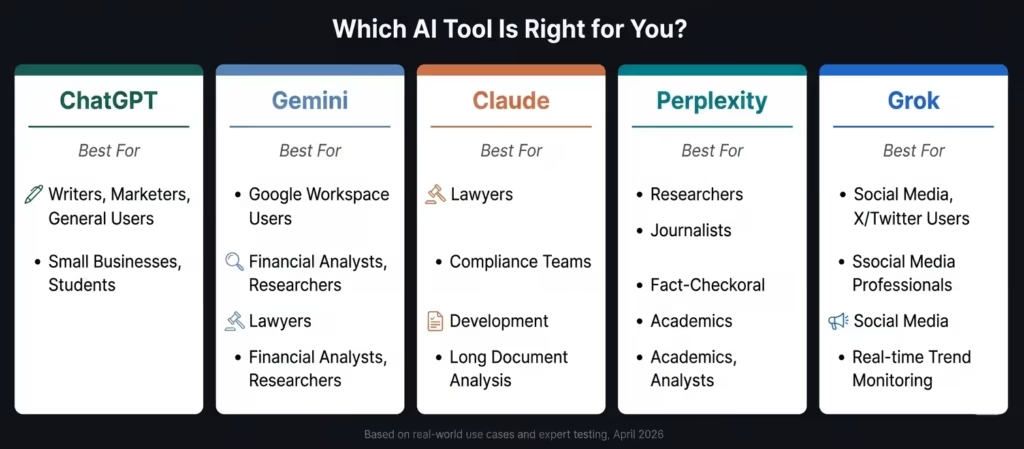
Figure 5: “Which AI Is Right for You?” Tool recommendations by user type | April 2026
- Choose ChatGPT if you need a reliable all-rounder with wide integrations for everyday writing, research, and productivity across varied tasks
- Choose Gemini if your work lives in Google Workspace or if you frequently need real-time multimodal tasks involving video, audio, or live web data
- Choose Claude if you process long documents, work in a compliance-sensitive environment, or need the most accurate and nuanced writing output
- Choose Perplexity if accuracy and citation are non-negotiable it is the best AI for research, fact-checking, and sourced analysis
- Choose Grok if you work in social media or need real-time X platform data and prefer an informal AI personality
Frequently Asked Questions
Which AI chatbot is the best in 2026?
There is no single “best” AI chatbot in 2026 the answer depends entirely on your use case. ChatGPT leads in consumer market share and general versatility. Claude leads in enterprise revenue and analytical depth. Gemini leads in multimodal tasks and Google Workspace integration. Perplexity leads in real-time research accuracy. For most general users, ChatGPT or Claude Pro offers the strongest combination of capability and value at $20/month.
Is Claude better than ChatGPT?
Claude outperforms ChatGPT on long-document analysis, nuanced writing, and compliance-sensitive tasks. ChatGPT outperforms Claude on breadth of integrations, creative tasks, and overall ease of use for general consumers. Anthropic’s enterprise revenue surpassed OpenAI’s in mid-2025, suggesting professionals who need precision prefer Claude. For casual everyday use, ChatGPT remains the more accessible choice.
Is Perplexity AI worth paying for?
Yes, for researchers, journalists, and fact-checkers, Perplexity Pro at $20/month is arguably the best value in the market. Every response includes cited sources, and Pro users can access multiple underlying models (GPT-5.4, Claude, Gemini) within one interface. For users whose primary need is accurate, sourced information rather than creative generation, Perplexity is unmatched.
Why is Grok so expensive compared to the others?
Grok Premium at $30/month is 50% more expensive than comparable plans from ChatGPT, Claude, and Perplexity, despite benchmark scores that do not consistently match those competitors. The premium is primarily a reflection of its distribution via X (Twitter) Premium+ subscriptions rather than standalone AI capability. Unless you are a power user of the X platform or need real-time X data, the price premium is difficult to justify.
Can I use multiple AI tools at the same time?
Absolutely and many professionals do. A common workflow is to use Perplexity for initial research and sourcing, Claude for deep analysis and drafting, and ChatGPT or Gemini for final editing and publishing tasks. Total cost for three tools is $60/month, which is below what many companies spend on a single SaaS tool. Perplexity Pro also provides native access to ChatGPT, Claude, and Gemini models within its interface, effectively giving you multi-model access for one subscription.
Which AI is best for coding in 2026?
Claude Sonnet 4.6 and ChatGPT GPT-5.4 are the top two options for coding. Independent tests show Claude produces fewer bugs on complex refactoring tasks and writes more idiomatic code. ChatGPT’s Deep Research and Code Interpreter features add value for data-heavy workflows. For developers building applications, Claude Code is the most powerful terminal-native coding AI available.
Conclusion: The Right AI for Every Professional
The five major AI tools in 2026 ChatGPT, Gemini, Claude, Perplexity, and Grok each serve a distinct professional need. ChatGPT is the versatile market leader. Gemini is the Google Workspace power tool. Claude is the analytical and writing precision instrument. Perplexity is the research and fact-checking specialist. Grok is the real-time social media AI.
The most important insight from this comparison: the right tool depends on your workflow, not the benchmarks. Try the free tier of your top two candidates. Upgrade based on actual usage friction, not hype. And do not overlook the power of using two tools in combination; it costs less than most professional subscriptions and delivers disproportionate results.
As AI capabilities continue to converge in 2026 and 2027, the differentiators will increasingly be ecosystem integration, pricing, trust, and safety record, not raw model performance. Anthropic, OpenAI, and Google are each betting on different long-term strategies. For now, you win by picking the tool that fits where you work today.