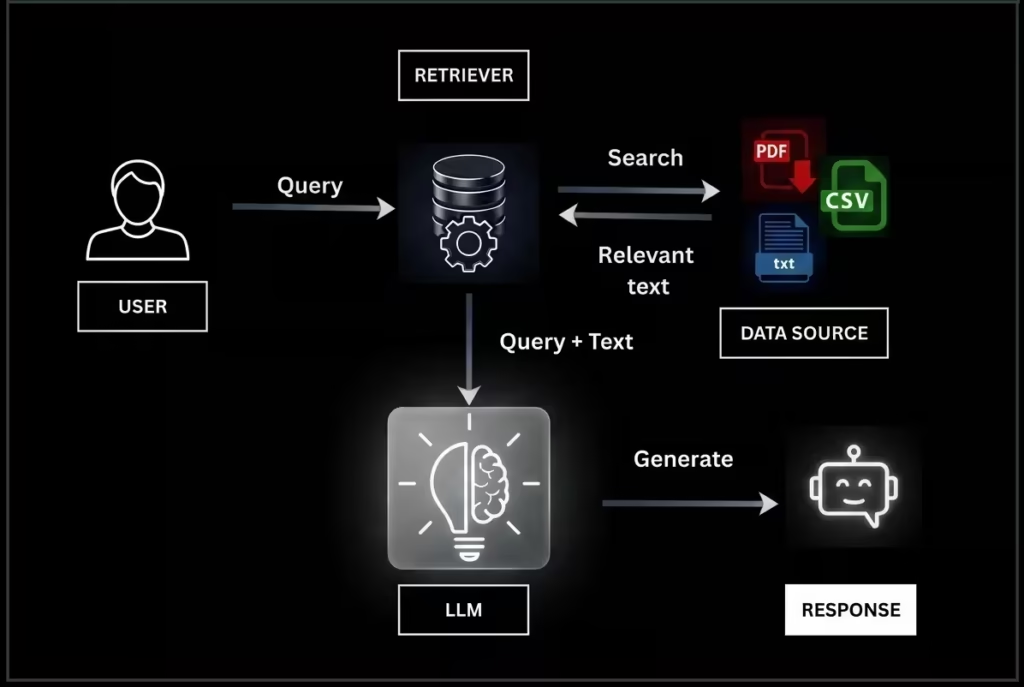
What Is RAG in AI? The Simple Definition
Retrieval-Augmented Generation (RAG) is an AI framework that connects a large language model (LLM) to an external knowledge base, allowing it to fetch relevant information before generating a response. The term was first introduced in a 2020 research paper by Meta AI (then Facebook AI Research), co-authored by Patrick Lewis and collaborators from University College London and New York University.
The core problem RAG solves is this: every LLM has a training cutoff date. Everything the model knows was locked in at that moment. Ask it about a news event from last week, a document it has never seen, or proprietary company data, and it will either hallucinate an answer or admit it does not know.
RAG fixes this by giving the model an open book to reference, rather than forcing it to work from memory alone. In short, RAG equals Retrieve plus Augment plus Generate:
- Retrieve: Find the most relevant documents or data chunks from an external source.
- Augment: Inject that retrieved information into the prompt sent to the LLM.
- Generate: The LLM uses both its training knowledge and the retrieved context to produce an accurate, grounded answer.
How RAG Works: Step-by-Step Breakdown
Understanding RAG requires following the data flow from the moment a user types a query to the moment the model responds.
- The user submits a query. For example: ‘What are our Q3 refund rates?’ or ‘What happened in AI news today?’
- The query is converted into a vector embedding, a numerical representation that captures the semantic meaning of the question.
- The retrieval system searches a vector database or web index for documents whose embeddings are mathematically closest to the query embedding.
- The top matching documents or text chunks are returned from the knowledge base.
- The retrieved content is injected into the prompt alongside the original user query. This is the augmentation step.
- The LLM receives the enriched prompt and generates a response grounded in both its training knowledge and the retrieved data.
- The response is returned to the user, often with source citations so claims can be independently verified.
The entire process typically runs in under two seconds in consumer AI products. In enterprise deployments, the knowledge base can be a private document repository, a CRM, internal wikis, or real-time databases updated continuously.
Why RAG Matters: Key Benefits
| Benefit | What It Solves | Business Impact |
| Reduces Hallucinations | LLMs fabricating facts from training data | Higher accuracy and trust in AI outputs |
| Real-Time Knowledge | Training cutoff producing outdated responses | Current answers without retraining the model |
| Cost Efficiency | Full model retraining is expensive and slow | Update the knowledge base, not the model |
| Source Citations | No transparency in standard LLM outputs | Users can verify every claim independently |
| Domain Specificity | Generic models lacking proprietary knowledge | Instant access to internal company data |
| Reduced Legal Risk | Hallucinated content causing compliance issues | Grounded outputs with traceable sources |
RAG vs Fine-Tuning: What Is the Difference?
RAG and fine-tuning are often confused, but they solve different problems. Fine-tuning adjusts the weights of the model itself by training it on new domain-specific data. RAG does not change the model. It expands what the model can see at inference time by connecting it to an external, updatable knowledge base.
RAG is the better choice when data changes frequently. Fine-tuning is better when you need the model to learn a consistent tone, format, or domain-specific reasoning pattern. Most production AI systems in 2025 and 2026 combine both approaches.
| Factor | RAG | Fine-Tuning |
| Cost | Low (update the knowledge base only) | High (requires GPU compute for retraining) |
| Speed to deploy | Fast (hours to days) | Slow (days to weeks) |
| Handles live or changing data | Yes | No |
| Source citations in output | Yes | No |
| Improves reasoning style | No | Yes |
| Requires labeled training data | No | Yes |
RAG in Major LLMs: ChatGPT, Claude, Perplexity, Grok, and Gemini
Each major AI platform implements RAG through a different underlying architecture. The differences are not about which tool is better they are about where the retrieval layer sits and what knowledge source it draws from. Understanding these architectural distinctions helps developers and enterprises choose the right platform for their RAG deployment.
1. ChatGPT (OpenAI): Agentic Web Retrieval Pipeline
ChatGPT implements RAG through an agentic multi-step retrieval pipeline called Deep Research. Rather than performing a single vector search, the system autonomously decomposes the query into sub-queries, issues multiple web searches in parallel, fetches and parses source documents, and synthesizes a grounded response with inline citations.
For document-level RAG, ChatGPT converts uploaded files into chunked embeddings at session time. Each user query triggers a similarity search across those chunks, and the top-ranked passages are injected into the prompt context before generation.
The retrieval corpus is the live web index, meaning the knowledge base is external, dynamic, and not controlled by the deploying organization.
2. Claude (Anthropic): Long-Context RAG Through Projects and Document Analysis
Claude’s RAG architecture differs fundamentally from web-retrieval models. Instead of a traditional retrieve-then-read pipeline with a separate vector database, Claude loads the entire document set directly into its active context window at inference time. Retrieval happens inside the context rather than before it.
The Projects feature adds a persistence layer on top of this. Document embeddings are stored across sessions, enabling multi-turn retrieval without re-uploading source material on each query. This makes Claude’s RAG implementation stateful at the session and project level, rather than stateless like most single-query retrieval pipelines.
The key architectural tradeoff: Claude’s approach maximizes cross-document coherence and citation accuracy but is bounded by context window size rather than database scale.
3. Perplexity AI: Search-Native RAG as Core Architecture
Perplexity is architecturally inverted compared to ChatGPT and Claude. In most LLM systems, the generative model is primary and retrieval is an enhancement layer added on top. In Perplexity, real-time web search is the foundation and language model synthesis is the layer built above it.
At query time, Perplexity issues a live web search, scores and ranks retrieved documents by relevance and source authority, injects the top passages into the prompt, and generates a response with every claim linked to a specific source URL. The model has no option to generate from training data alone — retrieval is mandatory for every response.
This architecture makes citation coverage and source traceability a structural guarantee rather than an optional feature.
4. Grok (xAI): Social Stream Retrieval
Grok’s retrieval layer is connected to the real-time X (formerly Twitter) data stream rather than a web index or document store. At inference time, Grok queries the live X firehose, retrieves posts semantically relevant to the input query, and uses those posts as grounding context for generation.
The architectural implication is significant: the retrieval corpus is composed of unmoderated, unverified social content updated in milliseconds. This gives Grok sub-minute recency on trending social data a retrieval latency no web-crawl-based system can match but it also means the knowledge source carries no editorial authority or fact-checking layer.
From a RAG systems perspective, Grok optimizes for retrieval recency at the cost of source reliability.
5. Gemini (Google): RAG Grounded in Google Search and Workspace
Gemini operates two parallel retrieval channels that can run independently or in combination. The first channel grounds responses in the live Google Search index the same crawled and ranked web corpus that powers Google’s core search product. This channel inherits Google’s existing PageRank and authority signals, meaning retrieval quality is influenced by traditional SEO factors.
The second channel connects directly to Google Workspace. When operating inside Gmail, Docs, Drive, or Sheets, Gemini performs structured retrieval against the user’s own file system. Queries are resolved against personal and organizational documents rather than the public web, keeping sensitive data within the Workspace environment.
This dual-channel design is architecturally distinct from all other platforms on this list it is the only RAG implementation that natively switches between private organizational knowledge and public web retrieval based on query context.
RAG Architecture Comparison (2026)
| Platform | Retrieval Layer | Knowledge Source | Retrieval Trigger |
|---|---|---|---|
| ChatGPT | Agentic multi-step pipeline | Live web + uploaded files | On-demand per query |
| Claude | In-context loading + Projects | Uploaded documents + stored project files | At session and project level |
| Perplexity | Retrieval-first (mandatory) | Live web index | Every query, no exception |
| Grok | Social stream retrieval | Live X/Twitter firehose | Real-time, sub-minute latency |
| Gemini | Dual-channel (web + Workspace) | Google index + user files | Context-switched per query |
Looking for a full comparison of capabilities, pricing, and use cases across these platforms? See our ChatGPT vs Gemini vs Claude vs Perplexity vs Grok comparison
Real-World RAG Use Cases by Industry
RAG is already embedded in tools that professionals use daily. Here is how RAG is applied across industries in 2026.
- Healthcare: Hospitals deploy RAG to connect LLMs to clinical guidelines databases. Clinicians ask natural language questions and receive answers grounded in the hospital’s own protocols, not generic web information.
- Legal: Law firms use RAG to connect LLMs to case law databases and internal document repositories. Attorneys query thousands of contracts and receive answers with specific clause citations in seconds.
- Finance: Investment teams connect LLMs via RAG to earnings call transcripts, SEC filings, and market data feeds. Analysts get real-time, source-cited summaries without manually reading every filing.
- E-commerce: Customer support chatbots use RAG to retrieve real-time order status, return policies, and product specifications from internal databases, eliminating hallucinated shipping timelines and incorrect product details.
- Marketing and SEO: Content teams use RAG-enabled tools to ground AI-generated content in current brand guidelines and live competitor data, reducing the risk of publishing outdated or off-brand copy.
- Human Resources: HR chatbots answer employee questions about leave policies, benefits, and payroll by retrieving the actual policy documents from the company knowledge base.
Frequently Asked Questions About RAG in AI
What does RAG stand for in AI?
RAG stands for Retrieval-Augmented Generation. It is an AI framework that enhances large language models by connecting them to external knowledge sources at inference time, allowing the model to retrieve relevant information before generating a response. The term was introduced in a 2020 research paper by Meta AI researchers Patrick Lewis and colleagues.
Is Perplexity AI a RAG system?
Yes. Perplexity AI is architecturally a RAG-native system. Unlike ChatGPT or Claude, which are generative models with RAG as an optional enhancement layer, Perplexity treats real-time web search as its core foundation and AI synthesis as the layer built on top. Every response includes inline citations linked to the live sources retrieved during that session.
Does Claude use RAG?
Claude uses RAG through its Projects feature and long-context document processing. Users upload large document sets or store persistent reference materials in Claude Projects, and Claude retrieves relevant context from those sources when answering questions. Claude’s RAG approach is optimized for document-level retrieval with a very large context window rather than real-time web search by default.
What is the difference between RAG and fine-tuning?
Fine-tuning modifies the model’s internal weights through additional training on domain-specific data. RAG does not change the model at all. It expands what the model can reference at query time by connecting it to an external, updatable knowledge base. RAG is better for frequently changing data. Fine-tuning is better for teaching the model a consistent style, tone, or specialized reasoning pattern.
Can RAG eliminate AI hallucinations completely?
RAG significantly reduces AI hallucinations by grounding responses in retrieved source documents rather than relying on statistical patterns from training data alone. However, RAG does not eliminate hallucinations entirely. If the retrieval step returns irrelevant or low-quality documents, the model may still generate inaccurate answers. The quality of the knowledge base and the retrieval mechanism directly determines the accuracy of RAG output.
What is a vector database and why does RAG need one?
A vector database stores data as numerical embeddings rather than structured rows and columns. When a query is submitted, it is converted to a vector and compared mathematically against stored vectors to find the most semantically similar content. RAG systems use vector databases because semantic search outperforms keyword search for natural language queries. Common vector databases used in RAG systems include Pinecone, Weaviate, Chroma, and pgvector.
Is RAG only for text data?
No. RAG can work with unstructured data such as text and PDFs, semi-structured data like JSON and tables, and structured data including SQL databases and knowledge graphs. Modern enterprise RAG systems retrieve from multiple data types simultaneously, combining keyword search, vector search, and structured database queries in a single retrieval pipeline.
Conclusion: RAG Is the Bridge Between LLM Intelligence and Real-World Knowledge
Retrieval-Augmented Generation is not a future technology. It is the mechanism already powering the AI tools millions of professionals use daily in 2026. Every time Perplexity cites a live source, every time Claude references an uploaded contract, every time ChatGPT’s Deep Research pulls a current article, every time Gemini reads a Google Drive file, RAG is running underneath.
Understanding how each platform implements RAG at the architectural level helps you ask better questions of each tool and deploy the right system for your use case. The retrieval layer not the generative model is often the deciding factor in whether an AI system produces accurate, grounded outputs or confident hallucinations.
The organizations and professionals who master RAG, both as users who know how to prompt it effectively and as builders who know how to deploy it, will hold a compounding competitive advantage as AI continues to penetrate every business workflow.