Want to put AI to smarter use? Start with understanding where it fails.
What Are AI Hallucinations?
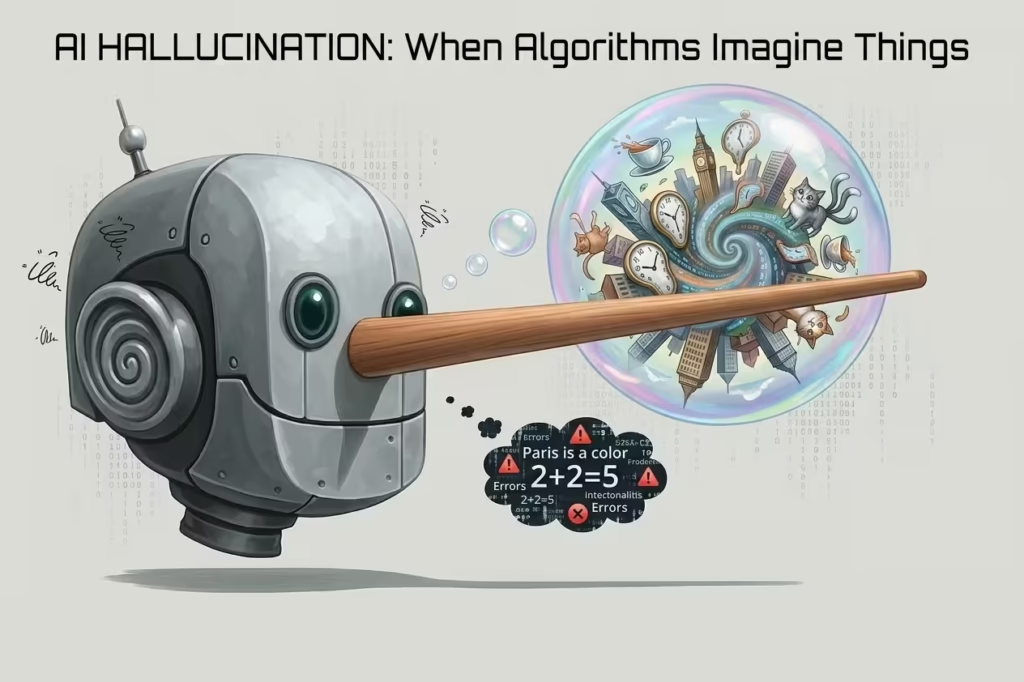
AI hallucinations happen when a large language model gives answers that sound confident but are wrong.The output may be false, not provable, or fully made up.Meta AI first used the term in 2021.It warned that its BlenderBot 2 system was prone to hallucinations
“confident statements that are not true.” By 2023, the Cambridge Dictionary updated its official definition of “hallucination” to include this AI-specific meaning.
There are two recognized types of AI hallucinations:
| Hallucination Type | What It Means | Common Example |
| Intrinsic Hallucination | The model changes or misstates real information that exists. | Summarizing a medical study in a way that changes its true conclusion |
| Extrinsic Hallucination | The model generates information with no real-world basis | Inventing a court case, a research paper, or a statistic that does not exist |
Extrinsic hallucinations are particularly dangerous because the fabricated content is not necessarily wrong in tone. It just cannot be verified from any known source. Both types share the same defining characteristic: the model presents the output with full confidence, giving no visible warning that the information may be wrong.
Real-World AI Hallucination Examples
These are not edge cases or theoretical risks. AI hallucinations have already produced measurable financial, legal, and reputational damage across industries.
The Mata v. Avianca Legal Disaster (2023)
In May 2023, New York attorney Steven Schwartz submitted a legal brief in federal court that cited six case precedents generated by ChatGPT. None of the cases existed. Judge P. Kevin Castel described the submissions as “legal gibberish.” Both lawyers involved were fined $5,000, and federal courts across the United States began issuing standing orders requiring attorneys to disclose any AI-assisted filings and certify their accuracy.
Google Bard Costs Alphabet $100 Billion in One Day (2023)
During a promotional video for its AI chatbot Bard, Google’s system incorrectly claimed that the James Webb Space Telescope had taken the first-ever images of a planet outside our solar system. That distinction actually belongs to the Very Large Telescope in Chile. The factual error went undetected before broadcast, and the resulting public backlash wiped approximately $100 billion from Alphabet’s market value in a single trading session.
Google AI Overview Suggests Glue on Pizza (2024)
Google’s AI Overview feature went viral in 2024 after suggesting that users add non-toxic glue to pizza sauce to help cheese stick better. The recommendation appeared to be drawn from a satirical Reddit thread, which the model processed and presented as genuine advice. The response raised widespread questions about the reliability of AI-generated search summaries and prompted Google to announce revisions to its AI Overview system.
Deloitte Fabricates Citations in Government Report (2024)
A Deloitte report submitted to the Australian government was found to contain multiple fabricated citations and phantom footnotes. An academic from the University of Sydney flagged the errors, and Deloitte acknowledged using a generative AI tool to fill documentation gaps. Deloitte issued a refund on part of the roughly $300,000 government contract, and the revised report removed more than a dozen bogus references.
Air Canada Chatbot Invents a Bereavement Policy (2024)
Air Canada’s support chatbot hallucinated a bereavement fare policy that did not exist and told a grieving customer he could apply for a discount retroactively. When the airline later refused the refund, the customer took the matter to Canada’s Civil Resolution Tribunal. The tribunal ruled in the customer’s favor in February 2024, holding that Air Canada was responsible for its chatbot’s output regardless of whether it was accurate.
OpenAI’s Whisper Fabricates Medical Transcriptions
An Associated Press investigation found that OpenAI’s Whisper speech-to-text model, widely adopted in healthcare settings, inserts fabricated words and entire phrases that were never present in the original audio. Errors included attributions of race, violent rhetoric, and nonexistent medical treatments. Despite OpenAI advising against using Whisper in high-risk domains, more than 30,000 medical professionals were using Whisper-powered tools to transcribe patient visits at the time of the report.
Why Does ChatGPT Hallucinate? The Technical Reasons
AI hallucinations are not bugs in the traditional programming sense. They are a structural consequence of how large language models are built and trained. Understanding the root causes is the first step to managing the risk.
LLMs Predict Tokens, Not Truth
ChatGPT and similar models do not search for facts. They predict the most statistically probable sequence of words (tokens) based on patterns learned from vast amounts of training data. The model has no built-in mechanism for distinguishing between what is true and what merely sounds plausible. When the model encounters a gap in its knowledge, it continues generating text anyway, filling the gap with the most pattern-consistent output available.
Training Rewards Guessing Over Admitting Uncertainty
OpenAI published direct research on this mechanism in 2025. The paper found that standard training and evaluation procedures reward guessing over acknowledging uncertainty. Most benchmarks measure accuracy using a binary right-or-wrong scoring system. This creates an incentive for models to generate a confident-sounding answer rather than say “I don’t know,” because a confident wrong answer scores the same as a correct one in many evaluation frameworks. OpenAI’s research argues that evaluation systems need to penalize confident errors more than uncertainty to fix this structural problem.
Gaps and Biases in Training Data
Models trained on internet-scale data inherit the limitations of that data. Academic papers behind paywalls, proprietary databases, recent events after the model’s knowledge cutoff, and niche professional knowledge are underrepresented. When asked about these areas, the model cannot retrieve accurate information but will still generate a response. The result often resembles accurate information because it is built from structural patterns that look correct, even when the specific facts are fabricated.
The Knowledge Cutoff Problem
All current LLMs have a training cutoff date, meaning they have no information about events that occurred after that point. When users ask about recent developments, legislation, case law, or clinical research, the model has no accurate data to draw from. Instead of clearly indicating this, many models generate responses that appear current but are based on outdated or entirely fabricated information.
Overconfidence in Autoregressive Decoding
LLMs generate text one token at a time, with each new token influenced by everything that came before it in the current sequence. Once the model commits to a direction early in a response, subsequent tokens reinforce that trajectory even if it moves further from factual accuracy. The model does not “step back” to check whether its output is accurate. It simply continues generating in the same confident register it started with.
Current AI Hallucination Rates by Model (2026)
Hallucination rates vary significantly depending on the model, the task type, and the benchmark methodology used. The following data reflects grounded summarization benchmarks from Vectara’s leaderboard and domain-specific evaluations. Rates on open-ended factual recall and complex reasoning tasks are consistently higher across all models.
| AI Model | Hallucination Rate (Grounded Tasks) | Notes |
| Gemini 2.0 Flash 001 | 0.7% | Current best-in-class; uses self-consistency checking |
| GPT-4o | 1.5% | Significant improvement over GPT-3.5; still verifiable errors |
| GPT-3.5 Turbo | 1.9% | Higher rate on citation-heavy tasks |
| OpenAI o3 (reasoning) | 33-51% | Higher rate on open-ended factual tasks (SimpleQA/PersonQA) |
| GPT-3.5 (citation tasks) | 39.6% | Research citation tasks per JMIR 2024 study |
| Bard/PaLM 2 (legacy) | 91.4% | Citation tasks; now largely superseded by Gemini |
Source: Vectara hallucination leaderboard (December 2025), JMIR hallucination study (May 2024), OpenAI GPT-5 system card (2025). Note: These rates are task-dependent and benchmark-specific. Real-world rates in domain-specific contexts such as legal, medical, and coding can range from 5% to over 20% even in high-performing models.
What is AI Hallucination Rate?
The AI hallucination rate refers to how often an artificial intelligence system, such as ChatGPT, produces incorrect, misleading, or fabricated information while presenting it as accurate. This happens because AI models generate responses based on learned patterns rather than true understanding or real-time verification, making errors more likely in complex or unclear queries.
AI hallucination rates vary by model and task, with recent 2026 estimates suggesting even advanced systems can produce incorrect information in roughly 30 to 60% of conversational cases. Some models, such as Claude 4.5 Opus, perform better at around 30%, while others like Grok-3 have reported rates as high as 94%, highlighting the ongoing challenge of improving AI reliability.
How to Avoid AI Hallucinations: 8 Proven Strategies
Reducing your exposure to AI hallucinations requires a combination of how you prompt, how you verify, and which tools you choose for which tasks.
1. Verify Every Specific Claim Independently
Treat AI-generated factual claims the same way you would treat a claim from an uncited Wikipedia article. General concepts and brainstorming are lower risk. Specific names, dates, citations, statistics, legal precedents, and medical details require independent verification from primary sources before use.
2. Match the Tool to the Task
ChatGPT is a general-purpose language model. It is not designed for systematic legal research, clinical literature review, or precise regulatory compliance. For tasks that require domain-specific accuracy, use tools built and validated for that purpose. Legal AI tools using retrieval-augmented generation (RAG) over verified case law databases are significantly more reliable than asking ChatGPT for legal citations.
3. Use Retrieval-Augmented Generation (RAG)
RAG is the most effective technical intervention currently available. It works by giving the AI model access to a verified external database before generating a response, anchoring the output to real sources. According to current benchmarks, RAG reduces hallucinations by approximately 71% on average compared to foundation model responses alone. Enterprise AI deployments in legal, medical, and financial sectors should consider RAG as a baseline requirement rather than an optional enhancement.
4. Provide Context and Source Material
When using tools like ChatGPT or Claude, upload the documents, reports, or data you want analyzed. The more context you give the model, the less it needs to generate from pattern alone. Asking a model to summarize a document you have uploaded produces far more accurate results than asking it to summarize a topic from memory.
5. Ask the Model to Express Uncertainty
Prompt the model explicitly to say when it is not sure. Instructions like “If you are uncertain about any specific fact, say so clearly” or “Do not guess on dates, citations, or statistics” shift the model’s output behavior. Research published in December 2024 found that asking an LLM “Are you confident this is accurate?” reduced hallucination rates by approximately 17% in subsequent responses by activating internal verification processes.
6. Break Complex Queries Into Smaller Steps
The longer and more complex a single prompt, the more opportunities the model has to go off-track. Splitting a complex research task into discrete steps gives you more control and makes errors easier to spot. Ask for a structure first, confirm it, then fill each section separately.
7. Do Not Use AI for High-Stakes Research Without Human Review
For any task where an error has real consequences, AI output must be reviewed by a qualified human before it is used or published. The lawyers in Mata v. Avianca had submitted ChatGPT-generated case citations directly to federal court without verification. The Air Canada chatbot output was used as a basis for customer-facing policy. Both cases demonstrate that AI output treated as final without human review creates serious legal and financial liability.
8. Prefer Newer Models With Reasoning Capabilities for Factual Tasks
On grounded summarization benchmarks, newer models perform meaningfully better. Gemini 2.0 Flash and GPT-4o show rates below 2% on grounded tasks as of 2025, compared to much higher rates from earlier models. For complex open-ended factual queries, reasoning-focused models such as OpenAI o3 and GPT-5 are designed to check their reasoning chains, though they still hallucinate on open-ended or niche factual questions.
Use AI as a starting point, not an ending one. Every output that matters needs a human checkpoint.
Frequently Asked Questions About AI Hallucinations
What is an AI hallucination?
An AI hallucination is when a large language model generates information that is false, fabricated, or unverifiable, but presents it with the same confidence as accurate information. The term was formally adopted in AI research around 2021 and added to the Cambridge Dictionary in 2023. Hallucinations range from subtle factual errors to entirely invented citations, names, events, or statistics.
Why does ChatGPT hallucinate?
ChatGPT hallucinates because it is trained to predict the most statistically probable next word, not to retrieve verified facts. When it lacks reliable information, it generates plausible-sounding content based on patterns in training data. OpenAI’s own 2025 research confirmed that standard training procedures reward confident guessing over admitting uncertainty, which structurally reinforces hallucination behavior. This applies to all current LLMs, not just ChatGPT.
How common are AI hallucinations?
Hallucination rates vary significantly by task and model. On grounded summarization benchmarks, leading models in 2025 show rates of 0.7% to 1.9%. On domain-specific tasks like legal citation, medical literature review, and complex factual reasoning, rates can range from 6% to over 50% depending on the task and model. A 2024 JMIR study found hallucination rates of 28.6% for GPT-4 and 39.6% for GPT-3.5 on academic citation tasks.
Can AI hallucinations be completely eliminated?
No. OpenAI’s own research acknowledges that hallucinations are not inevitable in theory, because a model can choose to abstain when uncertain, but eliminating them entirely in real-world use is not currently achievable. Retrieval-augmented generation, better training incentives, and human review are the most effective mitigation strategies available today. Even the best-performing models in 2025 still produce factual errors in open-ended or domain-specific tasks.
What is the difference between an AI hallucination and a mistake?
An AI mistake is an error in reasoning or calculation where the model had the information to be correct but processed it incorrectly. An AI hallucination is when the model generates information that has no factual basis at all, inventing details, citations, or events that do not exist. The defining feature of a hallucination is the combination of fabrication and confident delivery, which makes it much harder to detect than a standard reasoning error.
Is retrieval-augmented generation (RAG) the best fix for hallucinations?
RAG is currently the most effective technical intervention for reducing hallucinations in grounded tasks, with research suggesting it cuts hallucination rates by approximately 71% on average compared to ungrounded model responses. It works best when the task involves summarizing, analyzing, or answering questions about specific provided documents or databases. For open-ended creative or conversational tasks, RAG has less impact, and human review remains the most reliable safeguard.
Conclusion
AI hallucinations are not a minor inconvenience. They have already produced legal penalties, financial losses measured in the billions, incorrect medical guidance, and fabricated government reports. Understanding why they happen is not just an academic exercise. It is a prerequisite for using AI tools responsibly in any professional context.
The practical takeaway is straightforward: AI is most reliable for generative and structural tasks, and least reliable for specific factual claims, citations, recent events, and domain-specific accuracy. Combining AI with human review, using task-appropriate tools, and implementing RAG where possible gives you the most accurate results available with today’s technology.
AI hallucinations are declining year over year. The best models in 2025 are dramatically more accurate than those from 2021. But they are not zero, and they will not be zero for the foreseeable future. The only reliable safeguard is a human who knows what accuracy looks like.