The AIDA model in marketing is a four-stage framework Attention, Interest, Desire, and Action that maps the psychological journey a consumer takes from first discovering a product to making a purchase. Originally developed in 1898, it continues to power everything from email campaigns and landing pages to social media ads and sales scripts in 2026.
In this complete guide, you will learn what the AIDA model is, how each stage works, how to apply it to your marketing strategy, see real-world examples, and understand its limitations and modern variations.
What Is the AIDA Model in Marketing?
The AIDA model is a marketing and advertising framework that describes the four cognitive stages a potential customer moves through before making a purchase decision. AIDA stands for:
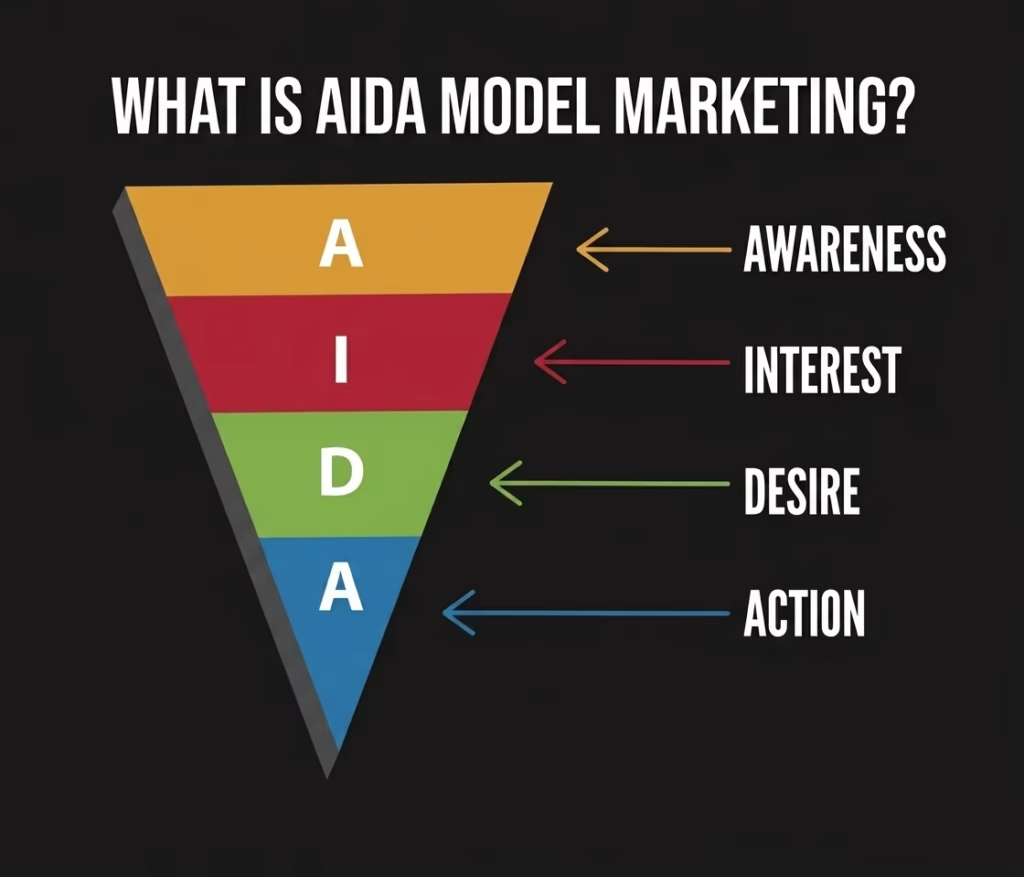
- Attention= capturing the consumer’s awareness of a product or brand
- Interest= generating genuine curiosity and engagement
- Desire= building an emotional connection and a strong want for the product
- Action= motivating the consumer to take a specific step, such as buying, signing up, or clicking
The model was developed by American advertising pioneer Elias St. Elmo Lewis in 1898, initially to optimize sales calls and advertising messages. Over the past century, it has been adopted across sales, marketing, copywriting, public relations, and digital marketing.
At its core, the AIDA model is a hierarchy of effects model that assumes consumers move sequentially through cognitive (thinking), affective (feeling), and behavioral (doing) stages before completing a purchase. This makes it both a communications planning tool and a consumer psychology framework.
Breaking Down Each Stage of the AIDA Model
1. Attention Stop the Scroll
The first stage of the AIDA model is capturing a potential customer’s attention. Before any purchase can happen, the consumer must first become aware that your product or brand exists.
In today’s saturated digital landscape, grabbing attention is harder than ever. Over 58% of Google searches now end without any click, meaning your headline, ad creative, or subject line must deliver immediate value in a fraction of a second.
Proven strategies for the Attention stage include:
- Creative disruption placing advertising in unexpected places (guerrilla marketing)
- Bold, curiosity-driven headlines that speak directly to a pain point
- Eye-catching visuals, videos, or interactive content
- Strong opening statistics or provocative questions
- Personalized messaging that feels tailor-made for the reader
Marketing example: A B2B SaaS company running a LinkedIn ad with the headline 73% of enterprise security teams say their tools create more noise than insight’ uses a sharp data point to immediately stop the scroll and demand attention.
2. Interest Build the Connection
Once you have attention, the next challenge is sustaining it. The Interest stage is where you demonstrate that your brand understands the consumer’s problem and has something genuinely valuable to offer.
Creating interest is often considered the most difficult stage of the AIDA model, especially if your product or service is not inherently exciting. The key is relevance showing the consumer that what you offer aligns precisely with their needs and goals.
Strategies for the Interest stage include:
- Educational blog posts, videos, and guides that address the consumer’s specific questions
- Personalization using the reader’s name, industry, or behavior to make content feel bespoke
- Storytelling that connects your brand to a relatable situation or struggle
- Breaking information into scannable sections with subheadings and visuals
- Demonstrating social proof customer logos, early testimonials, or media coverage
Marketing example: Wendy’s famous ‘Where’s the Beef? campaign built immediate interest by zeroing in on exactly what their audience cared about portion size and showing how Wendy’s delivered more value than competitors.
3. Desire Trigger the Want
The Desire stage is where the consumer moves from ‘I like this’ to ‘I want this.’ This is where you transition from informing to persuading, and from logic to emotion.
Interest and Desire often overlap. As you build interest with facts and benefits, you simultaneously need to cultivate an emotional connection that makes the consumer imagine owning or using your product. This is where compelling product descriptions, benefit-led copy, and social proof become critical.
Strategies for the Desire stage include:
- Highlighting benefits over features show the customer what life looks like after using your product
- Comparison content demonstrating why your product is superior to alternatives
- User-generated content, reviews, and case studies that validate the purchase
- Creating a sense of exclusivity or FOMO (fear of missing out)
- Addressing emotional triggers: security, status, convenience, belonging, success
Marketing example: Apple’s product marketing rarely focuses on technical specifications. Instead, Apple sells the feeling of creativity, innovation, and status turning product desire into an aspirational identity statement.
4. Action Drive the Conversion
The final stage of the AIDA model is converting desire into a tangible action. This is the moment of purchase, sign-up, download, call, or click the goal of every marketing campaign.
The Action stage is about removing friction and urgency. Even the most interested, desirable consumer will abandon the purchase if the path to conversion is confusing, slow, or filled with doubt.
Strategies for the Action stage include:
- Clear, compelling calls to action (CTAs): ‘Buy Now,’ ‘Get Your Free Trial,’ ‘Download Today’
- Limited-time offers, countdown timers, or low-stock indicators to create urgency
- Risk-reduction elements: money-back guarantees, free trials, or no-credit-card sign-ups
- Streamlined checkout or sign-up processes with minimal steps
- Retargeting ads that re-engage consumers who showed interest but did not convert
Marketing example: Amazon’s ‘Buy Now with 1-Click’ feature is one of the most powerful Action-stage optimizations in e-commerce history. By eliminating friction from the purchase process, Amazon dramatically increased conversion rates.
AIDA Model Summary: Stages, Goals & Tactics
| Stage | Consumer State | Marketer’s Goal | Key Tactics |
|---|---|---|---|
| Attention | Unaware of the brand | Create brand awareness | Ads, SEO, social media, PR, influencer marketing |
| Interest | Aware, starting to explore | Educate and engage | Blog posts, videos, email newsletters, webinars |
| Desire | Interested, evaluating options | Build emotional connection | Case studies, reviews, demos, comparison pages |
| Action | Ready to commit | Convert to customer | CTAs, limited offers, free trials, one-click checkout |
How to Apply the AIDA Model to Your Marketing Strategy
The AIDA marketing model is not just a theoretical concept, it is a practical, step-by-step framework you can map directly onto every marketing channel and campaign you run. Here is how to implement each stage strategically:
Step 1: Map Your Content to the Funnel
Each piece of content you create should have a designated place in the AIDA funnel. Top-of-funnel (Attention) content includes SEO blog posts, social media posts, and display ads. Mid-funnel (Interest & Desire) content includes product comparison pages, email sequences, and case studies. Bottom-of-funnel (Action) content includes landing pages, product pages, and retargeting ads with strong CTAs.
Step 2: Personalize Each Stage for Your Audience
The AIDA model becomes significantly more powerful when personalized. Use audience segmentation data, behavioral analytics, and CRM insights to tailor the messaging at each stage. A first-time website visitor needs different messaging than someone who has added a product to their cart three times without purchasing.
Step 3: Invest in High-Quality Content Marketing
High-quality content is the fuel that moves consumers through every stage of the AIDA funnel. Educational content drives awareness. Engaging storytelling builds interest. Testimonials and social proof create desire. And strong CTAs paired with a seamless user experience drive action. Content marketing should be the backbone of your AIDA strategy.
Step 4: Measure Performance at Each Stage
One of the biggest advantages of the AIDA model is that it gives you clear metrics to track at every stage: brand reach and impressions (Attention), engagement rate and time-on-page (Interest), wishlist adds and repeat visits (Desire), and conversion rate and revenue (Action). Identifying weak stages lets you allocate resources where they matter most.
AIDA Model For Business Real World Examples
Example 1: E-Commerce (Fashion Brand)
- Attention: Instagram Reel featuring a celebrity wearing a new collection
- Interest: A ‘Behind the Design’ email explaining the craftsmanship and sustainability story
- Desire: A countdown timer for a 48-hour exclusive pre-launch discount
- Action: A one-click purchase button with free shipping and easy returns
Example 2: B2B SaaS (Project Management Tool)
- Attention: A LinkedIn ad with a bold stat: ‘Teams using structured project tools finish 28% faster’
- Interest: A detailed blog post comparing task management methodologies
- Desire: A case study showing how a Fortune 500 company saved 15 hours per week
- Action: A 14-day free trial offer with no credit card required
Example 3: Email Marketing Campaign
- Attention: Subject line ‘You’re losing $3,200/month without knowing it’
- Interest: Email body identifying common financial leaks in small businesses
- Desire: A testimonial from a customer who recovered $40,000 using the product
- Action: A highlighted button ‘Start Your Free Audit Now Takes 2 Minutes’
AIDA Model Variations and Modern Extensions
Since its creation in 1898, marketers have expanded and adapted the AIDA model to address its limitations. The most common modern variations include:
AIDAR Model (Adding Retention)
The AIDAR model adds a fifth stage Retention to the original AIDA framework. Retention addresses the importance of building long-term customer relationships, encouraging repeat purchases, and turning buyers into brand advocates. In subscription-based businesses and e-commerce, retention is often more valuable than acquisition.
AIDCAS Model (Adding Confidence and Satisfaction)
The AIDCAS model extends the framework with Confidence and Satisfaction. Confidence refers to building trust before the purchase through social proof, money-back guarantees, and transparent communication. Satisfaction focuses on post-purchase experience to drive repeat behavior and referrals.
NAITDASE Model
The NAITDASE model is a more complex extension used in enterprise sales processes. It stands for Need, Attention, and Interest; Trust, Design, and Action; Satisfaction and Evaluation. It is particularly suited to high-value, long-cycle B2B sales where multiple stakeholders are involved.
Limitations of the AIDA Model
While the AIDA model remains invaluable, modern marketers should also be aware of its documented limitations:
It is a linear model: Real consumer journeys are rarely as neat or sequential as AIDA implies. Consumers may jump between stages, revisit earlier stages, or make impulsive purchases without passing through all four steps.
It excludes post-purchase behavior: The original AIDA model ends at Action. It says nothing about customer satisfaction, loyalty, referrals, or lifetime value all of which are critical in modern marketing.
It does not account for emotion or psychology fully: The model lacks depth in addressing emotional decision-making, cognitive biases, and the non-rational aspects of consumer behavior identified by behavioral economics.
It is channel-agnostic by default: Marketing strategy for an online store differs dramatically from that for an automotive dealership. AIDA must be adapted to each context and cannot be applied as a one-size-fits-all solution.
Limited empirical support: Extensive academic research, including a survey of over 250 marketing papers, has found limited empirical evidence that consumers strictly follow a hierarchical, linear model when making purchase decisions.
Despite these limitations, the AIDA model continues to be a foundational, practical tool for structuring marketing communications especially when used alongside data-driven, channel-specific strategies.
Frequently Asked Questions About the AIDA Model
What does AIDA stand for in marketing?
AIDA stands for Attention, Interest, Desire, and Action. It is a marketing and advertising framework that describes the four stages a consumer moves through before making a purchase. The acronym was created by advertising pioneer Elias St. Elmo Lewis in 1898 and is still widely used in modern digital marketing, copywriting, and sales strategy.
How is the AIDA model used in digital marketing?
In digital marketing, the AIDA model is applied across every channel and campaign type. SEO and social media content targets the Attention stage by driving awareness. Email marketing and blog posts build Interest. Landing pages, case studies, and product reviews generate Desire. And optimized CTAs, checkout experiences, and retargeting ads drive Action. The model helps marketers create cohesive, stage-appropriate messaging across the entire customer journey.
What is the difference between AIDA and the sales funnel?
The AIDA model and the sales funnel are closely related but not identical. The AIDA model is a consumer psychology framework focused on the internal mental states of the buyer from awareness to action. The sales funnel is a business process model focused on the stages of the seller’s pipeline from lead generation to closed deal. AIDA is often used as the psychological blueprint for designing sales funnel content and messaging.
Is the AIDA model still relevant in 2026?
Yes, the AIDA model remains highly relevant in 2026. While digital marketing has evolved dramatically, the core psychological principles behind AIDA capturing attention, building interest, creating desire, and driving action are fundamental to human decision-making. Modern marketers typically use AIDA as a foundation and supplement it with variations like AIDAR (adding retention) or integrate it with data-driven, omnichannel strategies and AI-powered personalization.
What are the biggest mistakes when using the AIDA model?
The most common mistakes include: skipping the Attention stage and assuming consumers already know about your product; failing to bridge Interest and Desire with compelling proof such as testimonials or case studies; creating friction in the Action stage with complex checkout processes; and treating AIDA as a rigid, linear sequence rather than a flexible framework. Additionally, many marketers neglect post-purchase engagement entirely, which the original model does not address.
How does the AIDA model relate to copywriting?
The AIDA model is one of the most foundational copywriting formulas in existence. Copywriters use AIDA to structure headlines (Attention), opening paragraphs and subheadings (Interest), benefit-led body copy and social proof (Desire), and calls-to-action (Action). It is widely applied in email marketing, sales page copy, product descriptions, ad copy, and content marketing to guide readers from initial curiosity to a specific conversion goal.
Conclusion
The AIDA model in marketing Attention, Interest, Desire, Action is one of the most enduring and practical frameworks in advertising history. Developed in 1898, it continues to serve as the psychological backbone of effective marketing campaigns across every channel and industry in 2026.
By understanding exactly where your audience is in the AIDA journey, you can craft precise, stage-appropriate messaging that guides them from total strangers to loyal customers. Whether you are writing a landing page, building a social media campaign, or designing an email sequence, the AIDA model gives you a proven structure that converts.
Start applying the AIDA model to your marketing strategy today, map your content to each stage, identify gaps in your funnel, and watch your conversion rates climb.