
30-Second TL;DR
- SEO best practices are the proven, foundational tactics, technical health, content quality, and authority signals, that help search engines and AI systems find, understand, and rank your content.
- The fundamentals haven’t changed much: fast, secure, well-structured sites with genuinely useful content still win. What’s changed is the number of surfaces you’re now optimizing for.
- A checklist gets you to average. It won’t get you past average, because your competitors are running the exact same checklist.
- E-E-A-T, technical health, and search intent matching remain non-negotiable. Skipping any one of them caps how well anything else performs.
- Brand signals, being consistently named, cited, and recognized across the web, now influence both Google rankings and AI citations more than they did even two years ago.
- If you’re chasing AI visibility specifically, the practices barely diverge from classic SEO. The same fundamentals just get evaluated by a different reader.
I run through a lot of SEO checklists in a given month, mine and other people’s, and they all converge on the same 10 to 15 items. That’s not a criticism. It means the fundamentals are genuinely settled. What isn’t settled is what you do once every competitor in your space has already ticked the same boxes.
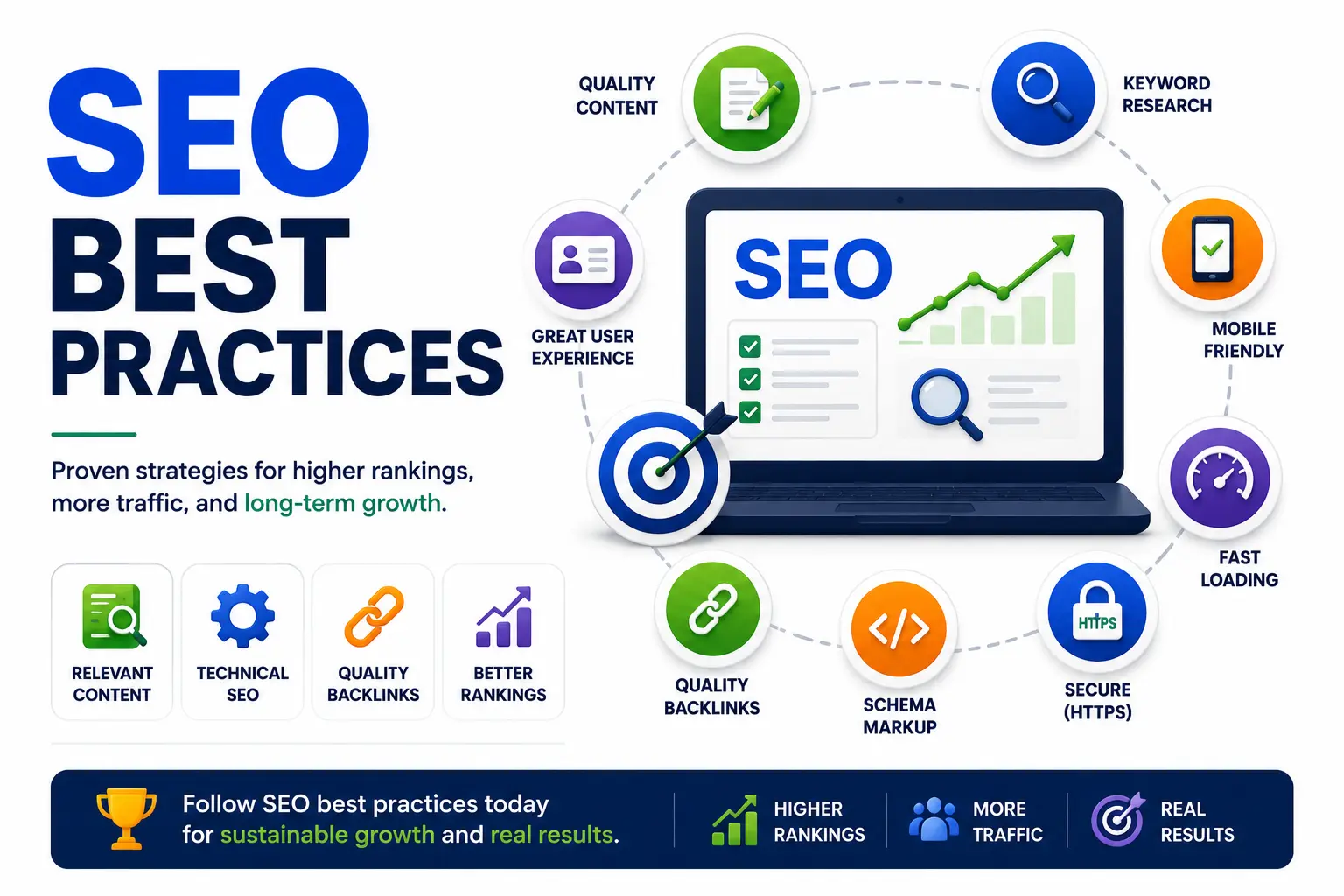
What Are SEO Best Practices, and Why Do They Keep Changing?
SEO best practices are the tactics search engines and AI systems consistently reward: technical accessibility, content that matches what people actually want, and credible signals that a page deserves to rank.
They keep getting rewritten because the surfaces they apply to keep multiplying. A decade ago, best practices meant ranking on one results page. Now the same fundamentals get evaluated by Google’s classic index, AI Overviews, and standalone tools like ChatGPT and Perplexity, each reading your page slightly differently.
Here’s what SEO best practices actually requires: the practices with the most consistent evidence behind them, condensed rather than padded, since I’ve written deeper guides on several of these already.
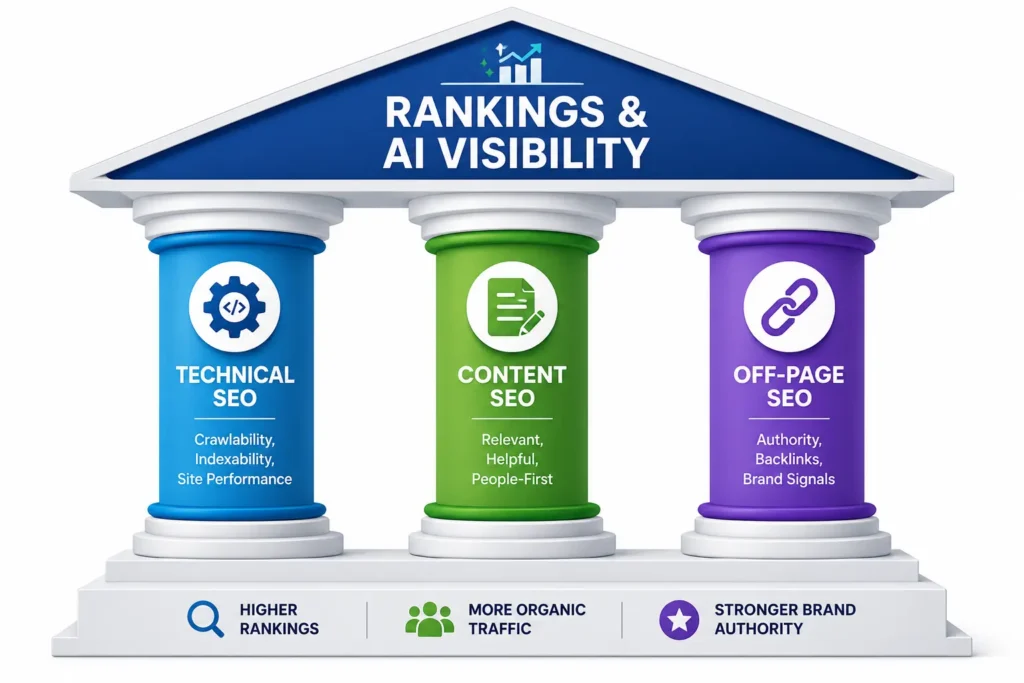
The Technical Best Practices That Still Matter
Technical health is the floor, not the ceiling. Nothing else on this list matters if search engines and AI crawlers can’t reliably access and parse your pages.
- Core Web Vitals. Aim for a Largest Contentful Paint under 2.5 seconds, an Interaction to Next Paint under 200 milliseconds, and a Cumulative Layout Shift under 0.1. These remain the clearest, most measurable page-experience signal available.
- HTTPS. A baseline ranking factor since 2014, and still a one-time fix if you haven’t done it.
- Mobile-first, crawlable pages. Google indexes the mobile version of your site by default, and content hidden behind unrendered JavaScript is content search engines and AI crawlers may never see.
- Clean site architecture. Every important page should sit a few clicks from your homepage, with no orphaned pages sitting outside your internal link structure entirely.
I’ve gone deeper on the page-speed side of this in my breakdown of what still matters above the fold, and on whether older frameworks like AMP are still worth the trade-off in a separate technical piece.
The Content Best Practices That Still Matter
Technical health gets you found. Content quality decides whether you deserve to stay.
- Match search intent first, keywords second. A perfectly optimized page targeting the wrong intent won’t rank, no matter how well it’s written. Check what’s actually ranking for a query before you write a word.
- Build topical authority, not isolated pages. A cluster of genuinely connected content on one subject, linked together clearly, consistently outperforms scattered one-off posts targeting the same broad topic.
- Demonstrate E-E-A-T. Experience, Expertise, Authoritativeness, and Trustworthiness aren’t a single ranking factor you switch on. Real author bios, cited sources, and content that shows genuine first-hand experience are what quality raters and algorithms are both increasingly trained to reward.
- Structure for extraction. Descriptive headings, short paragraphs that stand on their own, and a direct answer immediately after each heading make your content easier for both human skimmers and AI systems to pull from.
- Keep it current. Stale pages lose ground in both classic and AI search. A substantive update, not just a changed date, is what actually signals freshness.
If you’re still relying on old-style keyword research alone, I’d read my take on whether keyword research is dead before building your next content plan around it.
The Off-Page Best Practices That Still Matter
Off-page SEO, the authority signals that come from outside your own site, still has to be earned, and the mechanics of that haven’t changed even though the details have gotten more specific.
- Earn links, don’t manufacture them. A single relevant, editorial link still outweighs dozens of low-quality ones, and Google’s spam systems have only gotten better at telling the difference.
- Keep your anchor text natural. A profile leaning too heavily on exact-match phrasing reads as manipulation regardless of how good the linked content is.
- Track unlinked brand mentions too. A citation without a link still builds the kind of brand association AI systems increasingly draw on when deciding what to cite.
I’ve written full breakdowns of what actually makes a backlink valuable, the different types of backlinks worth pursuing, and how to get your anchor text ratio right, if you want the full link building detail behind this section.
Why “Just Follow the Checklist” Stopped Working in 2026
Here’s the part most best-practices guides skip entirely, and it’s the one worth sitting with.
Every checklist above is publicly available. Your competitors have the same one. When an entire industry optimizes against the same fixed list, the list stops being a differentiator and becomes table stakes, the price of entry, not the strategy itself.
Search veterans have been saying this plainly. In my experience, treating SEO as pure checklist execution misses the business-context thinking that actually separates winning strategies from adequate ones. The checklist tells you what to do. It never tells you what your specific business, audience, and competitive landscape actually need prioritized first.
That distinction matters more now because AI tools can execute a checklist for you in minutes. What AI can’t do is decide which of the thousand possible optimizations actually moves your specific business forward this quarter.

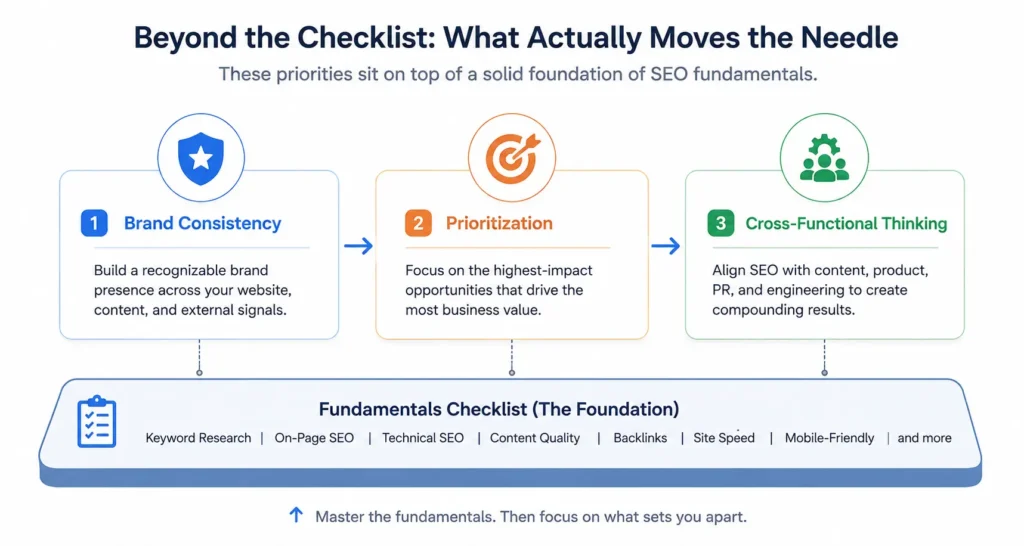
What Actually Moves the Needle Once the Basics Are Covered
Once your technical health, content quality, and link profile are solid, three things separate the sites that keep growing from the ones that plateau.
Brand consistency compounds. A name, product, and message referenced the same way across your site, your citations, and third-party mentions builds the kind of recognition both Google and AI systems reward. Inconsistent branding forces both to work harder to figure out who you even are.
Prioritization beats coverage. Trying to rank for everything spreads effort too thin to rank for anything well. The businesses gaining ground are picking a narrower set of topics and genuinely owning them, rather than publishing broadly and hoping volume compensates for depth.
Cross-functional thinking wins the moments that matter. SEO decisions made in isolation from product, PR, and customer experience keep missing opportunities that a coordinated approach would catch. A single credible mention from a well-placed PR pitch can outperform months of isolated content production.
None of this replaces the fundamentals. It’s what determines whether the fundamentals translate into actual growth once everyone else has them too.
Do SEO Best Practices Apply to AI Search and AEO the Same Way?
Mostly, yes, and that consistency is worth knowing before you build a separate strategy for it.
The technical, content, and authority practices above are largely what AI systems reward too, since they’re built on the same underlying signals: can the system access your content, does it clearly answer the question, and do independent sources back up what you’re claiming.
What shifts slightly is emphasis. Clear, extractable structure and demonstrable brand authority matter a bit more for AI citation than they historically did for classic rankings alone. I’ve covered the specific differences in what AEO actually requires if you want the deeper version of that comparison.
Frequently Asked Questions
What are the most important SEO best practices in 2026?
Technical health (Core Web Vitals, mobile-first indexing, crawlability), content that matches search intent and demonstrates E-E-A-T, and a natural, earned backlink profile remain the three pillars everything else builds on.
Do SEO best practices change every year?
The core fundamentals have stayed remarkably stable for years. What changes is the number of surfaces those fundamentals get evaluated on, now including AI Overviews and standalone AI tools alongside classic search.
Is following an SEO checklist enough to rank well?
It’s enough to reach a competent baseline, but not enough to outperform competitors running the same checklist. Real growth comes from prioritizing the specific practices your business and competitive landscape actually need first.
Do SEO best practices still matter if I’m optimizing for AI search?
Yes. The practices largely overlap, since both classic search and AI systems reward accessible, clearly structured, well-supported content. The emphasis shifts slightly toward extractable structure and brand authority.
How often should I revisit my SEO best practices checklist?
Quarterly for most sites is reasonable, though technical health should be monitored continuously. Treat the checklist as a baseline to maintain, not a project you finish once.
What’s the biggest SEO mistake businesses still make?
Of all the SEO mistakes I see, treating best practices as a one-time checklist rather than an ongoing habit is the costliest. Assuming that because a competitor is doing something, it’s automatically worth copying rather than checking if it fits their own specific situation accounts for more plateaued sites than any technical error I encounter.
Bottom Line
The technical, content, and authority fundamentals in this guide are genuinely settled, and skipping any of them will cap what everything else can achieve. But settled doesn’t mean sufficient.
Once you’ve covered the basics, the businesses pulling ahead are the ones prioritizing a narrower set of practices deliberately instead of chasing every item on every list, and building brand consistency that compounds across search and AI alike.