
30-Second
| Anchor text is the clickable, visible words inside a hyperlink. Google reads it as a relevance signal for whatever page it points to. There are seven recognized types: exact match, partial match, branded, naked URL, generic, LSI/semantic, and image alt text. For external backlinks, keep exact-match anchors under 5%. Branded should dominate, usually 30 to 50%. Internal links play by different rules. You control them, so keyword-rich anchors of 40 to 60% are normal and safe. Context matters more than the anchor itself. The sentence around a link, and whether the destination page delivers on what the anchor promises, carries real weight. If you run multilingual or international sites, anchor text needs its own per-language ratio. Treating every market like one profile is where most global sites quietly get this wrong. |
I still see the same mistake on client audits every month: someone read a “40% exact match is fine” tip from 2015 and never touched their link profile again. That number was already risky a decade ago. It’s worse now.
What Is Anchor Text?
Anchor text is the visible, clickable text inside a hyperlink. In HTML, it’s the content sitting between the opening and closing <a> tags.
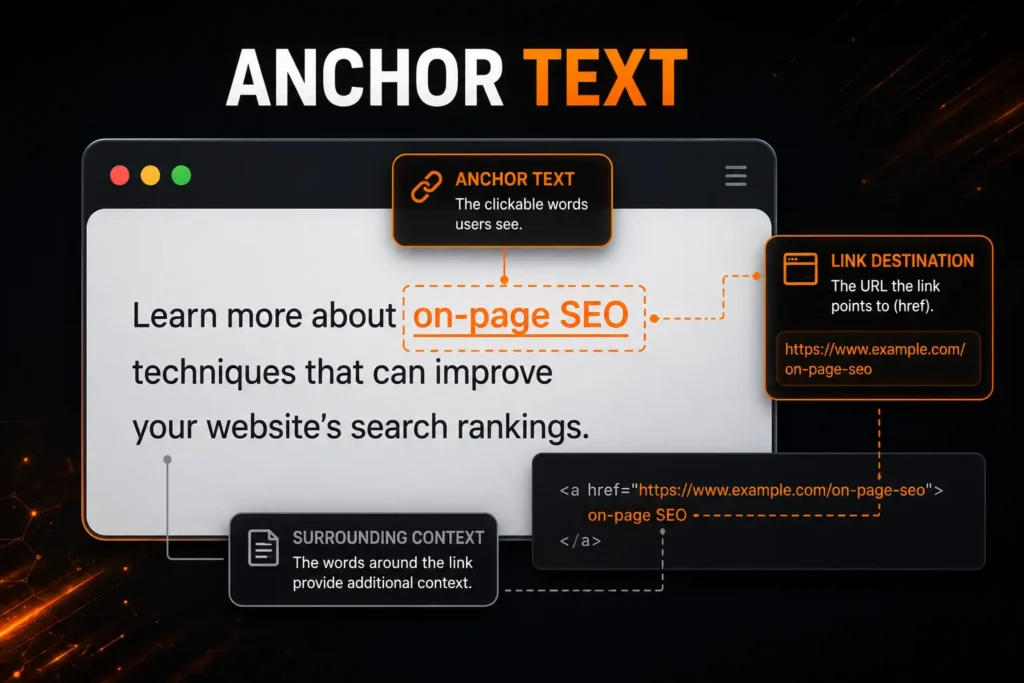
For a reader, it’s just the blue underlined words they click. For a search engine, it’s a label describing the page on the other end of that link.
If a link says “international SEO checklist,” that phrase tells Google, and the reader, exactly what to expect on the destination page. That’s the entire function it has always served, since before Google existed in its current form.
Why Does Anchor Text Still Matter for SEO in 2026?
Anchor text was one of the original signals behind Google’s PageRank algorithm in 1998, and it hasn’t gone away. What’s changed is how much weight it carries on its own.
It does two jobs today. First, relevance signaling: a page that consistently earns links with anchors like “keyword research” reinforces its topical association with that phrase. Second, trust evaluation: the mix of types across your link profile tells Google whether your links look natural or engineered.
That second job is where most sites get into trouble. A profile leaning too heavily on exact match phrasing reads as manipulation, and manipulation is exactly what Google’s Penguin system was built to catch.
Penguin launched in 2012 and got folded into Google’s core algorithm in 2016, meaning it now runs continuously rather than as a periodic update. That shift matters practically.
A manipulated link profile doesn’t wait months for the next Penguin refresh to get caught. The suppression can happen close to real time, which is part of why a quarterly audit habit beats a “fix it after something breaks” approach.
What Are the Main Types of Anchor Text?
Every link falls into one of seven types, and each sends a different signal.
| Type | Example | What It Signals |
| Exact match anchor | “international SEO agency” | Strong relevance, high risk if overused |
| Partial match anchor | “guide to international SEO strategy” | Relevance with natural variation |
| Branded anchor | “RANKMETRY” | Trust and entity recognition |
| Naked URL anchor | “rankmetry.com/” | Natural citation, no keyword signal |
| Generic anchor | “click here,” “read more” | Zero relevance, but reads as human |
| LSI anchor / semantic | “cross-border search visibility” | Topical relevance without the exact phrase |
| Image alt text | alt=“anchor text ratio chart” | Functions as the anchor for a linked image |
A single exact match anchor from a strong, relevant source is fine. A pattern of a dozen pointing at the same page is the thing that gets flagged.
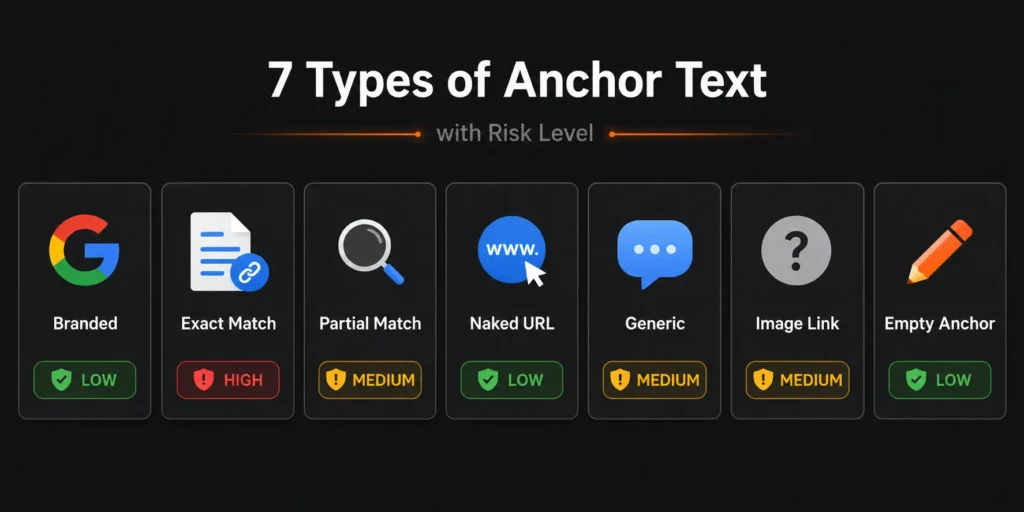
The most overlooked of these types is image alt text. If you’re linking an image, whatever you put in the alt attribute functions the same way, and most sites never fill it in with anything useful.
Getting familiar with these categories matters more than memorizing any single ratio, because the type you choose is what the ratio actually measures.
What Anchor Text Ratio Should You Actually Target?
There’s no single number that fits every site, but there is a defensible range, and it splits sharply between internal and external links.
For external backlinks, natural profiles tend to look like this:
| Anchor Type | Target Range | Reasoning |
| Branded | 30-50% | Dominant in every natural, editorially earned profile |
| Partial match anchor | 15-25% | Relevance without exact-match risk |
| Generic | 10-20% | Signals human, editorial linking behavior |
| Naked URL anchor | 5-15% | Common in citations and casual mentions |
| Exact match anchor | Under 5% | Useful in small doses, dangerous at scale |
Those ranges are a starting point, not a target to hit exactly. The more reliable benchmark is your actual competitors. Pull the profiles of the top three organic results for your target keyword, average their distribution, and use that as your real target instead of a generic table from a blog post.
How Is Internal Anchor Text Different From External Anchor Text?
This is the distinction most guidance on this topic skips, and it changes the advice completely.
External backlinks are links other sites choose to give you. You have limited influence over the anchor an editor picks, and Google expects that unpredictability, which is exactly why a heavy exact-match pattern looks suspicious there.
Internal links are different. You control every word of the anchor, every time. Google knows this, and there’s no meaningful penalty for using clear, keyword-rich anchors on your own site.
| Anchor Type | Internal Target | External Target |
| Keyword-rich (exact or partial) | 40-60% | Under 30% combined |
| Descriptive / LSI | 25-35% | Varies |
| Generic | 10-20% | 10-20% |
| Branded | 5-10% | 30-50% |
If you link to the same page from three different posts, vary the phrasing each time. “International SEO,” “international SEO strategy,” and “how international SEO works” all point to one page while reinforcing different angles of it.
What Anchor Text Mistakes Actually Trigger a Penalty?
A handful of patterns keep showing up in the sites that lose rankings, and most best practices here boil down to avoiding these five.
- Exact-match stacking. One or two exact match anchors on a page is normal. Fifteen or more pointing at the same target from similar sources is the clearest manipulation signal Google Penguin looks for.
- “Click here” on important internal links. Generic anchors are fine in small doses, but using them on links to your most important pages wastes a free relevance signal you already control.
- Identical anchors everywhere. Linking to one page with the exact same phrase from every post you publish reads as automated, not editorial.
- Anchor-context mismatch. A perfectly chosen anchor sitting in a sentence that never actually introduces the topic fails what Google increasingly treats as a coherence check. Write the sentence first. Pick the anchor to fit it, not the other way around.
- Velocity spikes. Fifty new partial match anchors appearing in a single week, especially from low-quality sources, looks manufactured regardless of how the anchors themselves are worded.
Any one of these on its own rarely triggers a penalty. Stack two or three together and Google Penguin has exactly the pattern it was built to catch.
How Do You Run an Anchor Text Audit and Fix an Over-Optimized Profile?
If you suspect your profile is already skewed, run this audit sequence rather than guessing.
- Export your full profile. Pull this from your backlink tool of choice or Google Search Console’s link reports.
- Categorize every entry. Sort them into branded, exact match, partial match, generic, naked URL, and LSI buckets.
- Calculate your current ratios. Divide each category’s count by your total link count to get a real percentage breakdown, not a guess based on what feels common.
- Flag the danger zones. Exact match phrasing above 10% on a single page, or above 5% site-wide, needs attention now, not eventually.
- Check page-to-anchor alignment. Confirm the links on your highest-authority pages actually point where you want that authority routed, not scattered across low-priority content.
- Build offset links if needed. Add new branded, generic, and naked-URL links to dilute an over-optimized ratio, rather than jumping straight to disavowing anything.
- Re-check quarterly. A one-time cleanup drifts back toward imbalance the moment a new campaign starts, so treat this as a recurring habit, not a single fix.
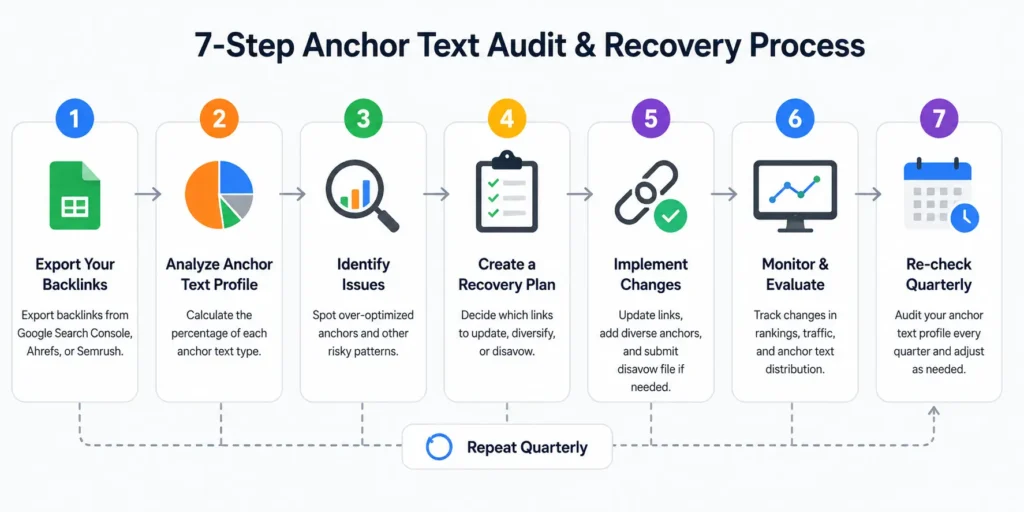
Recovery isn’t instant. Expect rankings to start responding somewhere between six and twelve weeks after the profile normalizes, not immediately after you make the change.
Does Anchor Text Still Matter for Multilingual and International SEO?
This is the part most guides on the topic skip entirely, and it’s the mistake I see most often on international sites.
Treating your anchor profile as one global number is the error. A site running English, Spanish, and Arabic versions of the same content needs its ratio evaluated per language, not as one blended average, because each language’s editorial link behavior looks different on its own.
A few specifics that matter here:
- Don’t translate exact-match anchors literally. “International SEO agency” translated word-for-word into another language often reads as unnatural to native speakers, which defeats the entire purpose of a natural-sounding anchor.
- hreflang doesn’t fix this on its own. Correct hreflang tags tell Google which page serves which language. They do nothing to correct a profile that’s over-optimized in one language and thin in another.
- Branded anchors travel better than exact match. Your brand name usually doesn’t need translation, which makes it the safest anchor type to lean on across every market you operate in.
- Local link sources produce naturally different ratios. A backlink from a Spanish-language industry publication will phrase your anchor differently than an English one would, and that’s exactly the natural variation Google expects to see.
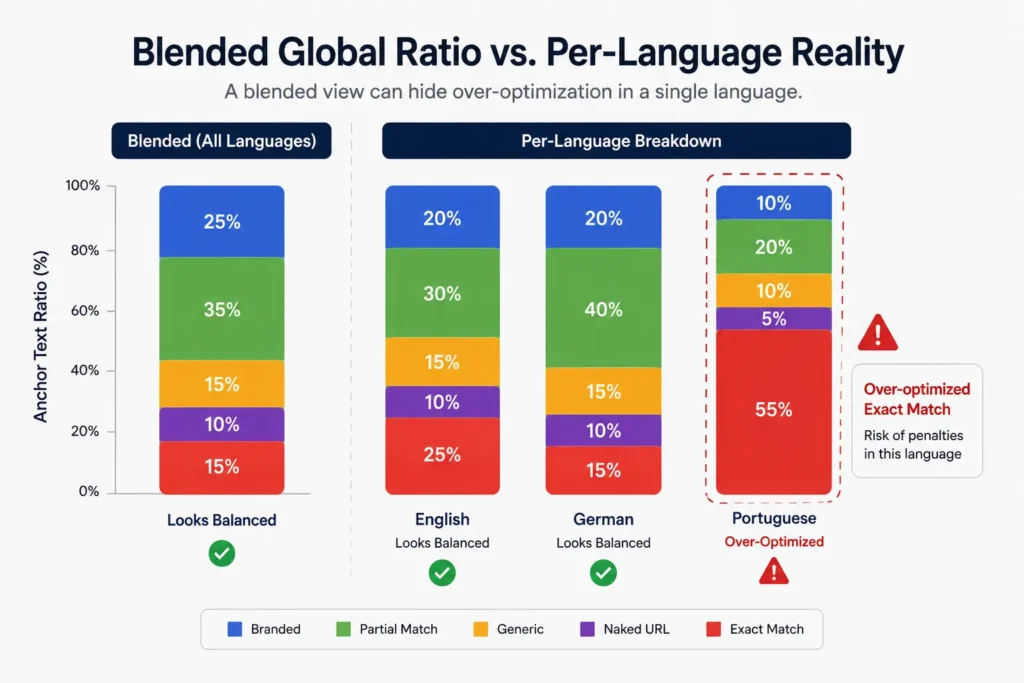
Here’s a concrete version of the problem: a SaaS site with English, German, and Portuguese versions of the same landing page might show a perfectly healthy 35% branded ratio overall.
Broken out by language, the English links could be clean, the German links fine, and the Portuguese links sitting at 22% exact match because a single outreach campaign only ran in that market. The blended number hides the risk entirely.
What Tools Actually Help With This?
You don’t need an expensive stack to do this properly. Google Search Console shows internal link data for free. Any paid backlink tool, Ahrefs, Semrush, or similar, will export your full external profile with type breakdowns. Screaming Frog handles a full internal audit across every page on a mid-sized site without a paid backlink subscription at all.
The tool matters less than actually running the audit on a schedule. A free tool used quarterly beats an expensive one that only gets opened after a ranking drop.
Does Anchor Text Matter for AI Search and AEO?
A little, but indirectly. As AI Overviews and chatbot answers increasingly cite web pages, the same signal that tells Google what a page is about also helps AI systems classify topical authority.
Content that earns natural, descriptively worded anchors because it’s genuinely useful tends to build the kind of authority AI systems recognize too. That overlaps heavily with what I’ve written about in what AEO actually requires: clean structure, real authority, and content that delivers on what it claims.
The strategy doesn’t split into two different playbooks. Earn links because the content deserves them, and let the words you use reflect how people actually describe your work.
Frequently Asked Questions
What is the ideal anchor text ratio?
For external backlinks, aim for roughly 30-50% branded, 15-25% partial match, 10-20% generic, 5-15% naked URL, and under 5% exact match. Internal links can run 40-60% keyword-rich, since you control them directly. Knowing the full set of anchor text types before setting any ratio matters more than the exact numbers you land on.
Does exact-match phrasing still help rankings?
In small, natural doses, yes. A pattern of many exact-match anchors pointing at one page is what causes problems, not the occasional well-placed one.
Is anchor text still a ranking factor in 2026?
Yes, though it works alongside surrounding context rather than in isolation. The sentence around a link and whether the destination page delivers on the anchor’s promise both affect how much weight that anchor carries.
Can bad anchor text get my site penalized?
Yes. An anchor text penalty usually follows an over-optimized, heavily exact-match pattern, and it’s one of the clearest signals Google’s Penguin system targets. It can suppress rankings or trigger a manual action.
How often should I audit my profile?
Quarterly for most sites, monthly if you’re actively building links or recovering from a known over-optimization issue. This is one of the anchor text best practices that’s easy to know and easy to skip.
Should multilingual sites use the same anchor text ratio in every language?
No. Evaluate each language’s anchor profile separately. A blended global average can hide a single language that’s badly over-optimized while the others look fine.
Bottom Line
Anchor text hasn’t stopped mattering, it’s just stopped working as a standalone lever. What decides whether an anchor helps or hurts you now is the mix around it: branded dominant, exact match rare, and every link sitting inside a sentence that actually earns it.
Audit what you have before you build anything new. If you’re running multiple languages, do that audit per language, not once for the whole site.