
| 30-Second Answer E-E-A-T stands for Experience, Expertise, Authoritativeness, and Trustworthiness, the framework Google’s human Quality Raters use to judge content quality. It’s not a direct ranking factor. There’s no E-E-A-T score. It’s a quality mindset that Google’s automated ranking systems are trained to approximate. Trust is the foundation. Google is explicit that content can show experience, expertise, and authority and still be rated poorly if it isn’t trustworthy. A large-scale 2026 academic study found AI Overviews cite domains that are measurably more credible than the organic results shown alongside them, and nearly 30% of AIO-cited domains don’t appear in those organic results at all, a distinct selection mechanism worth understanding. Full breakdown, how to build it, and how AI platforms judge it differently, below. |
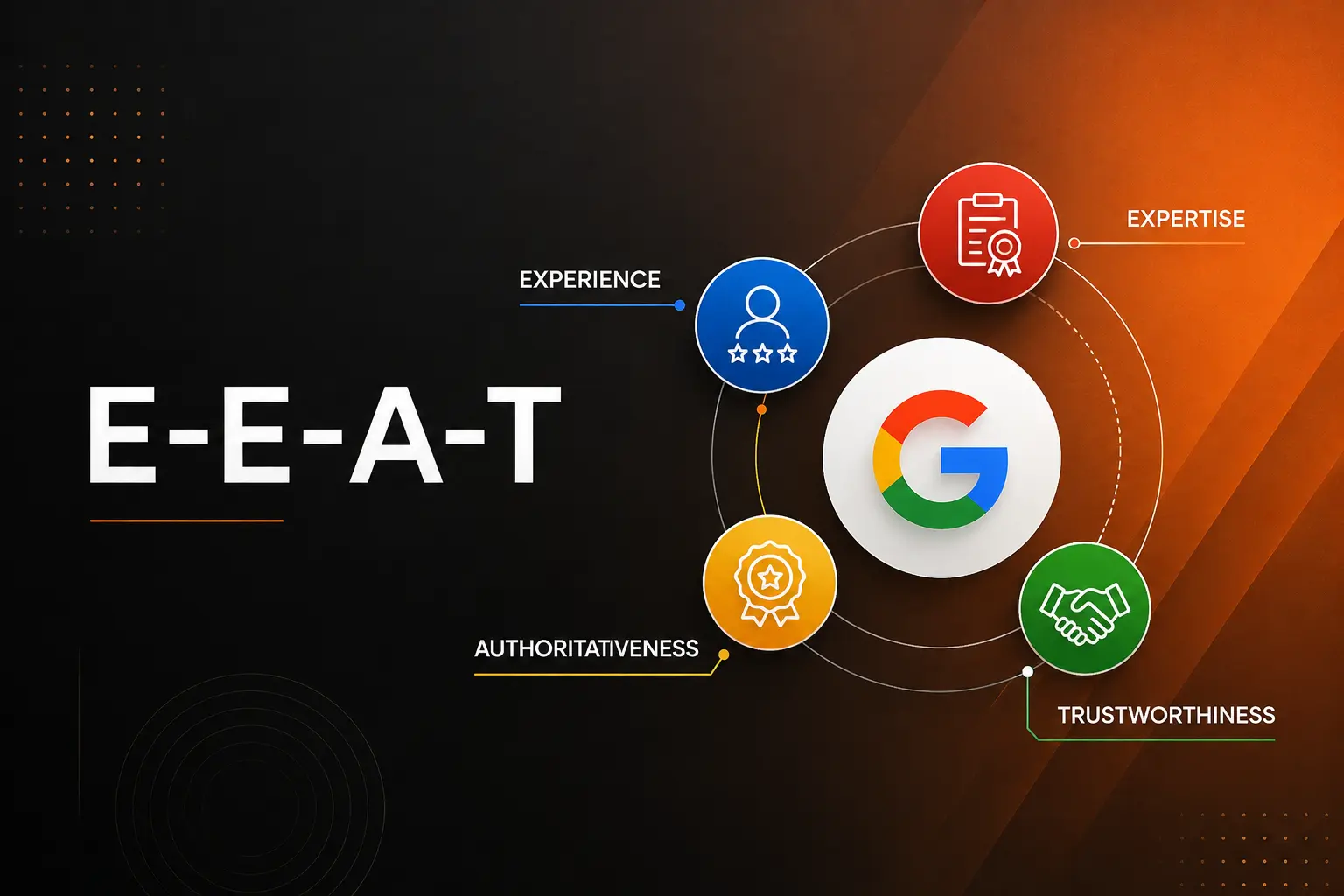
Google E-E-A-T stands for Experience, Expertise, Authoritativeness, and Trustworthiness, the framework Google’s human Quality Raters use to judge whether content is credible, accurate, and worth showing to searchers.
Google introduced the concept as E-A-T in its Quality Rater Guidelines back in 2014, then added the extra Experience in 2022 to place more weight on genuine, firsthand familiarity with a topic.
We’d call this the most misunderstood concept in SEO, and we mean that as a genuine warning, not a throwaway line. People treat it like a checklist or a score you can hit 100% on. It isn’t. There’s no E-E-A-T meter, no single fix, and no shortcut, it’s closer to a set of habits that compound over months, not a box you tick once.
What Does E-E-A-T Stand For?
| Element | What Google is really asking |
|---|---|
| Experience | Does the creator have genuine, firsthand familiarity with this topic, not just knowledge about it? |
| Expertise | Does the creator have the formal or informal skill and knowledge the subject requires? |
| Authoritativeness | Is this creator or site recognized as a go-to source by others in the field, not just by itself? |
| Trustworthiness | Is the content accurate, honest, safe, and reliable, and is the site itself secure and transparent? |
Trust sits at the center of the other three. Google has been explicit that a page can show real experience, expertise, and authority and still receive a poor rating if it isn’t trustworthy, dishonest or unsafe content doesn’t get a pass just because the author is genuinely knowledgeable.
Is E-E-A-T a Ranking Factor?
No, not in the way people usually mean that phrase. E-E-A-T comes from Google’s Quality Rater Guidelines, used by human evaluators to benchmark search quality, not to directly move any individual page up or down. Google has said this plainly: raters assess content quality based on expertise, authoritativeness, and trustworthiness, and those ratings don’t directly impact ranking, but they help Google benchmark whether its automated systems are actually surfacing good content.
In practice, that distinction matters less than it sounds. Google’s automated ranking systems are trained using rater feedback grounded in E-E-A-T principles, so while there’s no direct “E-E-A-T score” an algorithm checks, sites that genuinely demonstrate these qualities tend to perform better because the underlying signals, real backlinks, genuine reviews, clear authorship, consistent accuracy, are the same ones the algorithm already rewards for other reasons.
Why E-E-A-T Matters More in the AI Era
A large-scale academic study published in May 2026, tracking 55,393 trending search queries over a 40-day window, found that domains cited inside Google’s AI Overviews are measurably more credible than the organic results displayed alongside them, but nearly 30% of AIO-cited domains don’t appear in those first-page organic results at all. That’s a genuinely important nuance: AI Overviews appear to run a source-selection process distinct from traditional ranking, one that leans even more heavily on credibility signals than organic search already does.
This lines up with what we found in our own on-page SEO research: pages cited inside AI Overviews still earn meaningfully more clicks than uncited pages on the same results, even after a year of falling click-through rates industry-wide. Being trustworthy enough to cite is now doing double duty, it helps you rank, and it’s a separate, additional gate you have to clear to get cited at all.
How to Build and Demonstrate E-E-A-T
1. Show real, named authorship
Every piece of content should have a visible author with a real bio, credentials, and ideally a dedicated author page. Publishing under “admin” or leaving posts unattributed is one of the fastest ways to signal low E-E-A-T, both to human raters and to AI systems trying to verify who’s behind a claim.
2. Demonstrate genuine experience
Use your own photos, your own testing, your own firsthand account wherever the topic calls for it. A product review written by someone who actually used the product reads differently than one assembled from other people’s reviews, and increasingly, AI systems pull from user-generated platforms like Reddit and Quora specifically because that content demonstrates real experience stock content and secondhand summaries can’t fake.
3. Build off-page validation
E-E-A-T isn’t just what you say about yourself, it’s what others say about you. Backlinks from relevant sites, genuine reviews, press mentions, and community discussion all serve as third-party confirmation. This is essentially off-page SEO doing double duty: the same signals that build domain authority for ranking also build the external validation E-E-A-T depends on.
4. Strengthen your entity signals
Google and AI systems increasingly evaluate brands as recognizable entities, connected to specific people, topics, and organizations, rather than just as a collection of pages. Consistent naming, schema markup, and cross-linking between your team, your content, and your topics all reinforce this. We cover the mechanics in more depth in our technical SEO guide’s entity identity section.
5. Get the trust basics right
HTTPS, a real About page, visible contact information, and standard policy pages (privacy, terms, returns) are table stakes. None of them individually impress anyone, but their absence is a red flag that undermines everything else you’re trying to demonstrate. Reviews matter here too, especially for local SEO, where trust signals are often the deciding factor between two otherwise similar businesses.
6. Cite your sources
Link to where your data, statistics, and claims actually come from. Vague, unsourced claims read as suspicious to both human raters and AI systems trying to verify accuracy before citing you. This is also, not coincidentally, one of the SEO mistakes we see most often when brands lean too heavily on scaled, unoriginal AI content instead of genuine, sourced expertise.
7. Keep content updated
Stale content signals fading authority. Review your highest-value pages at least annually, ideally every six months, update anything that’s aged out, and show the last-updated date clearly. Authorities on a subject don’t let their information go quietly out of date, and neither should you.
How Google and AI Platforms Evaluate E-E-A-T Differently
| Points | Google Search | AI Platforms (ChatGPT, Perplexity, Gemini) |
|---|---|---|
| Signal accumulation | Cumulative, built over months or years of backlinks and reputation | Can weigh recent sentiment and mentions more immediately |
| What it produces | A ranked list; users decide who to trust | A synthesized answer; the platform decides who to cite and how to frame them |
| UGC weighting | Indexes it as one input among many | Often pulls directly from Reddit, Quora, and reviews to gauge real experience |
| Risk if ignored | Lower rankings, gradual traffic decline | Exclusion from citation entirely, or being framed unfavorably in the synthesized answer |
That last row matters more than it might seem. Google shows a ranked list and lets the searcher weigh your credibility for themselves.
AI platforms synthesize a single answer and decide the framing for you, being described as “the industry standard” versus “a budget option” carries real weight, and it’s shaped entirely by the same E-E-A-T signals covered above.
What Hurts E-E-A-T
A few patterns show up constantly in low-quality pages, and any one of them can undercut an otherwise solid page:
- Thin or unoriginal content that just rehashes what’s already ranking, with no new information, data, or perspective
- Unclear or missing authorship, no bio, no credentials, content attributed to “admin” or nobody at all
- No off-page validation, if nobody links to, mentions, or reviews you, it’s hard for Google or an AI system to verify you’re credible
- Exaggerated or misleading titles that overpromise relative to what the content actually delivers
- Excessive ads or distracting elements that overwhelm the main content
YMYL: When E-E-A-T Matters Most
YMYL stands for Your Money or Your Life, Google’s category for topics that could seriously affect someone’s health, financial stability, safety, or legal standing: medical advice, financial guidance, legal information, and similarly high-stakes subjects. E-E-A-T applies to every page, but Google holds YMYL content to a meaningfully higher standard,
since inaccurate information here can cause real harm, not just a bad customer experience. If you operate in a YMYL space, expect to need more visible credentials, more rigorous sourcing, and more explicit trust signals than a typical site would.
| The One-Sentence Version E-E-A-T isn’t a ranking factor or a score, it’s a quality framework Google’s raters use and its algorithms approximate. Trust is the foundation; experience, expertise, and authority don’t matter without it. Real named authorship, genuine experience, and off-page validation build it faster than any on-page trick. AI platforms weigh recent sentiment more heavily than Google and decide your framing, not just your visibility. YMYL topics (health, finance, legal, safety) need meaningfully stronger E-E-A-T signals than everyday content. |
E-E-A-T FAQs
Can you fake E-E-A-T signals?
Not reliably. E-E-A-T depends heavily on what other people and sites say about you, reviews, mentions, backlinks, which you can’t fabricate convincingly at scale. You can claim expertise on your own About page, but it only counts as a real signal once it’s externally verifiable.
Is there a tool that measures E-E-A-T?
No single tool gives you an E-E-A-T score, because it isn’t a measurable ranking factor. Most SEO platforms estimate credibility using proxy signals like backlinks, author visibility, and mentions, which gives a reasonable directional read even without an official score.
Does E-E-A-T apply to every page on a site?
Yes, but not equally. Google evaluates E-E-A-T at the page and author level, not just the domain level, and the bar is meaningfully higher for YMYL content (health, finance, legal, safety) than for lower-stakes topics.
How long does it take to improve E-E-A-T?
There’s no quick fix. Because trust signals like backlinks, reviews, and reputation build gradually and depend on other people acting, expect months of consistent effort rather than a fast turnaround from a single round of changes.
What’s the difference between E-A-T and E-E-A-T?
E-A-T (Expertise, Authoritativeness, Trustworthiness) was Google’s original 2014 framework. Google added the extra Experience in December 2022, placing more explicit weight on genuine, firsthand familiarity with a topic, not just formal knowledge about it.
Does good E-E-A-T guarantee better rankings?
No. It removes a barrier and aligns your content with what Google’s systems are trained to reward, but it isn’t a direct lever you pull for guaranteed movement. Strong E-E-A-T paired with weak on-page or technical fundamentals still underperforms.
The Bottom Line
E-E-A-T isn’t a checklist you complete once, it’s a set of habits: real named authorship, genuine firsthand experience, off-page validation you can’t fake, and content that stays accurate over time. Trust is the foundation everything else sits on, and in the AI era, it’s doing double work, shaping both whether you rank and whether you get cited at all.