
30-Second
| Agentic search is when an AI agent (ChatGPT’s agent mode, Perplexity Comet, Gemini, Claude) searches, compares, and sometimes acts on your behalf instead of handing you a list of links. Agentic web traffic grew 1,300% in the first eight months of 2025, and Google’s SAGE research found AI agents take an average of 4.9 steps per query before answering. Four things decide whether an agent finds and recommends you: Discovery, Clarity, Authority, and Trust. Skip one and you get filtered out before a human ever sees your brand. Agentic Search Optimization (ASO) is the emerging discipline for this. It builds on SEO and AEO but adds machine-actionable pages, “suitability” content, and consistent claims across third-party sources. I’d start by fixing whatever a human would trip on first too: unclear entity data, thin proof, or a contact form an AI can’t fill out. |
I’ve spent the last few months watching AI agents shop, book, and compare on behalf of real users. I keep landing on the same conclusion. This isn’t a future problem. Some version of it is already deciding whether your brand gets a fair look.
What Is Agentic Search?
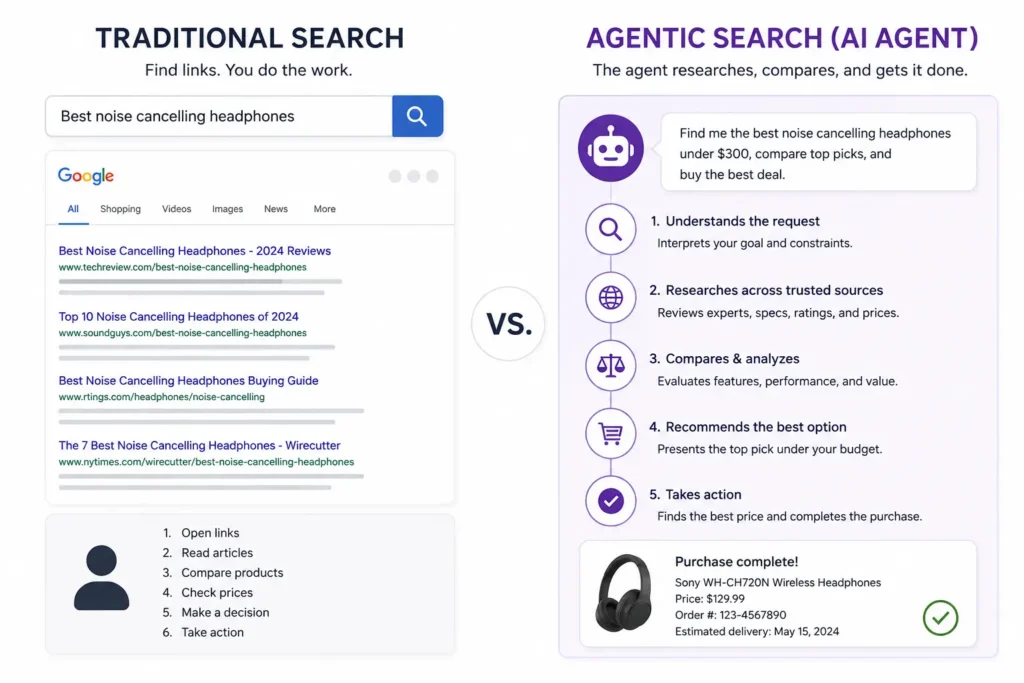
Agentic search is when an AI system doesn’t just answer a question. It plans a sequence of steps, pulls information from multiple sources, and sometimes completes an action, like a booking or a purchase, on the user’s behalf.
A regular search engine hands you links. An agent decides what to do with them.
Think of the difference like hiring a research assistant instead of using a card catalog. A card catalog points you to where the book might be. A research assistant reads the book, checks two others against it, and hands you a summary you can act on. That’s the leap from keyword search to this.
Some vendors call it agentic AI search instead. Same idea, different label. You’ll also see the underlying system called an LLM agent, since the reasoning driving each step is usually a large language model deciding what to do next.
The core entity here is the AI agent, an autonomous AI system that plans multi-step tasks, uses tools, and keeps memory across a session. Conductor’s Chief Product Officer, Wei Zheng, frames the bar this way: agentic behavior means an AI model taking actions on a human’s behalf, following multi-step instructions, keeping memory and context, and calling tools.
That’s narrower than “any tool that uses AI,” and it’s worth holding onto. A lot of vendor content blurs the two.
For concrete agentic search examples, picture an agent booking a venue, comparing three SaaS vendors against a budget, or filling a cart without the user clicking a single product page.
How Is Agentic Search Different From AI Search and Traditional SEO?
The short answer: traditional SEO gets you found by a person. Agentic search adds a layer where a machine evaluates you first, often before any human sees your brand at all.
A quick agentic search vs AI search distinction helps here. Generative search (the AI Overview or chatbot answer you’re used to seeing) mostly summarizes. It doesn’t act.
AI search is the broader category, covering how AI shapes the way people and machines find, compare, and decide. Agentic search is a subset of that: the AI retrieves information, evaluates options, and increasingly takes action on a user’s behalf.
Every one of these is AI search. Not every AI search is agentic.
| Dimension | Traditional SEO | AI Search / AEO | Agentic Search |
| Who evaluates you | A person, on your site | An LLM, summarizing for a person | An AI agent, acting for a person |
| What wins | Rankings, backlinks, on-page relevance | Citable passages, structured answers | Consistent, verifiable claims across sources |
| Where the decision happens | On your website | Inside the AI answer | Before the person even sees a link |
| What breaks you | Weak technical SEO | Vague, unstructured content | Contradictory claims or a form the agent can’t fill |
Nothing here replaces the AEO work I’ve written about before. If you haven’t read my breakdown of AEO vs SEO, start there, because this sits one layer on top of it.
The tools doing this work, AI search agents like ChatGPT’s agent mode or Perplexity Comet, are becoming everyday browsing companions in 2026, not niche experiments.
How Does Agentic Search Work?
If you’re trying to figure out how agentic search work in practice, it comes down to three stages. An AI agent retrieves candidates, evaluates them against the user’s real requirements, and, when it can, takes action.
- Retrieval. The agent runs its own searches, often more than one, and builds a candidate set. This is traditional GEO and SEO territory. Agents fan a single user command out into an average of 6.3 sub-queries before they even start comparing options, according to a First Page Sage study of 2,417 agent commands run between March and June 2026.
- Evaluation. The agent screens candidates against hard requirements first, then scores the survivors on weighted criteria. That same study found agents picked the AI platform’s top-ranked recommendation only 44.6% of the time. In 38.2% of cases, they chose an option ranked fourth or lower because it fit the user’s stated needs better.
- Action. If the task calls for it, the agent books, buys, or submits a form. Machine-actionable pages, meaning a product feed, an API, or a clean form, saw a 78.3% completion rate in the study. Pages an agent couldn’t parse completed at just 9.6%.
Here’s the part that surprised me: a verification layer runs underneath all three stages, continuously. Agents in the study cross-checked brand claims against an average of 3.4 independent sources.
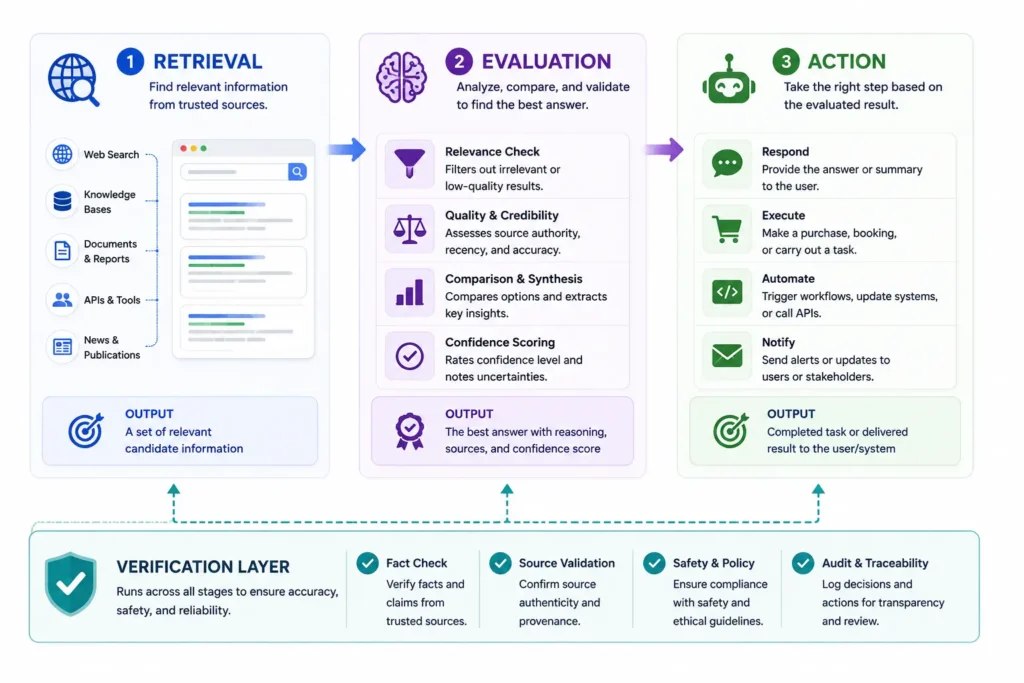
They dropped a candidate in 27.9% of evaluations when the site’s claims didn’t match what third parties said. If your website says one thing and your reviews say another, you’re the one who loses the comparison, not the agent.
What Determines Whether an AI Agent Recommends Your Brand?
Four layers decide it, and they build on each other.
Discovery gets you found. Clarity gets you understood.
Authority gets you considered. Trust gets you chosen.
Together, they add up to one outcome worth tracking: your brand visibility across every AI platform your buyers use.
- Discovery: can the agent find you at all? This is page-level relevance, structured data, and basic technical health. Miss this and nothing else matters.
- Clarity: does the agent understand what you actually offer, and do your site, reviews, and third-party listings agree with each other? Contradictions confuse the evaluation.
- Authority: do independent sources, review platforms, industry publications, back up what you claim about yourself? Self-praise on your own homepage doesn’t count for much here.
- Trust: at the point of action, would the agent hand you the transaction? This is the highest bar, and the one most brands haven’t touched yet.
I’d treat these as a checklist you run in order, not a menu you pick from. A brand with strong Authority but a confusing product page still loses comparisons it should win, because Clarity was never fixed.
How Do You Optimize for Agentic Search?
If you searched how to optimize for agentic search hoping for a shortcut, I don’t have one. What I have is a sequence.
Fix the fundamentals first, then layer on the pieces that are specific to agents. Here’s the order I use with clients.
- Audit your entity data. Search your brand name plus your category in ChatGPT and Perplexity. If the agent can’t summarize what you do in one accurate sentence, that’s your first fix, not your last.
- Close the contradiction gaps. Pull your Google Business Profile, your top three review platforms, and your own site copy side by side. Any place they disagree on price, hours, or scope is a place an agent will flag you.
- Build suitability content. Vendors with dedicated pages declaring exactly who a product is right for, and who it isn’t, were selected 2.7 times more often than equally ranked vendors without that content, per the First Page Sage study. A page that says “not a fit when…” reads as more credible to an agent than one that claims to suit everyone.
- Make your conversion path machine-readable. A product feed for ecommerce, a ChatGPT agent-navigable API for SaaS, or a form with logically labeled fields for services. If an agent can’t complete the action, it moves to a competitor that can.
- Ship schema and structured data. Article, FAQPage, Organization, and Product schema give agents a direct, unambiguous signal about what your page claims to be. This is cheap to do and still gets skipped constantly.
- Keep a recurring check. Run the brand-plus-category search again every few weeks. Beliefs about your brand shift as new content gets indexed, and you want to catch a slide before it costs you a comparison.
None of this replaces core SEO. If your technical foundation is shaky, read my what is SEO primer first, since Discovery depends on it entirely.
I’d also skip fancy tactics until your keyword strategy reflects how people, and agents, actually phrase requests in 2026.
Platform by Platform: How Different AI Agents Behave
Engine behavior changes fast and isn’t always documented officially. Treat this as a snapshot from August 2026, not a permanent rulebook.
I’ve compared the major assistants in more depth in a separate breakdown, if you want the full picture.
| Agent | Tends to favor | Worth knowing |
| ChatGPT agent mode | Third-party verified claims, recent citations | Navigates sites and fills forms, with user approval for payment |
| Perplexity Comet | Wide retrieval, willing to pick options outside the top three | Strongest for research-heavy, multi-source comparisons |
| Gemini | Structured data feeds, knowledge graph strength | Most likely to abandon a task if the conversion page isn’t machine-actionable |
| Claude (browsing and computer use) | Thorough, multi-criteria evaluation | Applied the most distinct suitability criteria per task in the First Page Sage study, an average of 7.2 |
You can check whether AI platforms are already crawling your site by looking at server logs for AI-specific user agents like GPTBot, ClaudeBot, and PerplexityBot. If none show up, you’re not being evaluated yet, which is either a relief or a warning depending on how big your category is.
Is Agentic Search the Same as Agentic SEO or ASO?
No, and the distinction matters more than it sounds like it should.
Agentic SEO is a workflow discipline: using AI agents internally to do keyword research, content audits, and technical fixes faster. The search side is the opposite direction: AI agents evaluating your brand on a user’s behalf.
Agentic Search Optimization (ASO) is what you do in response to that second thing.
I covered the full breakdown between the related disciplines in my AEO vs SEO guide, and the short version holds here too.
These aren’t competing strategies, they’re layers.
SEO is the foundation. AEO extends it to answer engines, and ASO extends it further, into brand accuracy and machine-actionable transactions.
Honestly, I don’t think ASO earns its own budget line for most small and mid-sized brands yet. It’s real, but for now it’s mostly the same fundamentals with a sharper checklist on top.
Frequently Asked Questions
What is agentic search in simple terms?
Agentic search is an AI agent doing multi-step research and sometimes taking action on your behalf, instead of just returning a list of links. It plans, searches, compares sources, and can complete a task like a booking or a purchase.
How is agentic search different from AI Overviews or ChatGPT answers?
AI Overviews and standard chatbot answers are largely reactive. They respond to one prompt with a summary. Agentic search is proactive: the system breaks a goal into sub-tasks, researches each one, and can act on the combined result.
Do I need to change my SEO strategy for agentic search?
Not entirely. Structured content, entity clarity, and technical health still matter, arguably more. What changes is the emphasis. You’re now optimizing for a machine evaluator as much as a human reader.
How do I know if AI agents are already looking at my site?
Check your server logs for AI-specific crawlers like GPTBot, ClaudeBot, and PerplexityBot. If they’re showing up regularly, agents are already pulling your content into their research.
What’s the biggest risk of agentic search for small brands?
Getting filtered out before a human ever sees you. Agents cross-check your claims against reviews and third-party sources you don’t control, so inconsistent or outdated information can quietly remove you from consideration.
Is agentic search only relevant for ecommerce?
No. The First Page Sage study behind this guide covered ecommerce, B2B software signups, travel, professional services, and healthcare. Any category where an agent might research or transact on a user’s behalf is in scope.
Bottom Line
Agentic search isn’t a rebrand of SEO or AEO. It’s a new evaluator sitting between your content and the person who might buy from you.
The work that gets you found by that evaluator, clean entity data, consistent claims across sources, and a conversion path a machine can actually complete, is work most brands haven’t started.
I’d fix Discovery and Clarity before touching anything agent-specific. Get the fundamentals in shape, then build the suitability content and machine-actionable pages on top. If you want a second set of eyes on where your brand currently stands, that’s the first thing I check in an AEO audit.