
30-Second
- A backlink is a hyperlink from one website to yours. Search engines read it as a vote of confidence in your content.
- Not all backlinks are equal. Relevance, source authority, and placement inside the actual content matter more than raw count.
- There’s no universal number. A local service business might need a dozen strong local backlinks. A competitive SaaS keyword might need fifty or more from real industry sites.
- dofollow links pass ranking value. nofollow, sponsored, and UGC links don’t, but they still build a natural-looking profile and can send real traffic.
- Backlinks now do double duty. AI systems like Perplexity and Google AI Overviews use them as fact-checking sources, not just ranking signals.
- Toxic backlinks are real but rare. Most sites don’t need to disavow anything, and disavowing the wrong links can do more harm than the links themselves.
I still get asked “how many backlinks do I need to rank” almost every week, and the honest answer is always “it depends on what you’re trying to outrank.” Anyone who gives you a flat number without asking that first is guessing.
What Is a Backlink?
A backlink is a hyperlink on someone else’s website that points to yours. It’s also called an inbound link or an incoming link.
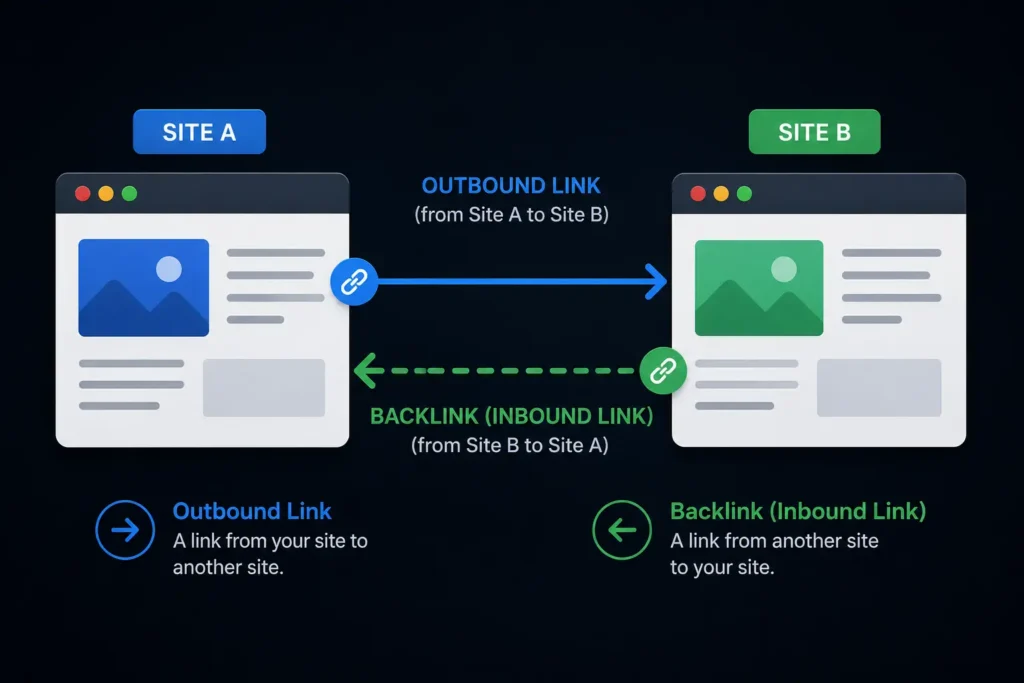
When another site links to your page, it’s functioning as a citation. Search engines treat it as a small signal that your content is worth pointing to, similar to how an academic paper gains credibility from being cited by other researchers.
The reverse direction has its own name too. A link from your site pointing out to someone else’s is an outbound link, and it plays a different role entirely, mostly around adding context and supporting your own claims.
Types of backlinks
Not all backlinks are the same. Here are the main types and what each can contribute to your site’s credibility and visibility:
- Editorial backlinks: Links earned naturally when a site references your content as a trusted source. These are among the strongest credibility signals.
- Guest post backlinks: Links placed within content you’ve written for another site. They can signal relevance and expertise when the host site is topically aligned with yours.
- Business profile and directory backlinks: Links from business listings, associations, directories, or partner pages. These can signal legitimacy and local or industry presence.
- Forum backlinks: Links placed in relevant forum discussions, answers, or community posts. They can help with referral traffic and visibility when they genuinely contribute to the conversation.
- Web 2.0 backlinks: Links from platforms where users can publish their own content, such as blogging and publishing platforms. Their value depends heavily on the quality and relevance of the content and platform.
- Google Stack backlinks: Links created across Google-owned platforms such as Google Sites, Google Docs, Google Drive, and other Google properties.
- Cloud stack backlinks: Links created through connected cloud properties and hosted content. They can support content discovery and visibility, but shouldn’t be treated as a replacement for genuine editorial links.
- Podcast backlinks: Links from podcast episode pages, show notes, or guest profiles. These can provide referral traffic, brand exposure, and relevant authority signals.
- UGC and sponsored backlinks: Links in user-generated content or paid placements, typically marked with
nofollow,ugc, orsponsoredattributes. They can still contribute to visibility and referral traffic, even when they don’t pass traditional ranking signals. - Social backlinks: Links from social media platforms. They may have limited direct SEO value, but they can drive traffic and put your content in front of audiences who may link to it from their own sites.
- Image backlinks: Links from websites that use your images, infographics, or visual content and credit your site as the source. They can increase referral traffic, brand visibility, and help attract relevant links from other websites.
- Comment backlinks: Links added to relevant blog or community comments. They may have limited direct SEO value, but useful comments can drive referral traffic, increase visibility, and help build relationships within your industry.
For a deeper breakdown, see our guide to the different types of backlinks.
Why Do Backlinks Still Matter ?
Backlinks have been part of how search engines rank pages since Google’s original PageRank algorithm in 1998, and the core idea hasn’t changed: a link from one page to another functions as an endorsement.
What’s changed is how much weight raw quantity carries. Google’s Penguin update in 2012 punished sites that gamed this system with link farms and paid networks, and the algorithm has only gotten better at spotting manipulation since.
Google Penguin got folded into the core algorithm in 2016, so this kind of manipulation gets caught continuously now rather than waiting for a periodic sweep. A single link from a genuinely relevant, trusted source now does more than dozens from low-quality directories.
The newer piece is what backlinks do for AI-driven search. Systems like Perplexity and Google AI Overviews use retrieval-augmented generation (RAG), meaning they pull from live web sources before generating an answer rather than working from static training data alone.
A page’s backlink profile is part of what determines whether it gets pulled into that retrieval step at all.
What Makes a Backlink High Quality vs Low Quality?
Four factors decide where a backlink lands on that spectrum, and they interact with each other rather than working in isolation.
| Factor | High Quality | Low Quality |
| Source relevance | Same or closely related topic | Unrelated niche or generic directory |
| Source authority | Established site with real organic traffic | Thin, low-traffic, or newly created site |
| Placement | Inside the main body of an article | Footer, sidebar, or comment section |
| Anchor text | Varied, natural phrasing | Repetitive exact-match keywords |
A single editorial mention from a respected publication in your industry outweighs a hundred links from directories nobody visits. That’s not a slogan, it’s how the underlying algorithm actually weighs things: relevance and placement multiply the value of authority, they don’t just add to it.
Domain authority scores from third-party tools are a useful shorthand for this, but they’re not a Google metric. Treat a high domain authority reading as a hint about a site worth pursuing, not proof that a link from it will move rankings.
Dofollow, Nofollow, sponsored, and UGC: What’s the Difference?
Every link carries an attribute that tells search engines how to treat it, whether that attribute is written explicitly in the HTML or left as the default.
| Attribute | What It Does | Common Use Case |
| dofollow (default) | Passes ranking authority to the destination | Standard editorial links |
| nofollow | Signals the link isn’t a personal endorsement | Blog comments, unverified sources |
| sponsored | Discloses a paid or commercial relationship | Affiliate links, paid placements |
| UGC | Marks content submitted by users | Forum posts, user profiles |
None of the non-dofollow attributes are inherently bad. A natural link profile includes a healthy mix of all four, and a profile made up entirely of dofollow links from big sites actually looks more suspicious than one with a realistic blend.
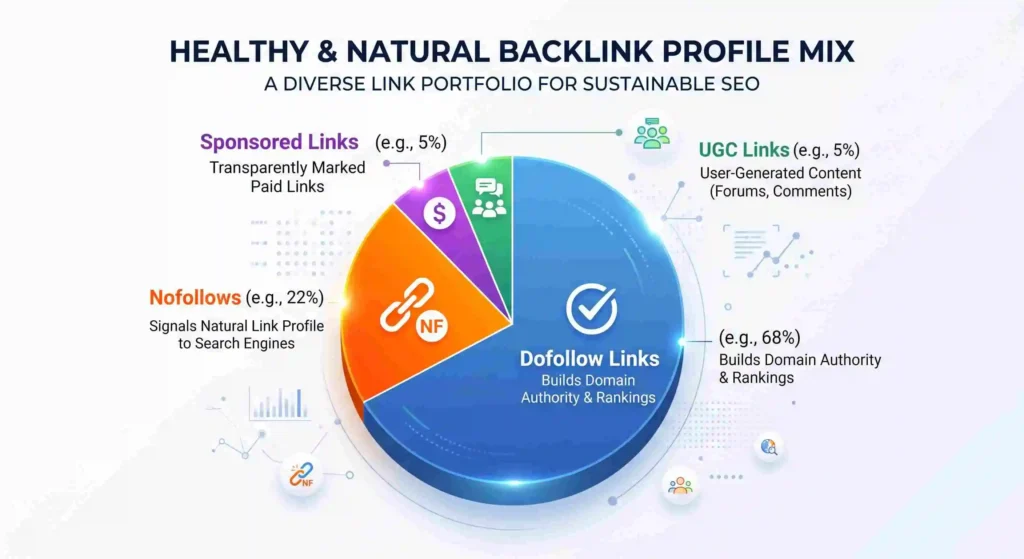
A sponsored link tag is legally expected in most markets for paid placements and affiliate content, and skipping it is a compliance risk, not just an SEO one.
How Many Backlinks Do You Actually Need?
This is the question nobody wants to answer with anything other than “it depends,” and that’s because the honest answer really does depend on your specific business type.
Local service businesses (plumbers, dentists, law firms) usually need surprisingly few. A dozen to twenty relevant local citations, a handful of local news mentions, and consistent NAP-accurate directory listings often beat a national competitor with thousands of generic links.
SaaS and B2B software competing on commercial keywords typically need more volume and more authority. Fifty or more editorial backlinks from industry publications, comparison sites, and integration partners is a realistic target for a competitive term.
Ecommerce sites split by page type. Category pages need a broader base of relevant links over time. Individual product pages rarely need direct backlinks at all, since internal linking from category and blog content usually carries them.
Content and media sites need continuous acquisition, not a one-time push. Publishing something genuinely citable on a regular basis matters more than any fixed target number.
The pattern across all four: match your link building effort to what the pages currently ranking above you have earned, not to a generic industry benchmark.
What Are Toxic Backlinks and When Should You Disavow Them?
A toxic backlink comes from a source built specifically to manipulate rankings: private blog networks, comment spam, paid link schemes, or sites that exist purely to sell links. This is the exact pattern Google Penguin was originally built to catch.
Most sites have a handful of these sitting in their profile without any real consequence, because Google’s spam systems already discount obviously manipulative links automatically. Disavowing isn’t usually necessary unless you can point to a specific ranking drop that lines up with a spam attack or a legacy black-hat campaign you inherited.
Run a real audit before touching the disavow tool. Export your full backlink profile, flag sources with no organic traffic or an unrelated niche, and only disavow the ones with a clear pattern of manipulation. Disavowing legitimate links by mistake can quietly remove ranking value you actually earned.
How Do You Build Backlinks Ethically?
Three approaches consistently outperform the rest, and none of them involve buying links or joining a link exchange network.
- Publish something worth citing. Original data, a genuinely useful tool, or a deep resource on a topic nobody else has covered well earns links without you asking for them.
- Fix broken links on relevant sites. Find dead links on pages in your niche and offer your own content as the replacement. It’s a small, unglamorous tactic that still works because you’re solving a real problem for the site owner.
- Do outreach that actually offers something. A pitch to a journalist or blogger works when it includes a genuine data point, expert quote, or resource, not just a request for a link back.
Every one of these takes longer than buying a package of links, and every one of them survives the next algorithm update.
Do Backlinks Matter for AI Search and GEO?
Yes, arguably more than before, just for a slightly different reason than classic ranking.
AI systems answering questions in real time need to ground their answers in something more reliable than their own training data, especially for anything time-sensitive or specific. Retrieval-augmented generation pulls from live pages, and a page’s backlink profile is one of the signals that determines whether it gets treated as a trustworthy source worth retrieving.
That overlaps directly with what I’ve written about in what AEO actually requires: the same content that earns natural citations from real publications is the content AI systems end up citing too.
Frequently Asked Questions
What is a backlink in simple terms?
A backlink is a link from another website pointing to yours. Search engines treat it as a vote of confidence, and a strong backlink profile is one of the clearest signals of a trustworthy, authoritative site.
Are backlinks still important for SEO?
Yes. The mechanism has gotten more selective, favoring relevance and authority over raw volume, but the underlying signal, other sites vouching for your content, is still one of the strongest ranking factors search engines use.
How many backlinks do I need to rank on page one?
There’s no fixed number. It depends on how competitive your keyword is and what the pages currently ranking above you have already earned. A local keyword might need a dozen relevant links, while a competitive national term might need fifty or more from real authority sites.
What’s the difference between a backlink and anchor text?
A backlink is the entire link, including its destination and its attributes. Anchor text is just the clickable words inside that link. One is the connection, the other is the label describing what it points to.
Do nofollow backlinks help SEO at all?
They don’t pass direct ranking authority, but they still drive referral traffic, build brand visibility, and contribute to a natural-looking link profile. A profile with zero nofollow links actually looks less natural to search engines.
Should I disavow bad backlinks?
Usually not, unless you can trace a specific ranking drop to a clear spam attack or inherited black-hat campaign. Google’s spam systems already discount most manipulative links automatically, and disavowing legitimate links by mistake can hurt more than it helps.
Bottom Line
A backlink is still just a link from someone else’s site to yours, but what counts as a good one has narrowed considerably. Relevance and placement matter more than volume, and the businesses winning are earning links by publishing something worth citing rather than chasing a number.
Match your effort to your actual competition rather than a generic benchmark, keep your anchor and link-type mix natural, and treat disavowing as a last resort rather than routine maintenance.