
30-Second
- A local citation is any online mention of your business name, address, and phone number (NAP), on a site that isn’t your own.
- Citations come in two forms: structured (formal directory listings like Google Business Profile or Yelp) and unstructured (mentions in blog posts, news articles, or reviews).
- Citations mattered more a decade ago than they do now. Independent research has tracked their share of local ranking signals shrinking over time, but they haven’t disappeared, they’ve just stopped being a magic lever.
- Quality and consistency beat raw volume. A handful of accurate, relevant citations outperforms hundreds of inconsistent ones.
- AI-powered local search is starting to lean on the same NAP data classic local SEO always relied on, so citation accuracy now feeds two different systems, not one.
- Building citations yourself is realistic for a single-location business. Multi-location brands usually need a paid service or platform to keep pace with drift.
I still open a lot of local SEO audits to find the same business listed three different ways across five directories, one address has a suite number, one doesn’t, one phone number is an old forwarding line. That inconsistency alone can cap how well everything else performs.
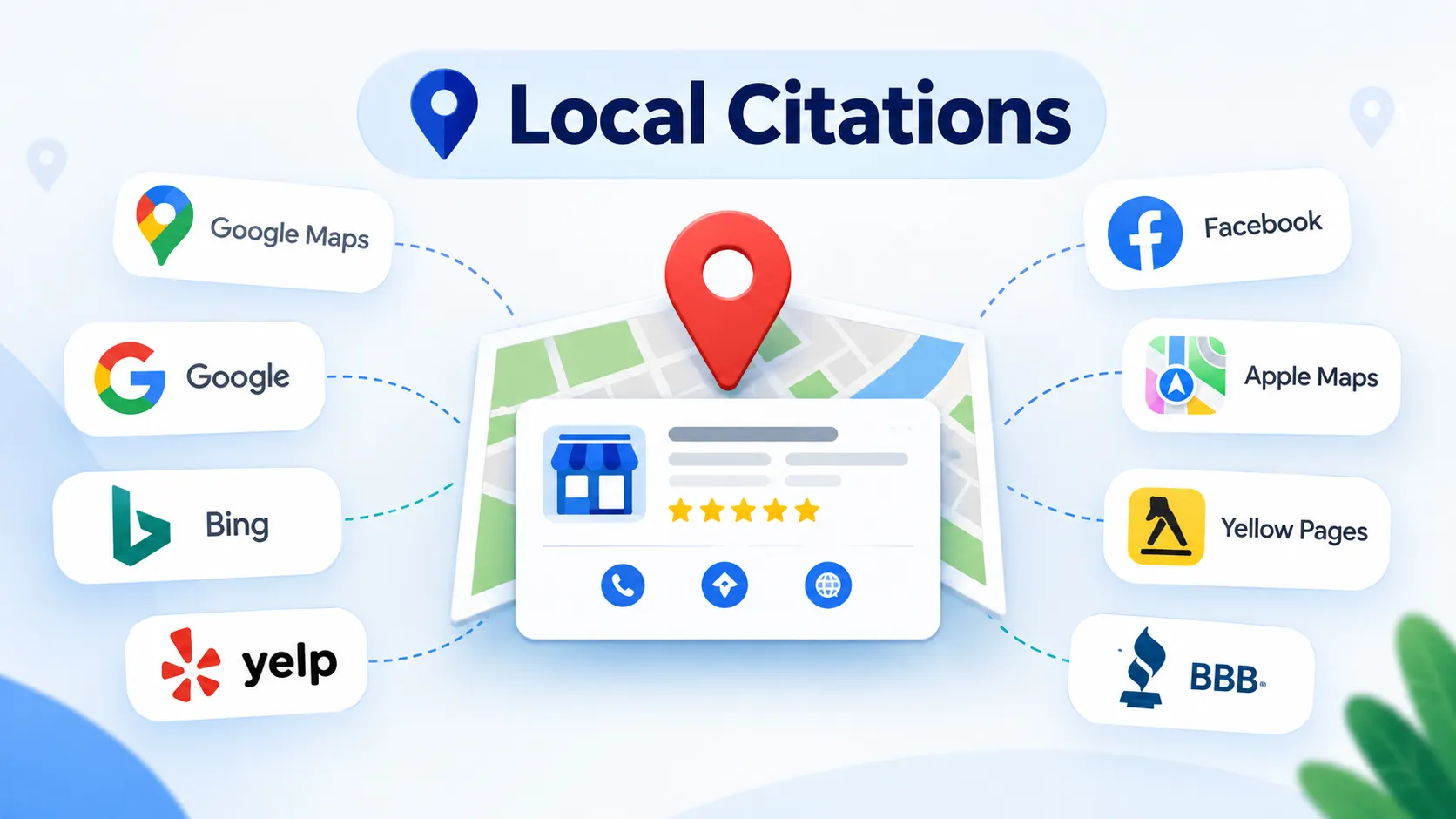
What Is a Local Citation?
A local citation is any online mention of your business’s name, address, and phone number, commonly shortened to NAP, on a website that isn’t your own.
The term itself has a specific origin. Local SEO consultant David Mihm coined it in 2008, drawing a direct comparison to how academic citations validate a claim by pointing to an independent source. The idea carried over cleanly: a citation validates that your business is real by having independent third parties reference the same details.

A citation doesn’t need to link back to your site to count. The value sits in the mention itself, not the backlink.
A citation missing one piece of the NAP, no phone number, say, is usually called a partial citation. Google’s own guidelines for representing your business require that name, address, and category stay consistent across every location, the exact standard a clean citation profile is built to meet.
Structured vs. Unstructured Citations
Every citation falls into one of two categories, and the distinction affects how you go about building each one.
| Type | What It Looks Like | Where You Find It |
| Structured | A formal listing with clearly labeled fields for name, address, and phone | Google Business Profile, Yelp, Apple Maps, industry directories |
| Unstructured | A natural mention of your business woven into other content | Blog posts, local news articles, forum threads, social media posts |
Structured citations are easier to build deliberately, since you’re filling out a form on a known directory. Unstructured citations are harder to earn on purpose, since they depend on someone else deciding your business is worth mentioning, but they tend to carry more weight precisely because they read as organic rather than manufactured.
Why Do Local Citations Still Matter in 2026?
Less than they used to, and that’s worth saying plainly instead of repeating outdated advice.
A widely cited 2018 industry survey ranked citation signals as roughly the fifth most influential factor in local pack rankings. Even at the time, a meaningful share of the SEOs surveyed said citations weren’t moving the needle much for them anymore.
More recent tracking puts citation signals, NAP consistency and citation volume combined, at closer to 7% of local pack ranking factors. The trend line is consistent even if the exact percentage varies by source: citations have been quietly losing ground to reviews, on-page relevance, and behavioral signals for years.
That doesn’t mean they’re worthless. Google’s own guidance treats consistent business information as a basic trust signal.
A Google spokesperson has described citation-style mentions as functioning more like advertising than a ranking hack, useful for the exposure, not a lever to abuse. Getting your core citations right is still foundational. It just isn’t going to be the thing that wins you the local pack on its own anymore.
Do Local Citations Matter for AI Search Too?
Increasingly, yes, and this is the part most local SEO guides haven’t caught up to yet.
AI-powered local discovery tools are starting to cross-reference the same NAP data before recommending a business, using consistency as a basic trust check in much the same way Google’s local algorithm always has.

A notable recent development: OpenAI signed a licensing deal with Yelp, meaning ChatGPT can now pull directly from Yelp’s structured local business data when answering location-based questions. This is exactly the kind of AI search local discovery shift worth planning around now, not after it’s already standard practice.
That means the accuracy work you do for classic local SEO now feeds a second system too. A business with clean, consistent NAP data across major platforms is better positioned for both a Google Business Profile ranking and an AI assistant’s local recommendation, since both are checking the same underlying facts.
How Many Citations Do You Actually Need?
If you’re asking how many citations do I need, the answer is fewer than most local SEO checklists imply, and going for volume without relevance usually wastes time.
A tight set of accurate citations on the platforms that actually matter covers most of the real benefit: the core search engines and Google Business Profile, the two or three biggest general directories, and a handful of industry-specific or city-specific listings.
Beyond that, chasing every directory that will accept a listing adds inconsistency risk without adding much ranking value.
Prioritize by relevance to your specific industry over raw domain authority. A niche directory that specifically serves your type of business, dentists, contractors, restaurants, tends to carry more weight with a local searcher and a local algorithm than a generic, high-authority directory nobody in your category actually uses.
How Do You Find Citation Opportunities You’re Missing?
Once your core listings are locked down, the harder question is finding the citations that actually fit your specific business, rather than the same generic directories everyone starts with.
Check what your competitors have that you don’t. Search a competitor’s exact business name in quotes, excluding their own site and social profiles from the results, and see what surfaces. It’s often a niche directory or local publication that already accepts businesses like yours. A backlink-gap comparison, checking who links to a competitor but not to you, tends to surface the same kind of opportunity from a different angle.
Go industry-specific before going generic. A directory built for your exact category consistently earns more trust from a local searcher, and often from the local algorithm, than a broad, high-authority directory nobody in your industry actually uses.
| Industry | Example Directory |
| Home services (plumbers, electricians, contractors) | Angi |
| Automotive sales and repair | Cars.com |
| Legal | Avvo |
| Healthcare | Healthgrades |
| Dental | American Dental Association directory |
| Caregiving and senior care | Care.com |
| Travel and hospitality | Tripadvisor |
| Weddings | WeddingWire |
| Real estate | Realtor.com |
| Software | Capterra |
Look at trade associations and chambers of commerce. Many run periodic member spotlight features, a newsletter mention or blog post profiling a member business, that produce a genuine unstructured citation along with real referral exposure. Applying is often as simple as filling out a short form through the association’s own site, and this route tends to get overlooked entirely in favor of directory submissions.
How Do You Audit Your Current Citations?
Run this citation audit sequence before building anything new. Fixing what’s already wrong matters more than adding volume on top of an inconsistent foundation. Citation consistency across every listing is the whole point of this exercise, not an afterthought.
- Search your exact business name plus city. See what’s already indexed, and note every version of your NAP that shows up.
- Check your core listings first. Google Business Profile, Bing Places, and Apple Business Connect carry the most weight, verify these are complete and accurate before touching anything else.
- Flag every inconsistency. Different suite numbers, old phone lines, misspelled business names, and outdated hours all count.
- Fix the highest-authority listings first. Correcting your Google Business Profile and top two or three directories delivers more impact than fixing fifty low-traffic ones.
- Set a recheck schedule. Listings drift on their own, aggregators sync stale data, competitors occasionally edit shared listings, so a quarterly recheck catches problems before they compound.
Should You Build Citations Yourself or Hire It Out?
This DIY vs hire local SEO question depends more on how many locations you manage than on your budget alone.
Do it yourself if: you run a single location and can commit a few focused hours to claiming and correcting your core listings. Most of the highest-value citations, Google Business Profile, Bing Places, one or two major directories, take longer to research than to actually fill out.
Use a citation management platform if: you manage multiple locations, since manual updates don’t scale once you’re syncing NAP data across dozens of listings for each one, and a platform that pushes updates to data aggregators saves real time.
Hire a local SEO service if: citation work is one piece of a broader local visibility gap, alongside review management, on-page local content, and Google Business Profile optimization, and you’d rather have someone else own the whole picture.
What Mistakes Actually Hurt Your Citation Profile?
A handful of patterns account for most of the damage I see in audits.
- Multiple business names for one location. “Joe’s Plumbing” on one directory and “Joe’s Plumbing LLC” on another reads as two different, unrelated entities to some systems.
- Suite or unit number inconsistency. Adding, dropping, or reformatting a suite number across listings is one of the most common, and most overlooked, sources of NAP drift.
- Duplicate listings for one location. Two Google Business Profile listings for the same address confuse rather than reinforce, and can suppress both.
- Abandoned old phone numbers or addresses. A citation pointing to a number you disconnected two moves ago actively misleads customers, not just algorithms.
- Chasing citation volume from irrelevant directories. Listings on directories with no connection to your industry or location add clutter without adding trust.
Frequently Asked Questions
What is a local citation in simple terms?
It’s any online mention of your business’s name, address, and phone number on a website you don’t own, like a directory listing, a review site, or a local news article.
Do local citations still help SEO in 2026?
Yes, but less than they did a decade ago. They function more as a foundational trust signal now than a primary ranking lever, and consistency matters more than raw volume.
What’s the difference between structured and unstructured citations?
Structured citations are formal directory listings with clearly labeled NAP fields, like Google Business Profile or Yelp. Unstructured citations are natural mentions woven into other content, like a blog post or news article.
How many local citations do I need?
Fewer than most checklists suggest. A tight set of accurate listings on your core platforms and a handful of industry-relevant directories covers most of the real benefit.
Do citations need to link back to my website to count?
No. The value is in the accurate mention of your business details, not the backlink, though a link is a nice additional benefit when a directory offers one.
Do AI search tools use local citations too?
Increasingly, yes. AI-powered local discovery features are starting to cross-reference the same NAP data classic local SEO relies on, and partnerships like OpenAI’s licensing deal with Yelp mean AI assistants can now pull directly from structured local business data.
Bottom Line
A local citation is still just an accurate mention of your business elsewhere online, but its role has shifted from ranking lever to foundational trust signal. Get your core listings right, fix inconsistencies before adding volume, and don’t chase every directory that will take your submission.