
30-Second
- An AI citation is a linked reference to a specific webpage that an AI system used to generate part of its answer. This is different from citing AI tools in academic writing (APA/MLA style), which this guide doesn’t cover.
- A citation isn’t the same as a mention. An AI system can name your brand without linking to you, or link to your page without ever saying your brand name. Getting both is the real goal.
- Citations come in three flavors: informational, product, and multimedia, and AI systems don’t always provide one at all, only when they pull from a live source instead of pure training data.
- What actually gets cited leans heavily on structure: short, self-contained sentences near the top of a page, genuinely original content, and technical accessibility to AI crawlers.
- Citation behavior barely overlaps between platforms. A page cited heavily by one AI system is often invisible to another, so single-platform optimization leaves real visibility on the table.
- You can track this with the same “Share of Voice” logic used in classic brand monitoring, just measured across AI answers instead of search rankings.
I get asked “why does ChatGPT cite my competitor but not us” almost weekly now, and 90% of the time the honest answer is structural: the competitor’s page just happens to say the same thing in a cleaner, more extractable sentence.
What Are AI Citations?
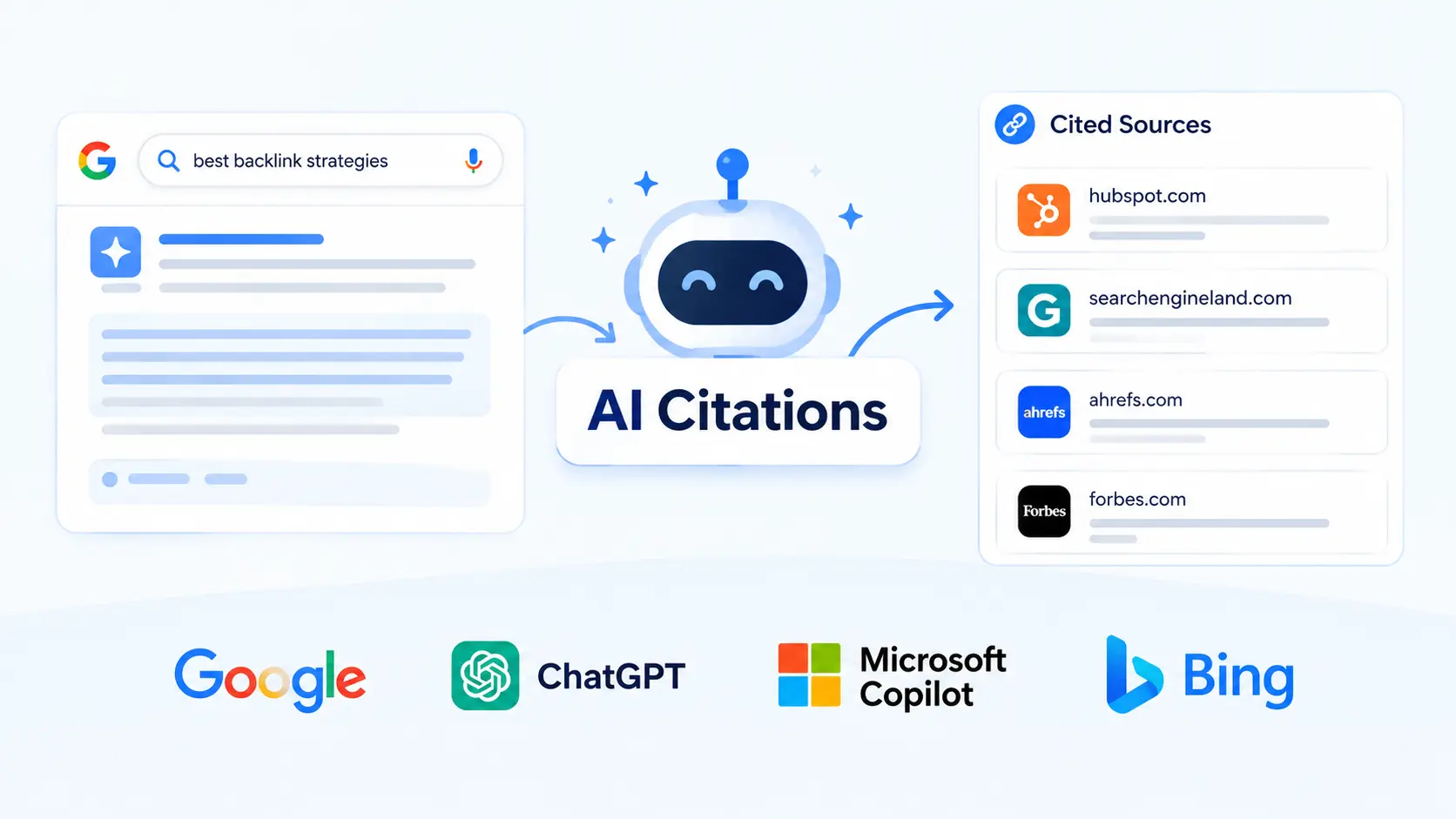
An AI citation is a specific, linked reference to a webpage or document that an AI system pulled information from to build part of its answer.
Quick disambiguation, since this phrase gets used two different ways: if you’re looking for how to format a citation for ChatGPT in an academic paper (APA, MLA, Chicago style), that’s a different topic entirely.

Check your style guide or a tool built for that. This guide is about the marketing sense: how your website earns a citation inside an AI-generated answer, per Google’s own documentation on AI features.
Citations show up differently depending on the platform. In a Google AI Overview, they typically appear as numbered source links alongside the summary. In ChatGPT, they show up inline in the response text and again in an expandable sources panel.
Why Do AI Citations Matter?
Because a citation splits into two outcomes that affect your brand very differently, depending on whose page gets linked.
A first-party citation links directly to your own site, which drives traffic, reinforces your authority, and puts your brand name in front of someone actively researching a decision.
A third-party citation links to someone else’s page, a review site, a comparison article, a forum thread, that happens to discuss your brand. That second kind can help or hurt you depending on what it says, and you have far less control over it.
The stakes are rising because AI-sourced traffic reportedly converts several times better than traditional organic traffic in early industry data, and search behavior is visibly shifting toward AI-mediated answers. Getting cited isn’t a vanity metric anymore, it’s becoming a real acquisition channel.
Citation vs. Mention: The Distinction Most Guides Skip
This is the part that trips people up, and it’s worth being precise about.
A mention is when an AI system names your brand in its answer, with no link attached. A citation is when it links to a specific URL as the source behind a claim. These are not the same outcome, and having one doesn’t guarantee the other.
One large-scale industry analysis found that in more than 6 out of 10 cases, an AI citing your website doesn’t actually name your brand anywhere in the visible answer text, a gap sometimes called a “ghost citation.”
A reader sees a numbered source link, clicks through if they’re curious, but never registers who you are unless they follow it. That means citation count alone overstates your actual brand visibility. You need both: enough citations to earn traffic, and enough clear brand naming to earn recognition.
The 3 Types of AI Citations
Every citation falls into one of three categories, and each serves a different part of the user’s journey.
| Type | What It Links To | User Benefit |
| Informational | A page or document supporting a factual claim, explanation, or summary | Lets the user verify or dig deeper into a claim |
| Product | A specific product page inside a shopping-style AI response | Continues the purchase journey directly |
| Multimedia citation | An image or video source, often shown as a visual carousel | Adds visual context to the written answer |
Most brand-visibility strategy focuses on informational citations, since they show up across the widest range of queries, but ecommerce brands should pay particular attention to product citations as AI-driven shopping features expand.
Do AI Systems Always Provide Citations?
No. Citations only appear when the system retrieves information from an external, current source rather than answering purely from its pre-trained knowledge.
If a question can be answered confidently from a model’s training data alone, no retrieval happens, and no citation shows up. If the question needs current information, a live product listing, breaking news, anything past the model’s training cutoff, the system fetches real pages and cites them, a process known as retrieval-augmented generation.
Some platforms retrieve by default. Google’s AI Overviews and AI Mode are tied to live search results, so they almost always cite something. Other assistants only search the web when the question specifically calls for it, meaning a plain, general-knowledge question might get a confident, uncited answer even from a system fully capable of citing sources.
How Do AI Systems Decide What to Cite?
This is where the real optimization opportunity sits, and it goes deeper than “write good content.”
- Position on the page matters more than people expect. Independent analyses of citation patterns found the overwhelming majority of cited passages sit in the first third of a page, and the highest-performing sentences run a tight 6 to 20 words, short enough to lift cleanly into an answer without editing. Long, hedge-everything introductions bury the exact sentence a retrieval system is looking for.
- Self-contained sentences win. A sentence that makes complete sense pulled out of context, sometimes called an “atomic fact,” gets cited far more often than a sentence that only makes sense with three paragraphs of setup before it.
- Content format has a measurable effect. One 2026 cross-engine monitoring study found AI search engines cite list-formatted pages at roughly 5 times the rate of conventional blog posts or long-form guides, likely because ranked lists are cheaper for a retrieval system to parse and extract from cleanly.
- Cross-platform overlap is much lower than most people assume. Separate independent studies each found that the domains one AI system cites and the domains a different AI system cites for the same topic overlap by roughly 5 to 13%. Optimizing for a single platform and assuming the rest follow along leaves most of the opportunity untouched.
- Traditional rankings still gate eligibility. One large-scale study of AI Overview citations found the large majority came from pages that also rank somewhere in Google’s top 100 organic results. AI citation and classic SEO aren’t separate games, they share the same qualifying round.

How Do You Get AI Citations?
If you’re asking how do I get AI citations, fixing structure earns you a shot. None of it guarantees one, since the underlying content still has to be genuinely useful.
- Publish content that couldn’t be answered from training data alone. Original research, real case studies with your own numbers, and a clearly stated, defensible opinion all give a retrieval system a reason to pull from you specifically rather than paraphrase something more generic.
- Structure for extraction. Put your most important claim in the first third of the page, in a self-contained sentence under 20 words. Use descriptive subheadings that match how people actually phrase questions.
Make your content accessible to AI crawlers. Favor server-rendered HTML over content that only appears after heavy JavaScript execution, since most AI crawlers read raw HTML rather than executing scripts. Keep the content publicly accessible, not behind a login or paywall. Consider publishing an llms.txt file, a simple markdown file that helps AI crawlers navigate your site, similar in spirit to robots.txt for traditional search crawlers. It isn’t a universally adopted standard yet, but the cost of adding one is close to zero.
- Build real authority signals. Genuine backlinks, earned brand mentions, and third-party reviews all feed into whether an AI system treats you as a trustworthy source worth citing. This is the same authority-building work that supports classic SEO, not a separate track.
- Use schema markup for hygiene, not as a citation shortcut. Structured data still helps systems build a broader picture of what your site covers, but treat it as good practice rather than something that directly moves a citation decision on its own.
- Consider your content format. Given how strongly list-style formatting correlates with citation rate, a well-organized, genuinely useful list or comparison table is a reasonable structural choice for topics where it fits naturally, not just prose for its own sake.
How Do You Track AI Citations?
If you’re setting up how to track AI citations for the first time, three distinct metrics get lumped together constantly, and treating them as one number hides what’s actually happening.
Citation Rate measures how often your specific URLs get linked as a source across your tracked prompts. Mention Rate measures how often your brand name shows up at all, cited or not. Share of Voice measures your citations or mentions as a percentage of the total across you and your named competitors, for the same set of prompts.
A practical way to build a manual baseline without a dedicated platform: pick 20 to 30 real questions your buyers ask, run them across ChatGPT, Perplexity, and Google AI Mode consistently, and log whether you’re cited, mentioned, both, or neither each time. Repeat monthly. Most brands see this baseline shift meaningfully within 60 to 90 days of a focused effort.
For traffic specifically, add a dedicated channel group in your analytics platform that groups referral traffic from AI domains (chatgpt.com, perplexity.ai, and similar) separately from generic referral traffic, since most platforms bucket it as plain “referral” or even “direct” by default, hiding the actual source.
Does This Replace Classic SEO?
No. If anything, the data argues the opposite.
Since the large majority of AI citations still come from pages that already rank well organically, the two goals share the same technical and content foundation. Citation-specific tactics, structure, format, crawler access, are a layer on top of solid SEO, not a replacement for it.
I’ve covered the fuller version of that relationship in aeo-vs-seo/”>AEO vs SEO, and the mechanics of how Google’s own AI Overviews retrieve and cite content specifically in what AI Overviews actually are.
Frequently Asked Questions
What is an AI citation in simple terms?
It’s a link inside an AI-generated answer that points to the specific webpage the AI used as a source for a claim. It’s different from citing AI tools in academic writing, which follows separate style-guide rules like APA or MLA.
What’s the difference between an AI citation and an AI mention?
A citation includes a link to your specific URL. An AI mention just names your brand in the text, with no link. You can get one without the other, and a real visibility strategy tracks both separately.
Do all AI platforms provide citations the same way?
No. Some, like Google’s AI Overviews, are tied to live search and cite almost by default. Others only retrieve and cite when a question specifically requires current information beyond their training data.
How long does it take to see more AI citations?
Most focused efforts show a measurable shift within 60 to 90 days, though technical fixes like crawler accessibility or schema can show smaller effects within a few weeks.
Does getting cited by one AI platform mean I’ll get cited by others?
Not reliably. Independent research consistently finds low overlap, often under 15%, between which domains different AI platforms cite for the same topics, so single-platform optimization misses most of the opportunity.
Do I need a separate content strategy just for AI citations?
Not a separate one, an additional layer. The underlying content still needs to satisfy classic SEO fundamentals; citation-specific work is about structure, extractability, and crawler access on top of that foundation.
Bottom Line
An AI citation is a link, a mention is a name-drop, and the brands winning right now are tracking both instead of assuming one implies the other.
Structure your best claims into short, self-contained sentences near the top of the page, keep your content genuinely accessible to AI crawlers, and don’t assume success on one platform carries over to the rest.
If you want a clear picture of where your brand currently stands across AI platforms and what’s actually blocking citations, that’s exactly the kind of audit I run in our aeo-agency/”>AEO service.