
30-Second TL;DR
- There are roughly 15-20 recognized types of backlinks, grouped into three lenses: how they’re earned, what HTML attribute they carry, and where they sit on the page.
- Editorial, digital PR, and HARO/journalist links sit at the top of the value hierarchy because a real editor chose to include them, not because of any single metric.
- Every backlink also carries an attribute, dofollow, nofollow, sponsored, or UGC, and a healthy profile needs a mix of all four, not just dofollow.
- PBNs, comment spam, and reciprocal link exchanges at scale sit at the bottom. Google’s detection has gotten good enough that these mostly get ignored rather than actively penalized, but the risk isn’t worth the effort either way.
- Where you should focus depends on your site’s maturity. A brand-new site needs different types than an established one, and chasing the wrong type at the wrong stage wastes months.
- AI answer engines don’t weigh types the same way Google does. Free tools and original data assets get cited more often than a standard editorial mention.
I get shown a lot of backlink reports where every link is technically real, technically dofollow, and still doing almost nothing for the site. The type of link explains why almost every time.
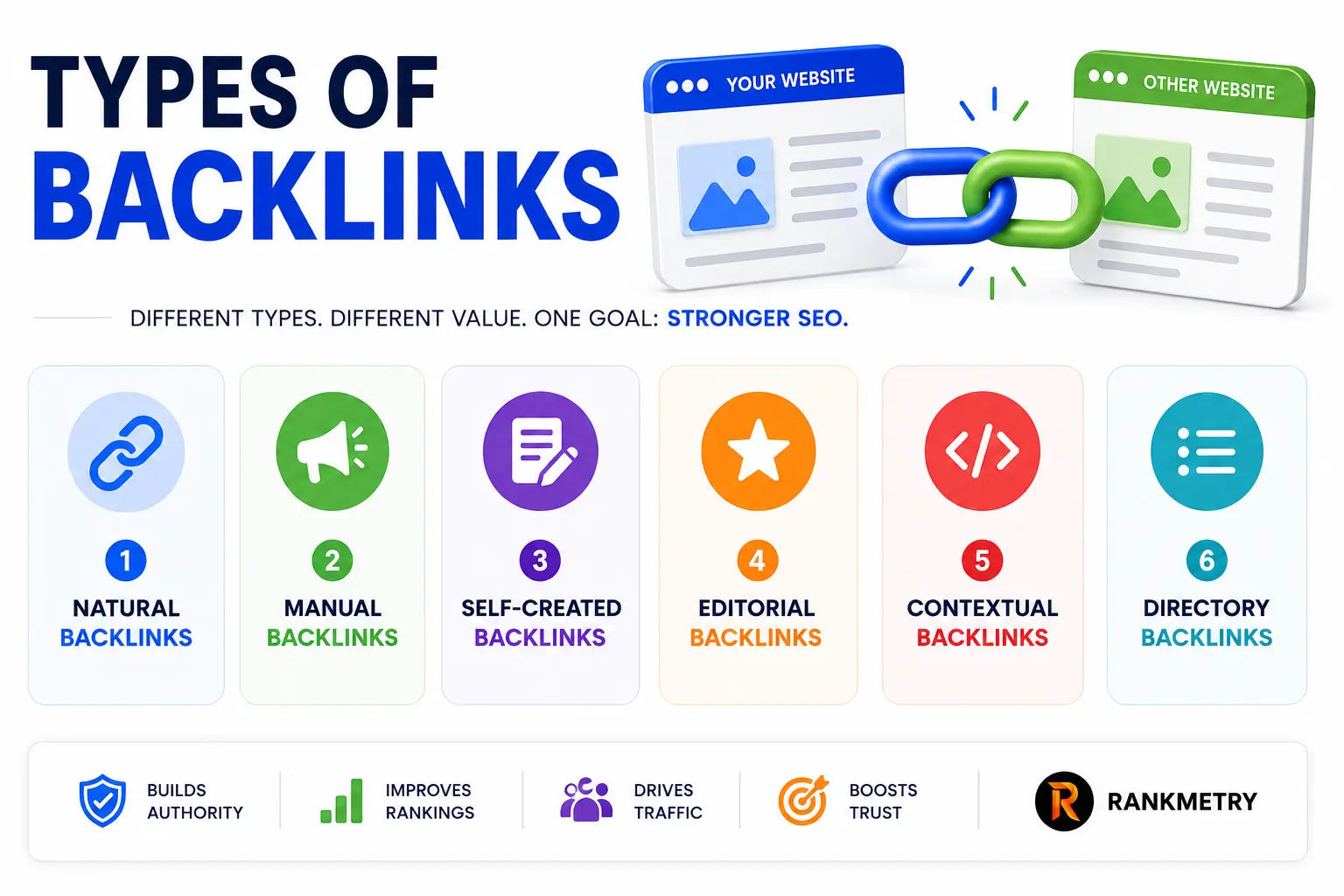
What Determines Whether a Backlink Type Is Worth Pursuing?
Every backlink type gets judged on three things: who’s giving it to you, whether it endorses you, and where it sits on the page. Get those three right and the type barely matters.
Source quality asks whether the linking page has real traffic and real editorial standards, not just a high domain metric. Endorsement asks whether a human chose to include your link because it helped their content, or because it was paid for, templated, or dropped in a comment field. Placement asks whether the link sits inside a sentence a reader would actually read, or in a footer nobody scrolls to.

Stack all three high and you get an editorial link from a relevant publication, placed inside the body copy. Stack all three low and you get a comment-spam link from an unrelated forum. Everything else on this list sits somewhere between those two extremes.
The 4 Link Attributes: Dofollow, Nofollow, Sponsored, and UGC
Before the type of backlink even matters, every link carries one of four attributes in its HTML. These aren’t types on their own, they’re modifiers that apply to any type above.
| Attribute | What It Signals | Typical Use |
| Dofollow (default) | Full endorsement, passes ranking authority | Standard editorial links, most natural mentions |
| Nofollow | Not a personal endorsement | Blog comments, unverified sources |
| Sponsored | Paid or commercial relationship, disclosed | Affiliate links, paid placements, sponsored content |
| UGC | Submitted by a site’s users, not the site owner | Forum posts, review sections, community content |
Google introduced nofollow in 2005 to fight comment spam, then added sponsored and UGC in 2019 to give publishers a more precise way to disclose intent. Since 2019, Google treats all three as hints rather than hard directives, meaning a nofollow link from a genuinely authoritative source can still carry some weight.
A profile made up entirely of dofollow links actually looks more suspicious than one with a realistic mix. Real websites accumulate all four attribute types naturally over time.
High-Value Backlink Types (Build These)
These share three traits: the source has genuine editorial independence, the placement reflects real endorsement, and the surrounding content reinforces what your page is actually about.
- Editorial backlinks. A writer or editor cites your page because it strengthens their own content, with no payment or arrangement involved. This is the hardest type to earn and the one every other type is trying to imitate. Editorial links reportedly deliver 30 to 50% greater ranking impact than placed links, precisely because they can’t be bought.
- Digital PR backlinks. Coverage in news outlets and industry publications, usually earned by pitching original data, a survey, or a genuinely newsworthy angle. These often carry a nofollow tag on press release syndication, but organic pickup from journalists frequently earns a clean dofollow link plus real brand exposure.
- HARO and journalist backlinks. A reporter needs an expert quote, you provide one through a platform like Connectively (formerly HARO) or Qwoted, and you get cited with a link back. These HARO backlinks score well because a journalist’s outlet vouches for your expertise directly.
- Guest post backlinks. An article you write for another site’s audience, with one or two contextual links back to your own. Google’s own guidance recommends marking guest post links as nofollow by default, since the contributor placed them intentionally. In practice, well-established publications often still grant a dofollow link when the piece is genuinely earned, but treat the nofollow default as the norm, not the exception.
- Resource page and niche edit backlinks. Resource page backlinks come from a curated list of useful links on a specific topic, or a link inserted into an already-published, already-ranking article. Both work because the surrounding page has already earned trust and traffic.
- Embedded asset backlinks. Calculators, free tools, original research, and data visualizations that other sites link to or cite because they’re genuinely useful. These accumulate passively once built, and they’re increasingly the type AI systems reference most, not just Google.
Supporting Backlink Types (Use Strategically)
These rarely move rankings on their own, but they build the entity signals and profile diversity that make everything above look natural.
- Business citations and directory listings. Yelp, Google Business Profile, and niche industry directories. Weak for direct ranking value, but foundational for local entity verification.
- Testimonial backlinks. A genuine review you write for a product you use, published on their site with a link back. Low effort, legitimately earned, modest value.
- Podcast and webinar backlinks. Show notes and landing pages that credit you as a guest or speaker. Builds a visible expertise footprint across multiple domains over time.
- Badge and sponsorship backlinks. Earned by sponsoring an event, conference, or open-source project that displays a badge linking back to you.
- Social media backlinks. Almost always nofollow, but still useful for discovery, referral traffic, and brand visibility.
- Forum and community backlinks. Genuinely helpful answers on Reddit, Quora, or niche forums. Minimal direct authority, but real value in topical association when done honestly.
Backlink Types by Placement on the Page
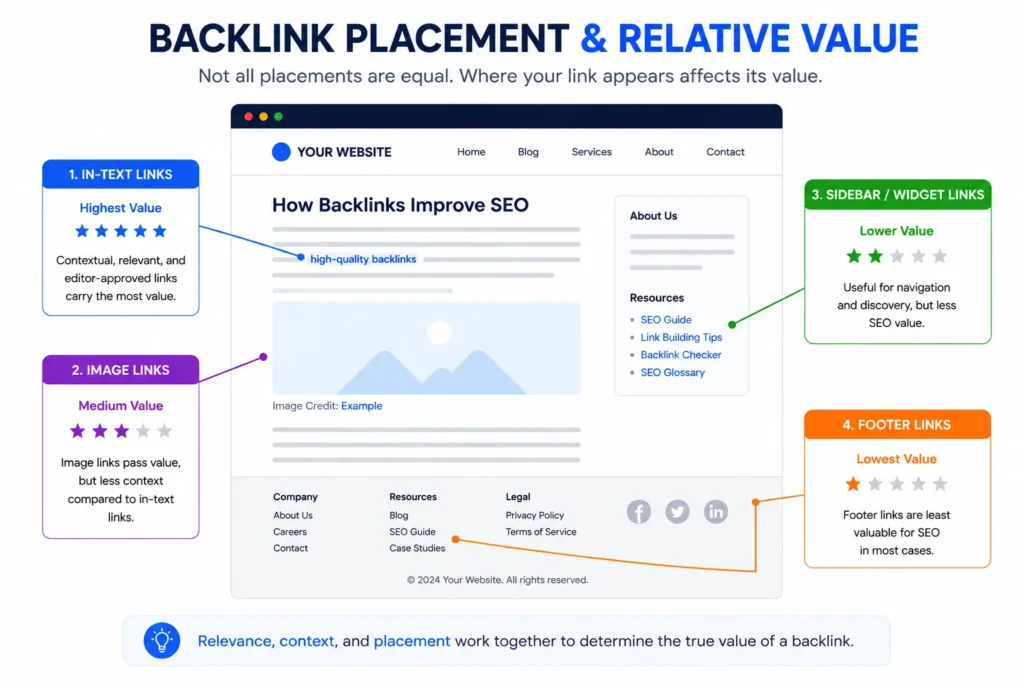
The same link type can behave completely differently depending on backlink placement, and this is the part most backlink guides skip entirely.
- In-text links sit inside the main body content, surrounded by relevant sentences. These carry the most weight because the surrounding text gives the link context a search engine (or an AI model) can actually parse.
- Image links point to your site from a clickable image, like a banner or an infographic. These carry less weight than text links because there’s no surrounding anchor text, only whatever alt attribute the publisher bothered to fill in.
- Footer links sit in the bottom navigation, often exchanged for a discount on services like web design or hosting. Low visibility, low reader engagement, correspondingly low value.
- Widget and sidebar links come embedded in a tool or badge a publisher installs on their site. These can look natural at a small scale but read as manipulative the moment they show up on hundreds of unrelated sites at once.
If you only remember one rule from this section: a mediocre link in the body text usually outperforms a great link buried in a footer.
Backlink Types to Avoid
A handful of types carry real risk, and none of them are worth the trade-off anymore.
- PBN (Private Blog Network) links. A group of websites built or bought specifically to link to one “money” site. Google’s detection systems have gotten good at spotting the footprints, shared hosting, thin content, overlapping ownership, and PBN links mostly just get ignored now rather than penalized. Ignored still means wasted money.
- Comment spam and auto-generated links. Placed at scale by software, not people. These carry no positive signal and can create a negative pattern if they accumulate.
- Excessive reciprocal links and link farms. A handful of natural reciprocal links between real partners is fine. Systematic link exchanges across dozens of pages get flagged as an affiliated network.
- Hidden or injected links. Placed through CSS tricks, invisible text, or a hacked site. These carry the highest risk of a manual action because they’re indistinguishable from malicious manipulation.
You generally don’t need to disavow any of this unless you’ve received an actual manual action notice in Search Console. Google’s spam systems already discount most of it automatically.
Which Backlink Types Should You Actually Pursue?
The right mix depends on where your site currently stands, not on a universal best-practices list.
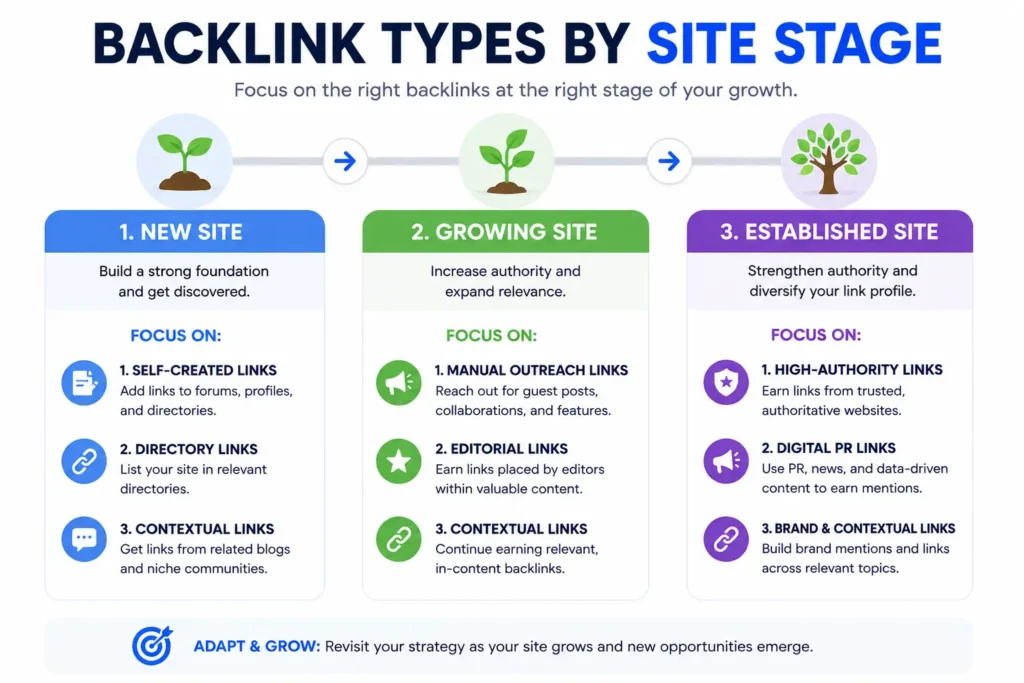
If you’re just starting out, prioritize entity foundation first: business citations, a complete Google Business Profile, and a handful of genuine testimonials. These won’t move rankings much, but they establish that your business is real before you chase anything harder to earn. Layer in guest posts on real, relevant, trafficked sites once that foundation is in place.
If you’re actively growing, guest posts, resource page placements, and HARO responses should be your main channels. This is also the stage to start building one genuinely useful free tool or piece of original research, since it takes time to accumulate links passively but pays off for years once it does.
If you’re already established, the marginal value of another guest post drops fast. Shift toward digital PR campaigns, embedded assets that compound, and editorial links earned through content nobody else in your space has bothered to produce.
Do Backlink Types Matter Differently for AI Search and AEO?
Yes, and the gap between what wins on Google and what wins in AI answers is wider than most people realize.
Free tools and webinar pages reportedly get cited roughly 3.4 times more often than editorial links in AI-generated answers. AI systems favor sources with clear utility and narrow query alignment they can reuse directly in a response.
Editorial links still matter for classic rankings, but if your only acquisition strategy is press mentions and guest posts, you’re likely under-represented in the systems increasingly answering your customers’ questions directly.
Frequently Asked Questions
What are the most valuable types of backlinks?
Editorial backlinks from relevant, trafficked publications consistently rank highest, followed closely by digital PR placements and journalist citations. All three share the same trait: a human chose to include the link because it genuinely helped their content.
How many types of backlinks are there?
Most classifications land between 15 and 22 distinct types, depending on whether you’re grouping by acquisition method, HTML attribute, or page placement. This guide covers the types that show up across all three lenses.
Do nofollow backlinks help SEO?
Not directly for rankings in most cases, but they still drive referral traffic, build brand visibility, and contribute to a natural-looking link profile. A profile with zero nofollow links looks less natural, not more optimized.
Are PBN backlinks still worth using?
No. Google’s detection systems have gotten good enough that most PBN links simply get ignored, meaning the money and effort spent building them produces little to no return.
What’s the difference between a guest post and a resource page backlink?
A guest post is content you write specifically for the host site, usually with a link inside the body or in your bio. A resource page backlink comes from an existing curated list, where an editor adds your link to an already-published page without you writing anything new for them.
Do backlink types matter for AI search the same way they matter for Google?
Not exactly. AI systems reportedly cite free tools and original data assets more often than standard editorial mentions, which means the type mix that wins in Google Search isn’t automatically the mix that wins in AI-generated answers.
Bottom Line
The type of backlink matters more than the raw count, and it has for years. Editorial, digital PR, and HARO links sit at the top because a real person chose to include them. PBNs and comment spam sit at the bottom because nobody did.
Match your effort to your site’s actual stage rather than chasing every type on this list at once, and build at least one asset, a tool, a dataset, a genuinely original piece of research, that can earn links passively instead of requiring outreach forever.